

Summary
- Alexander Forrest used a drone to record a humpback whale giving birth in Australia.
- The video is believed to be the first known aerial recording of such a birth.
- The footage shows the calf’s first breath, early dives, and the mother’s care.
- ORRCA believes the material could support research into humpback whale reproduction.
A 20-year-old wildlife photographer used a drone to record a humpback whale giving birth off the coast of Australia, capturing what is believed to be the first known aerial footage of its kind.
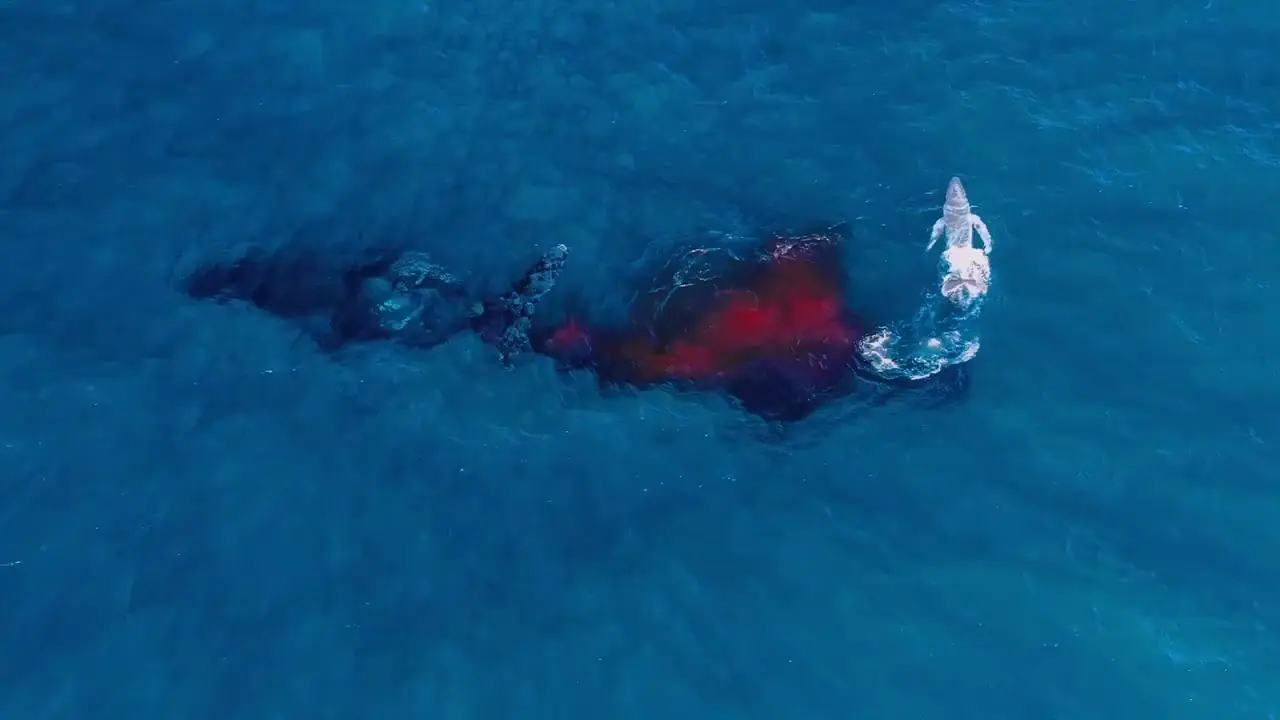
Alexander Forrest was standing at a coastal location in northern New South Wales on July 28, observing the annual humpback whale migration, when he noticed an adult female moving unusually slowly through shallow water. Shortly after launching his drone, a large red cloud appeared in the sea and a newborn calf surfaced beside the whale.
The recording is considered scientifically significant because humpback whale births are observed extremely rarely. According to Annie Post, head of research at the Organisation for the Rescue and Research of Cetaceans in Australia, only three previous observations of humpback whale births have been published, and none were recorded from the air.
The moment the scene changed
Forrest had positioned himself on a coastal point to film whales passing along the well-known migration route on Australia’s east coast. The area is often described as the “humpback highway” because of the large number of whales that travel through it each year.
The female’s slow and consistent movement attracted his attention. He initially assumed that the whale might be resting, but decided to launch his drone to observe her behavior from above.
When the bright red cloud appeared in the water, the photographer feared that the whale had been attacked by a predator. Within moments, however, a light-colored calf surfaced beside her, revealing that the blood was associated with a birth.
The calf’s first breaths
The footage shows the newborn emerging from the red cloud and immediately moving its tail as it rises toward the surface. It then lifts its head above the water, appears to take its first breath, and begins swimming beside its mother.
For several moments after the birth, the adult female remained almost motionless. She then turned toward the calf, beginning the close contact and care that characterize the first hours of a newborn whale’s life.
Forrest said that despite spending thousands of hours filming whales from the air, he had never witnessed anything comparable.
Working with ORRCA
After witnessing the birth, the photographer contacted ORRCA so the organization could be informed and monitor the condition of the mother and calf.
ORRCA drone operators Tanya Snowden and Dominic Cotter-Dephoff later arrived at the location and continued recording the pair with Forrest for several hours.
The material is not limited to the moment of birth. It includes the calf’s first hours of life, its first dives, the mother’s nurturing behavior, and brief encounters with other humpback whales that approached the pair.
Why the footage is important
The reproductive behavior of humpback whales remains difficult to study because much of it takes place away from human observation. A detailed recording of a birth and the hours that follow can offer information about maternal behavior, the calf’s earliest movements, and the way the bond between mother and newborn begins.
The aerial perspective also provides a different view of the process, allowing researchers to observe the movements of both animals and the distances between them in the water.
Annie Post described the footage as an important contribution to the understanding of humpback whale reproduction and maternal behavior.
What we think
The value of this recording lies not only in its rarity or striking imagery. The footage documents a rarely observed stage in the humpback whale’s life cycle and could provide useful material for scientists studying cetacean reproduction and behavior. At the same time, the claim that it is the first aerial recording should continue to be presented as a belief until the material has been fully assessed and compared with previous observations.
Frequently asked questions
When and where was the birth recorded?
The birth was recorded on July 28, 2026, off the coast of northern New South Wales in Australia.
Who captured the footage?
The initial footage was recorded by 20-year-old wildlife photographer and drone operator Alexander Forrest.
Why is the recording considered historic?
It is believed to be the first known aerial recording of a humpback whale giving birth. According to ORRCA, only three previous observations of such births had been published.
What does the video show after the birth?
The footage shows the calf’s first breath and movements, its first dives, the mother’s care, and other humpback whales approaching the pair.