

Summary
- The 49th Drama International Short Film Festival will run from September 6 to 12, 2026
- This year’s edition includes 157 short films
- A total of 3,420 films were submitted from around the world
- The festival will host 45 world premieres
- The new competition section is the International Documentary Competition
- The International Competition includes 26 films from 20 countries
- The new documentary section includes 17 films, 5 of them from Greece
- The festival is expanding its support for filmmakers through DISFF PASS, a residency, screening fees and international networking
- This year’s motto is “Welcome Home”
- 157 films from 3,420 submissions
- Welcome Home: the motto of the 49th edition
- New initiatives for filmmakers
- A more audience-friendly experience
- The visual identity and the official spot
- The National Competition
- The International Competition
- The new International Documentary Competition
- The National Student Competition
- The International Student Competition
- The Kiddo programme
- Short Film Hub and Pitching Lab
- Balkan Tales and the European Film Academy
- From Drama to the Oscars
- What we think
- Frequently Asked Questions
The 49th Drama International Short Film Festival has unveiled its programme, with 157 films, 45 world premieres and the motto “Welcome Home”.
The DISFF49 programme presentation took place on July 8, 2026, on the rooftop of the Lais open-air cinema, where the artistic director of the Drama Film Festival, Giorgos Angelopoulos, announced the selections for the five main competition programmes of this year’s edition. The 49th Drama International Short Film Festival will take place from September 6 to 12, 2026.
This year’s edition carries particular weight, as it comes one year before the festival’s 50th anniversary and introduces a series of changes that go beyond the screening programme. The festival places stronger emphasis on supporting filmmakers, international networking, the collective experience of cinema-going and the expansion of its role through new initiatives, the most important addition being the new International Documentary Competition.
157 films from 3,420 submissions
The Drama Film Festival will screen a total of 157 short films. Of these, 30 films will compete in the National Competition and 19 in the National Student Competition, while 45 films will have their world premiere in Drama.
A total of 3,420 films were submitted from around the world, confirming DISFF’s position as one of the most important reference points for short cinema in Greece and the wider region.
The 49th edition includes the National Competition, the National Student Competition, the International Competition, the International Student Competition and the newly established International Documentary Competition. The programme is also complemented by Kiddo, the Short Film Hub, the Pitching Lab, special tributes and parallel events.
Welcome Home: the motto of the 49th edition
The motto “Welcome Home” sets the tone for this year’s edition. The Drama Film Festival presents Drama as the “home” of short film, but also cinema as a place of encounter, memory and shared experience.
Giorgos Angelopoulos connected this year’s motto with the festival’s history, which began with a film club in a Macedonian city and evolved into an international festival with a strong presence. This year’s return to the roots of the institution is accompanied by a reference to its Balkan identity, which will also be reflected in a tribute to Balkan films.
“Welcome Home” does not function only as a communication slogan, but as a statement of direction. The festival aims to become more audience-friendly, more useful for filmmakers and more stable as an international hub for short film.
New initiatives for filmmakers
During the programme presentation, emphasis was placed on the actions developed over the past year to support filmmakers.
The Drama Film Festival gave Greek creators the opportunity to travel to major international events, such as the Clermont-Ferrand Festival, the Cannes Film Festival, ECAM Forum and Beldocs, with the aim of promoting their next film projects.
At the same time, the festival held its first short film screenwriting residency, in which award-winning filmmakers from the European Film Academy mentored emerging screenwriters.
Among the initiatives presented were also the DISFF PASS, which offers free access to cinemas for participating directors, free submissions of Greek films to major international festivals, and the systematic effort to pay screening fees for screenings of the “Drama Film Festival Travels” programme.
According to the figures presented, in less than a year more than 6,000 euros were paid to directors who competed in Drama. For several filmmakers, it was the first time they were paid, even symbolically, for the screening of their work.
The festival’s upcoming plans also include the creation of a sales company for Greek short films, with the aim of strengthening their international presence and extending their journey beyond Greece.
A more audience-friendly experience
DISFF49 also seeks to improve the audience experience. This year’s edition invests in collective viewing and introduces structural changes, with fewer but more coherent competition programmes, shorter screening slots and Q&A sessions with filmmakers after the screenings.
The intention to host all competing filmmakers until the end of the festival is also significant, strengthening Drama’s role as a place of meaningful encounter and networking, rather than simply a screening venue.
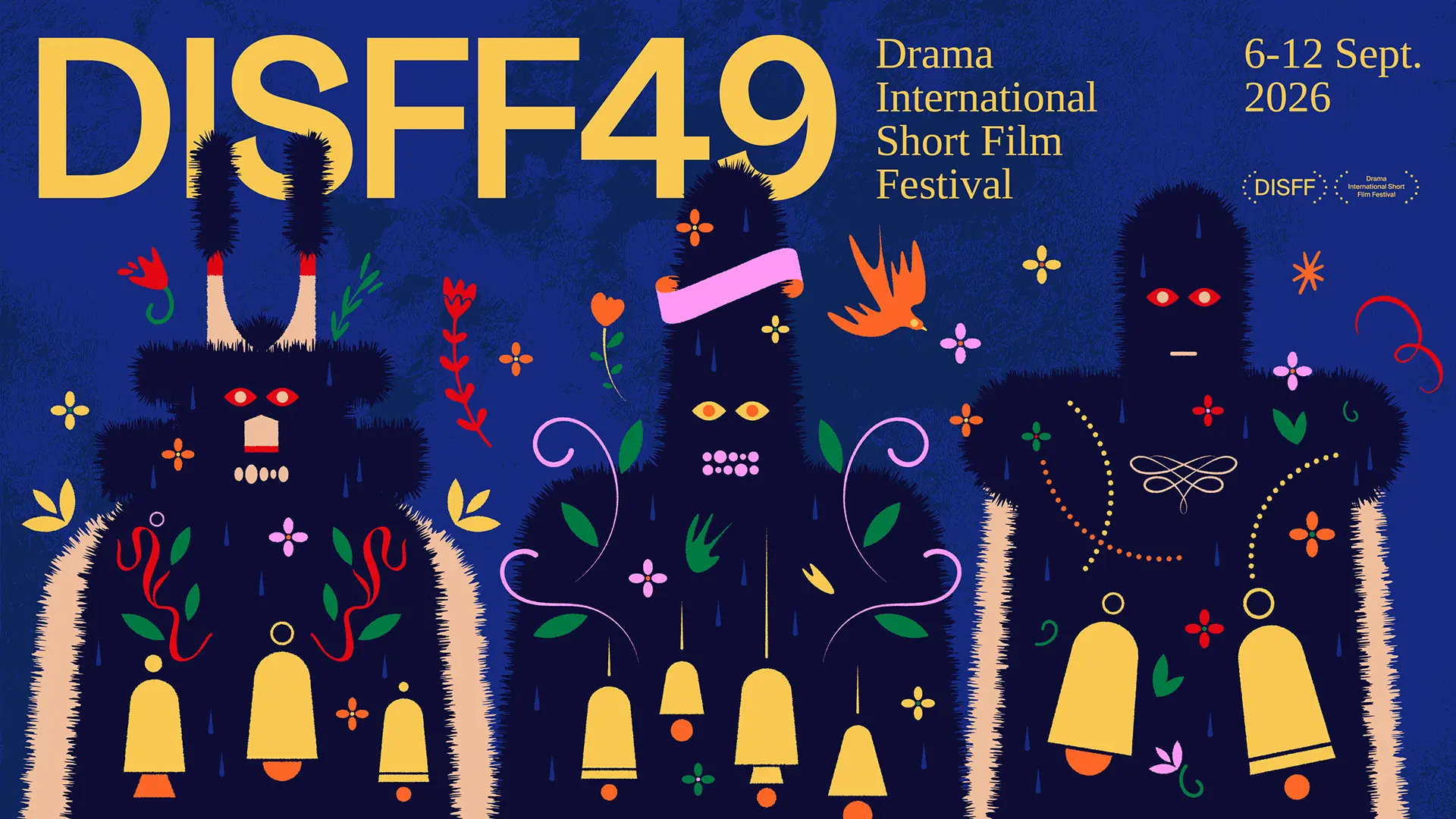
The visual identity and the official spot
The visual identity of the 49th Drama Film Festival is once again designed by Drama-based designer Konstantinos Pavlidis.
The official spot of the edition is directed by Isabella Margara and was filmed entirely in Drama. Its aesthetic is connected to Balkan Dionysian tradition and the figure of the bell bearer, bringing ritual elements, local memory and the idea of returning to a common place of experience to the foreground.
The National Competition
The National Competition includes 30 Greek short films and is presented as an image of contemporary Greek cinema through new voices, diverse themes and independent productions.
The themes of the films touch on the Greek family, the need for resistance, toxic human relationships, the search for love and romance, the return to childhood or adolescence, and queer characters with supernatural dimensions.
Of particular interest is the fact that three directors who competed last year return this year with a new film, something that shows a rare speed of production for Greek standards and an urgent need for cinematic expression.
The films of the National Competition are:
All the Love in My Body – Carmen Baltzar
Art is missing – Tzortz Kontos
Free Eliza (Notes On An Anatomical Imperfection) – Alexandra Matheou
Holterline – Alexandra Ntelitheou
Mia krypsona – Flora Ilia
Multi Family Garage Sale – Zak Simha
Shift – Ioanna Skylοgianni
Sisters – Marianna Bozantζoglou
Starflyer – Maria Hatzakou
The Great Organ – Roxanne Krimizi
Unleaded Wasteland – Vasilis Kalemos
Wheel to Live – Vicky Anastasiadou
Adespotoi – Anastasia Gkivalou
Amaranti – Anthi Daoutaki
Arkansas – Giannis Karpouzis
Jasmine and Rose – Spyros Charalambous
Epifaneies – Melina Loukanidou
Zoi kai Kota – Lefki Derizioti
The Desert – Ioanna Digenaki
To kata tou Alektoros – Thanos Tokakis
Good Friday – Loukia Tzortzopoulou
Don’t Eat Me – Konstantinos Kalogridis
A Small Story of Resistance – Ioulia Biba, Diamantis Anastasiadis
The Delivery Guy – Ermolaos Fotiou
The Dog – Konstantinos Demis
Horizon – Aphrodite Tavri
We Didn’t Even Get Horny – Marthilia Svarna
Soirée After the Tour – Christos Samaras
The Candle – Chrysianna Papadaki
Holes – Petros Kalfamanolis
The head of the National Competition is Giorgos Angelopoulos.
The International Competition
The International Competition remains one of the central sections of the Drama Film Festival, as it is a qualifying programme for the Academy Awards and the European Film Awards.
This year’s selection includes 26 films from 20 countries, with different forms, genres and themes. The films deal with love, survival, loss, identity, harassment, the relationship between humans and the environment, Artificial Intelligence, oppression and the need for expression.
Animation has a distinct presence within the International Competition this year, with 6 films and a variety of techniques, from handmade drawing and stop motion to 2D political satire.
The films of the International Competition are:
Azul – Algoritmo Malvado
Wheel to Live – Vicky Anastasiadou
Spermatheca – Silje Baer
We Were Here – Pranav Bhasin
Bad Ideas – Jan Bujnowski
Carla and her Legs – Christoph Büttner
Shutterspeed – Jasper De Maeseneer
Buše – Dalija Dozet
Astronauta – Giorgio Giampà
Tuna Tartare – Lena Greene
The Flesh Dress – Joachim Hérissé
Somewhere Between Memories – Niloufar Jahangiri
Silent Voices – Nadine Misong Jin
Taxi Moto – Gaël Kamilindi
City of Owls – Zhenia Kazankina
The Great Organ – Roxanne Krimizi, Michalis Kimonas
The Flames of Me – Daniel Léger
Corpus Christi – Bea Lema
The Mountain – Sebastián Lojo
Free Eliza (Notes on An Anatomical Imperfection) – Alexandra Matheou
Mind Your Step – Alina Milkina
Holterline – Alexandra Ntelitheou
Silent Mode – Georgi Petkov
Kentucky Gaza – Omar Rammal
What Do the Maknines Dream Of – Sarra Ryma
Spiritus Sanctus – Michał Toczek
The head of the International Competition is Vasilis Terzopoulos.
The new International Documentary Competition
The most important institutional addition to the 49th edition is the International Documentary Competition, a new autonomous section for short documentary films.
The programme presents 17 films from around the world, 5 of which come from Greece. According to the festival, the majority of the films are directed by women, while the selection focuses on discovery, inquiry, social observation, sensitivity and the hybrid forms of contemporary documentary.
The films of the International Documentary Competition are:
DASMA ’96 – Fjorida Cenaj
Ruins Talking Back – İklim Doğan
If You Don’t Like It, Look Away – Margaux Fournier
Always Ready – Jasper Heinrichs, Jan Schuenke
Baisanos – Andrés Khamis Giacoman, Francisca Khamis Giacoman
Guided Tour – Alba Jaramillo
Before the Meal Got Cold – Alkistis Kafetzi
The Boys and the Bees – Arielle C. Knight
In Search of a Goodbye – Vangelis Kollias
How to Catch a Butterfly – Kiriko Mechanicus
Fruits of Despair – Nima Nassaj
Loutropolis – Anna Papadopoulou
Kite – Thanos Psichogios
A Fighter – Aurélien Richard
Your City – Ting Su
Buckskin – Mars Verrone
My Cosmonaut – Eleni Zentefi
The head of the International Documentary Competition is Gianna Sarri.
The National Student Competition
The National Student Competition includes 19 films and highlights new creators taking their first steps.
The films of the National Student Competition are:
(AN)OIKIA – Nelly Evangelidou
A moment in her life – Nikolas Kostis
Bloom – Christoforos Irodotou
El Consuelo – Elena Papakonstantinou
Find Fenia – Lila Barba
Interrogation Room – Ioannis Kostopoulos
Meltdown – Evgenia Papazisi
Resídua – Nasia Stouraiti
Still Sexy – Panos Zygouros
The Monsters of the City – Giorgos Vlassis
Trace – Feyyaz Bayram
From 1 to Blue – Sofia Priovolou
Sailing Away – Giorgos Polymeropoulos
Self-Appointed Winged One – Vangelis Panagiotakopoulos, Thanasis Fousekis
Game Farm – Vasilis Georgoulas
Cherry – Eftychia Manola
My Cousin’s Wedding – Silva Tsoumana
Solountrania – Akis Stavropoulos
Text Me When You Arrive… – Konstantinos Taliadouros
The International Student Competition
According to the Greek participations announced, the International Student Competition includes the films:
Imago – Iakovos Sax Lane, Hayley Wade
My Cousin’s Wedding – Silva Tsoumana
The head of the International Student Competition is Kostis Charamountanis.
The Kiddo programme
International Kiddo continues to give space to films aimed at younger audiences and families, strengthening children’s contact with the short film form.
The announced films and Greek participations for Kiddo are:
Cinema Rialto – Antony Petrou
Sisters – Marianna Bozantζoglou
The Boy Who Fell To Earth – Vasilis Bourantas
Tree house – Nasia Koko
Mia krypsona – Flora Ilia
Good Friday – Loukia Tzortzopoulou
Mouskema – Alexandros Romanos Lizardos, Akis Melachris
Dad, Look at Me! – Voula Stampelou
The head of Kiddo is Giorgos Angelopoulos.
Short Film Hub and Pitching Lab
The Short Film Hub will run throughout the festival, with daily one-to-one meetings between directors, screenwriters, producers and industry professionals, as well as open discussions, panels and roundtables.
The head of the Short Film Hub is Antigoni Papantoni.
The international Pitching Lab, led by Varvara Douka, brings together the 10 best screenplay proposals from around the world. The Greek projects selected to participate are:
Broken Relationship Museum – Antonis Kitsikis
Khaki babes – Angelos Charalambous
Twin Cherries – Dimitra Petmeza
Balkan Tales and the European Film Academy
DISFF49 will present the Balkan Tales tribute, featuring a selection of Balkan films that have been nominated for or awarded the European Film Academy Award over the past 20 years.
The tribute functions as a precursor to the European Film Academy Awards ceremony in Athens.
For the first time, Drama will host the annual meeting of the network of festivals that are members of the European Film Academy. The initiative, like the residency, is part of the actions supported by EKOMEDE ahead of the European Film Awards ceremony in Athens.
The detailed programme of parallel events and the remaining tributes of the festival will be announced in August.
From Drama to the Oscars
The Drama Film Festival maintains its connection with the Academy Awards, as the films that receive the top distinctions in the National and International Competition sections secure eligibility for the Academy Awards process, in accordance with the applicable regulations.
This connection has significantly strengthened DISFF’s international prestige and offers filmmakers a meaningful bridge from Drama to the global film scene.
What we think
The 49th Drama Film Festival shows an institution preparing seriously for its anniversary milestone. The addition of the International Documentary Competition, the emphasis on screening fees, the effort to promote Greek short films internationally and the strengthening of the audience experience show that DISFF is not content with the role of an annual festival, but aims to function as a stable mechanism of support and outreach for filmmakers.
Frequently Asked Questions
When will the 49th Drama Film Festival take place?
The 49th Drama International Short Film Festival will take place from September 6 to 12, 2026.
How many films will be screened at DISFF49?
A total of 157 short films will be screened.
How many films were submitted to this year’s edition?
A total of 3,420 films from around the world were submitted to the 49th Drama Film Festival.
How many world premieres will the festival host?
The festival will host 45 world premieres in Drama.
What is the new competition section?
The new competition section is the International Documentary Competition, featuring 17 films from around the world.