Summary
- Glyph has introduced a USB4 40Gbps CFexpress Type A reader and a separate dual-SD model.
- The company quotes up to 5,000 MB/s and 1,000 MB/s respectively, figures that do not guarantee the speed of an individual card.
- The SD reader supports simultaneous offloads from two cards.
- US prices are $149.99 and $99.99 respectively.
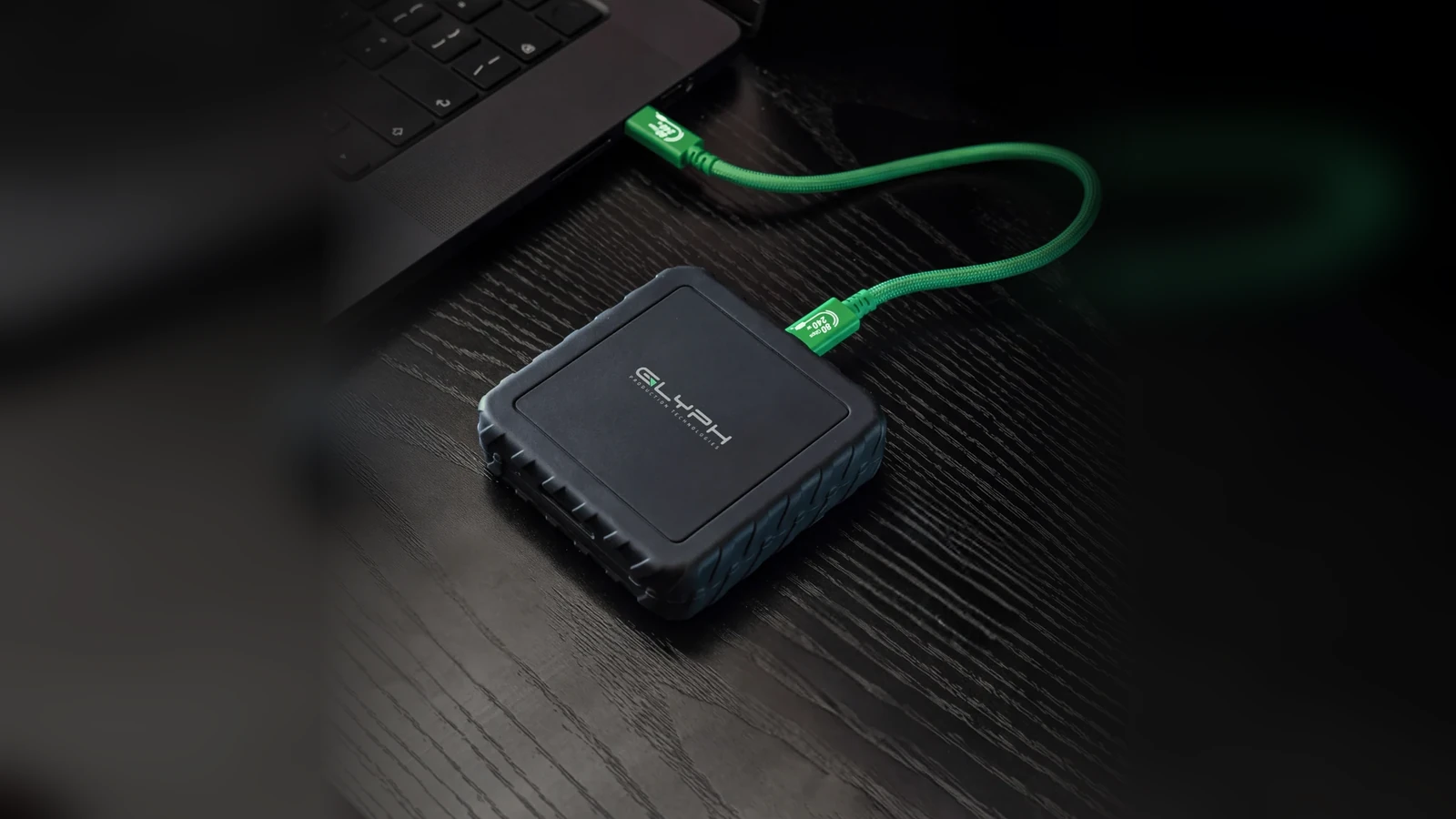
Glyph has introduced two Capture+ card readers: a 40Gbps USB4 CFexpress Type A model and a dual-SD reader designed to offload two cards simultaneously.
When a photo assignment or video shoot fills several memory cards, offloading is an essential part of the production day. Developments such as Sony’s CFexpress 4.0 Type A cards are increasing demand for faster readers, particularly on RAW-heavy and high-bitrate video projects.
Capture+ CFexpress Type A USB4: one slot and a 40Gbps connection
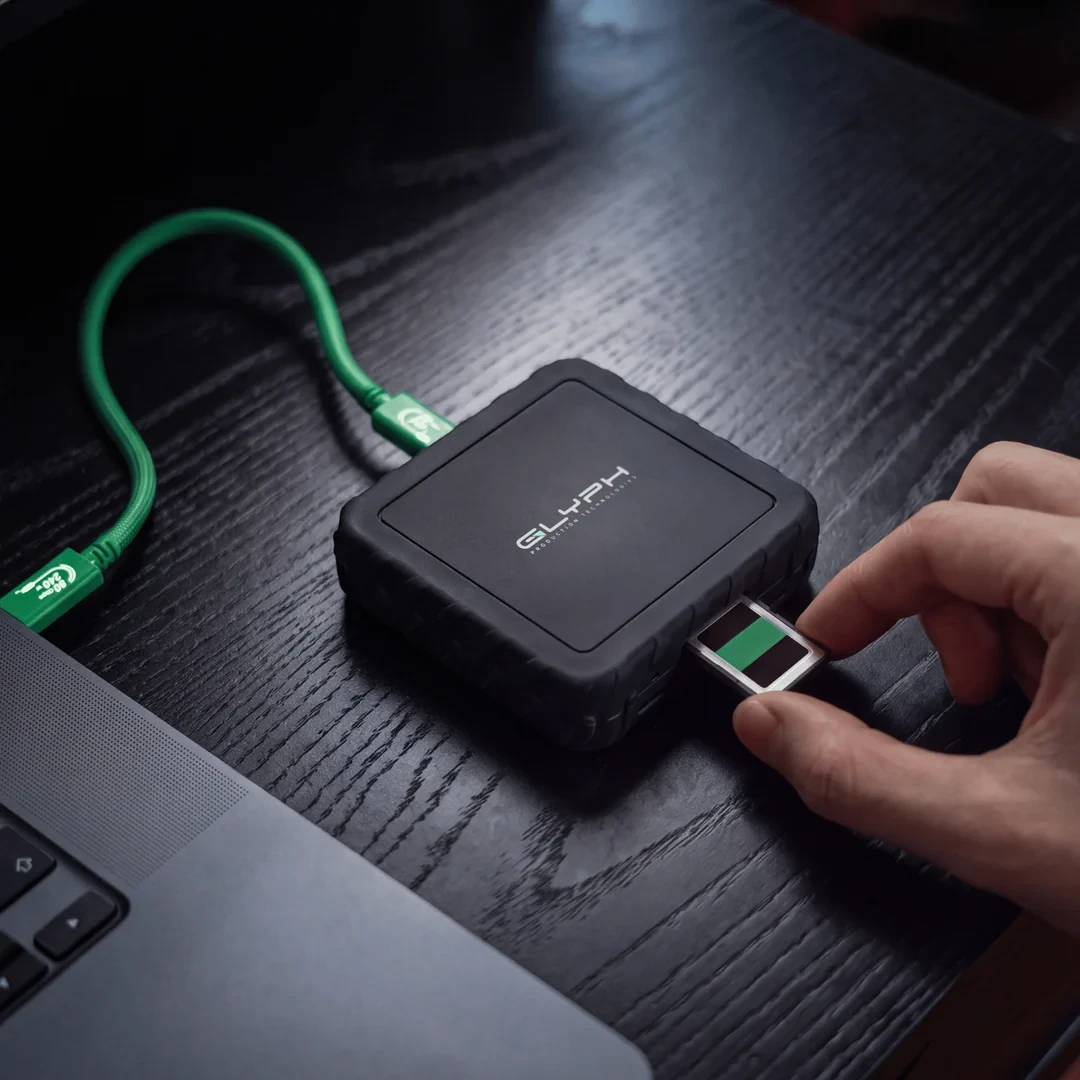
The Capture+ CFexpress Type A USB4 (CFA-RDR) has one CFexpress Type A slot and uses a 40Gbps USB4 Type-C connection. Glyph quotes a maximum transfer rate of 5,000 MB/s for the reader. This is not a guaranteed reading speed for every card: actual performance depends on the card, host port, cable and destination drive.
Its design combines an aluminum core and shell with a removable protective cover and passive, fanless cooling. According to Glyph, its SteadyIO technology aims to reduce performance drops during sustained transfers. The bus-powered reader measures approximately 85.9 × 85.9 × 23.1 mm and includes a 30 cm USB-C to USB-C cable.
More information here.
Capture+ Dual SD: two cards in the same offload workflow
The Capture+ Dual SD (SD-RDR) has two SD slots and supports simultaneous offloads from both cards. It uses a 10Gbps USB-C connection and has a quoted maximum reader rate of 1,000 MB/s. Both slots share that connection, so the figure does not mean each card can independently transfer at 1,000 MB/s.
The reader shares the family’s passive-cooling design, protective cover and USB bus power. It is useful when a camera records to two SD cards or cards from different bodies need to be copied without repeated swapping. The official product description does not explicitly specify whether the slots support UHS-I or UHS-II, which is worth checking before purchase.
More information here.
Where does a modern offload workflow save time?
The headline figures describe the capabilities of a reader and its connection, not necessarily the speed of the card inside it. Newer products such as ProGrade’s CFexpress 4.0 Type A cards help explain the appeal of a faster reader, while older cards may be limited somewhere else in the transfer chain.
For photographers and DITs, the practical gain is completing copies and data verification sooner, before cards are cleared for reuse. Reading two SD cards at once reduces manual handling, but it does not replace copy verification or the safe retention of original footage.
Price and availability
Glyph’s US online store lists the Capture+ CFexpress Type A USB4 at $149.99 and the Capture+ Dual SD at $99.99. The Type A listing shows it as in stock, while the Dual SD is labeled for pre-order with shipping expected in early December 2026. No official European price was found.
According to Glyph, both models include three years of hardware coverage, including cables, and one year of advance replacement service.
What we think
The Type A reader makes the most sense for creators working with several fast CFexpress cards and moving hundreds of gigabytes after each shoot. But if a card reads well below the limit of a typical 10Gbps connection, USB4 alone will not transform the transfer. Check the performance of the cards you actually use before spending more on a reader.
For event photographers and videographers recording to two cards per camera, the Dual SD might be the more useful option. Being able to insert both cards, start the copies and get on with another task rather than swapping media repeatedly is an everyday convenience that can matter more than a spectacular headline speed.
We would like Glyph to be clearer about actual performance with different media, especially the Dual SD model’s UHS-II support. On a professional job, predictable sustained speeds and verified copies are more valuable than the biggest number printed on a box.
Frequently asked questions
Can the CFexpress Type A reader also take Type B cards?
No. The CFA-RDR is designed for CFexpress Type A. Type A and Type B cards have different physical sizes and cannot be interchanged.
Does the computer need USB4?
Not simply to use the Type A reader: Glyph lists compatibility with USB 3.0 and Thunderbolt 3/4/5. Reaching higher transfer rates requires a suitably fast connection and compatible card.
Does the Dual SD model support UHS-II SD cards?
The official listing does not explicitly identify the UHS version of its two slots. Confirm the specific capabilities with Glyph before buying it for UHS-II use.