Summary
- Colsto traced a camera using faint aircraft sounds in a video.
- He compared two Doppler traces with public ADS-B flight data.
- The process reduced tens of thousands of candidate locations to an identifiable camera.
- The demonstration highlights a privacy risk for video creators.
A video showing little more than trees can still reveal where it was filmed—not through the picture, but through the barely perceptible sound of aircraft in the background.
YouTuber Colsto traced a low-resolution recording back to its camera by analysing frequency changes in the soundtrack and comparing them with publicly available flight records. His demonstration shows just how much location information ordinary audio can contain even when the footage offers no recognisable landmarks.
How the camera was located
The starting point was a video of trees, ambient noise and birdsong. The known clues were the recording date, September 8, and a broad location: the contiguous United States. The precise time and place were unknown.
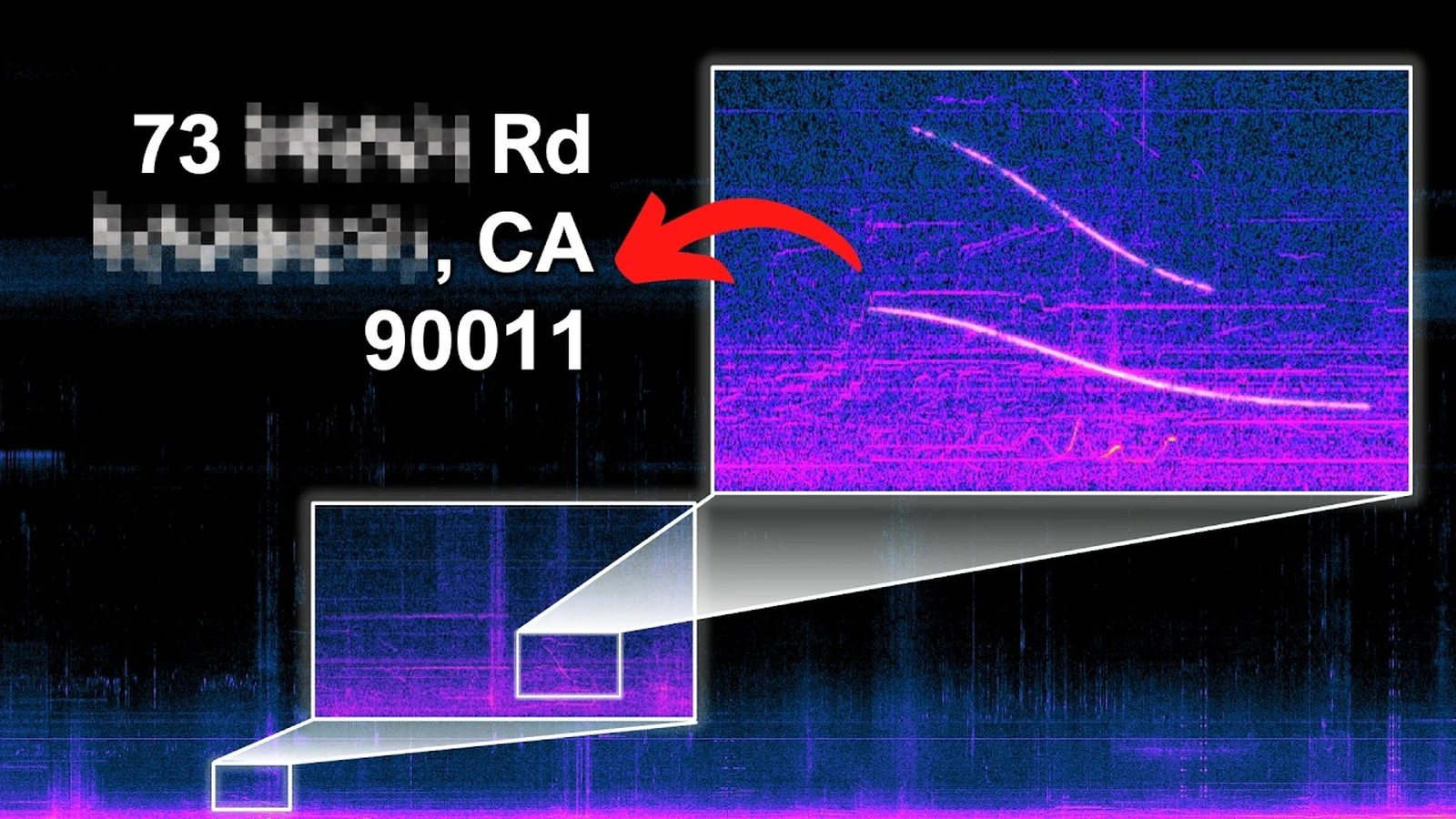
Colsto inspected a spectrogram—a display of frequencies over time—and identified two curved traces from passing aircraft. The two acoustic events were separated by 920 seconds, or 15 minutes and 20 seconds.
An initial comparison with aircraft flight paths produced approximately 70,000 candidate positions. Requiring two flyovers with that time separation, and ruling out areas where additional aircraft should have been audible, reduced the possibilities to roughly 15,000. Detailed matching against simulated Doppler curves narrowed the search further. Colsto eventually identified the actual camera using Google Street View.
How aircraft noise reveals a location
The key is the Doppler effect: the frequency picked up by a microphone changes as an aircraft approaches and then recedes. The shape of that change can provide clues about speed, distance from the microphone and the plane’s path relative to it.
Aircraft fitted with ADS-B broadcast information including position, altitude and speed. Much of this information is collected by publicly accessible flight-tracking services. Historical flight paths can therefore be compared with recorded sound curves to test possible microphone locations.
Matching two flights by timing alone is not enough. Subtle changes in the curves can reflect acceleration, a climb or descent, or a change in heading. Colsto generated many possible curves and scored how well each model matched the recording.
What creators should take from this
Removing GPS and other EXIF metadata remains worthwhile, but it does not remove clues embedded in the audio or picture itself. Just as visual details in travel photographs can expose locations, and tools such as GeoSpy analyse imagery for geographical clues, the soundtrack can reveal an entirely different set of signals.
This matters for videos filmed at homes, sensitive sites, on reporting assignments or around protected wildlife. If a location must remain confidential, creators need to consider not only what the camera shows but also what the microphone records, along with any date or context disclosed alongside the post.
This demonstration does not mean that every video can be geolocated. It depends on detectable aircraft sounds, suitable flight records and enough starting context to make the search manageable. ADS-B coverage and publicly available flight histories are not universal.
What we think
The striking part is how an apparently insignificant sound—a distant aircraft that most people would ignore—provided a useful clue to a specific camera location, even though the picture contained almost no geographical information.
On a shoot, we naturally check the frame for street signs, landmarks or recognisable buildings. This example is a reminder that the soundtrack deserves the same attention. For an ordinary travel vlog it might make little difference. For a journalist or creator protecting a sensitive location, it could matter a great deal.
There is also a constructive use: matching sound against historical flight records could help verify claims about when and where footage was recorded. It should be one corroborating clue among others, not a supposedly infallible location detector.