Summary
- Group f/64 held its first exhibition in San Francisco on November 15, 1932.
- Seven original members and four guests presented a total of 80 photographs.
- Its manifesto advocated sharp, direct photography as an independent art form.
- Its influence extended well beyond the show itself.
On November 15, 1932, a small group of photographers opened a San Francisco exhibition defending sharp, direct photography as an independent art form.
The Group f/64 show at the M. H. de Young Memorial Museum brought together 80 photographs by artists including Ansel Adams, Edward Weston, and Imogen Cunningham. The exhibition ran through December 31, 1932.
Seven members and four invited photographers
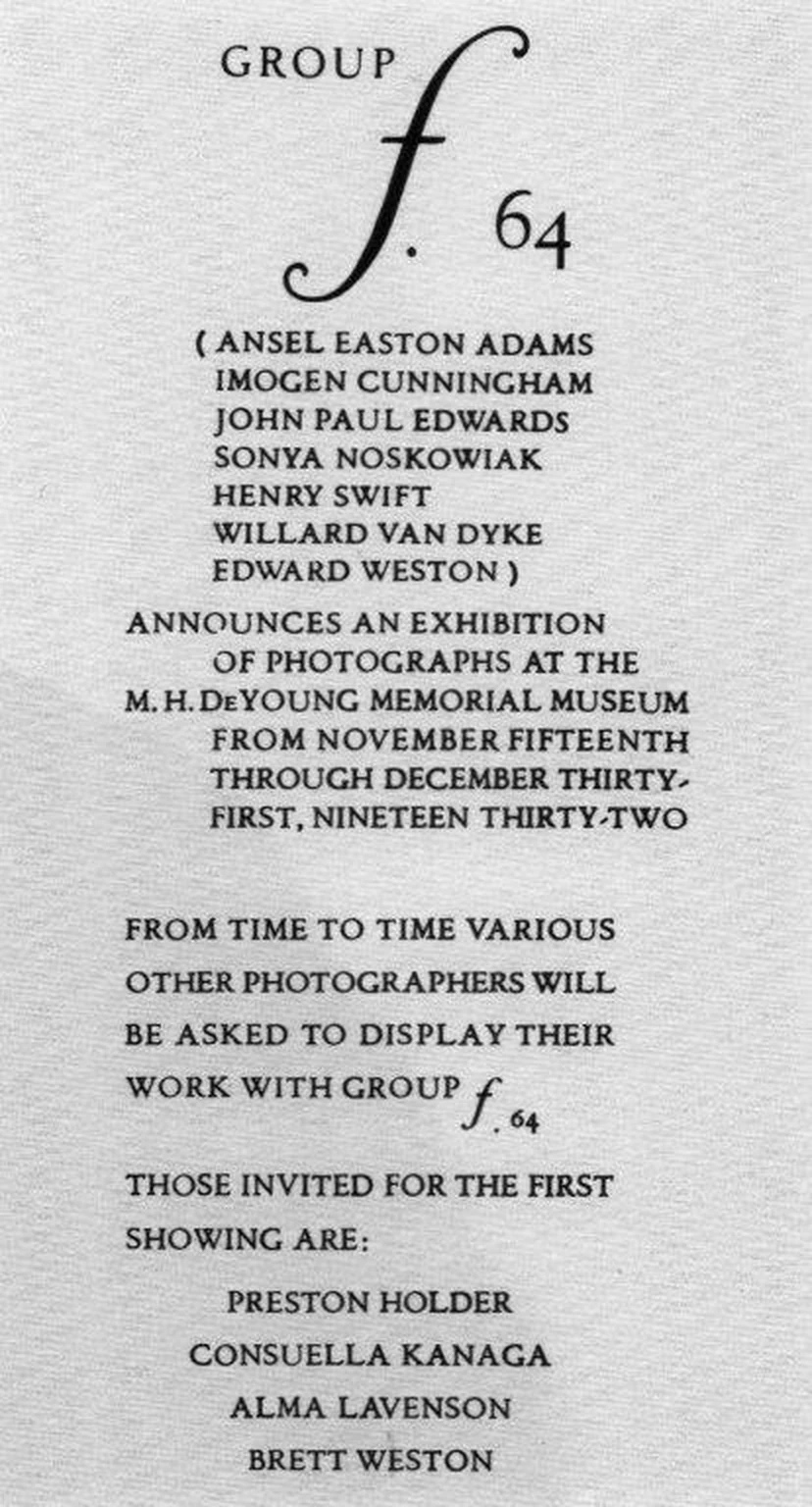
The seven original members were Ansel Adams, Imogen Cunningham, John Paul Edwards, Sonya Noskowiak, Henry Swift, Willard Van Dyke, and Edward Weston. The original exhibition announcement clearly distinguished them from four invited exhibitors: Preston Holder, Consuelo Kanaga, Alma Lavenson, and Brett Weston.
Each of the seven members contributed nine prints, except Adams, who showed ten. The four guests exhibited four photographs apiece, bringing the total to 80.
What f/64 meant and what the manifesto demanded
The name referred to the f/64 aperture setting used on large-format cameras, which allowed a very extensive depth of field. For the group, it stood for sharpness, fine detail, and the precise depiction of a subject, whether a landscape, still life, or portrait.
The Group f/64 manifesto challenged Pictorialism, a photographic approach that often borrowed techniques and visual effects from painting. Its members wanted photography to draw on its own strengths: optical description, tonal range, and deliberate composition, rather than trying to resemble a painting.
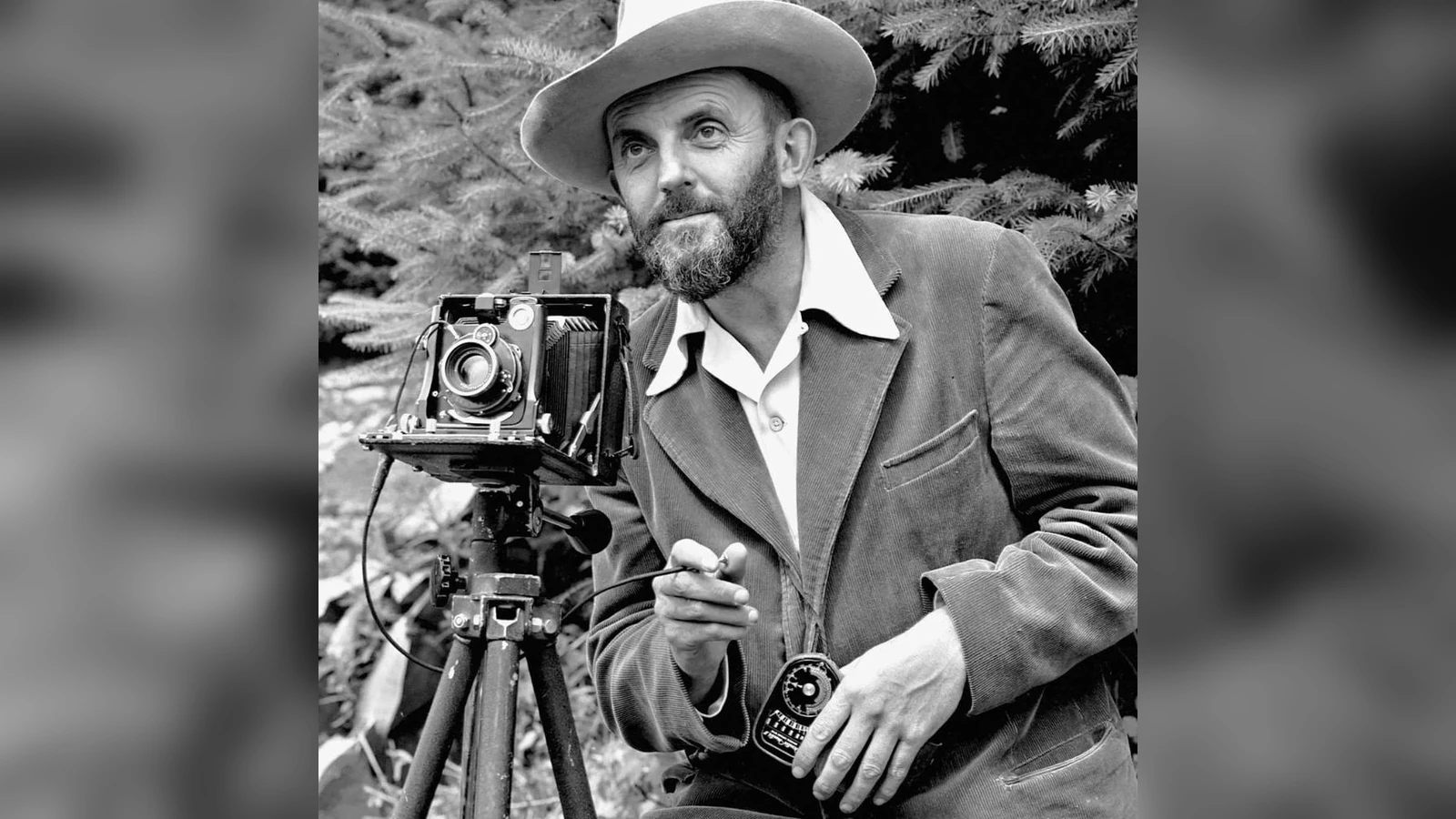
Ansel Adams and his meticulous approach to exposure and printing became a defining example of that thinking. The same spirit can be seen in Edward Weston’s still lifes and Imogen Cunningham’s botanical studies.
An influence that outlasted the exhibition
Group f/64 was not a single rigid style shared by every member. Its photographers explored different subjects and developed distinctive ways of seeing, but they agreed that photography should be judged on its own terms. Their example helped strengthen its standing as an independent medium in modern art.
The legacy goes beyond an aperture setting. It rests in the idea that choices about focus, framing, light, and printing can give an image a powerful individual voice. The Ansel Adams Gallery offers further insight into his work and career.
What we think
There is something compelling about a group of artists choosing an aperture number as their name. It was a way of saying that technique was not merely a step before the art; it was part of the photographic language itself. Detail and tonal control became creative decisions in their own right.
Of course, there is no reason to shoot everything at f/64 today. On modern digital cameras, very small apertures can actually reduce sharpness through diffraction. The lasting lesson is the intent behind the group’s work: understand what you want from your camera, and let the subject speak through carefully considered photographic choices.
There is another distinction worth making: a clear rendering is not automatically an objective truth. The subject, viewpoint, and timing are still chosen by a person. That is one reason the photographs of the f/64 artists remain interesting beyond their technical precision.
Frequently asked questions
Why was it called Group f/64?
The name refers to an aperture setting. On the large-format cameras of the period, f/64 suggested extensive depth of field and the finely detailed, sharp rendering the group championed.
Were there eleven founding members?
Eleven photographers participated in the debut exhibition, but the core group had seven members. Preston Holder, Consuelo Kanaga, Alma Lavenson, and Brett Weston were listed as invited exhibitors.