

Summary
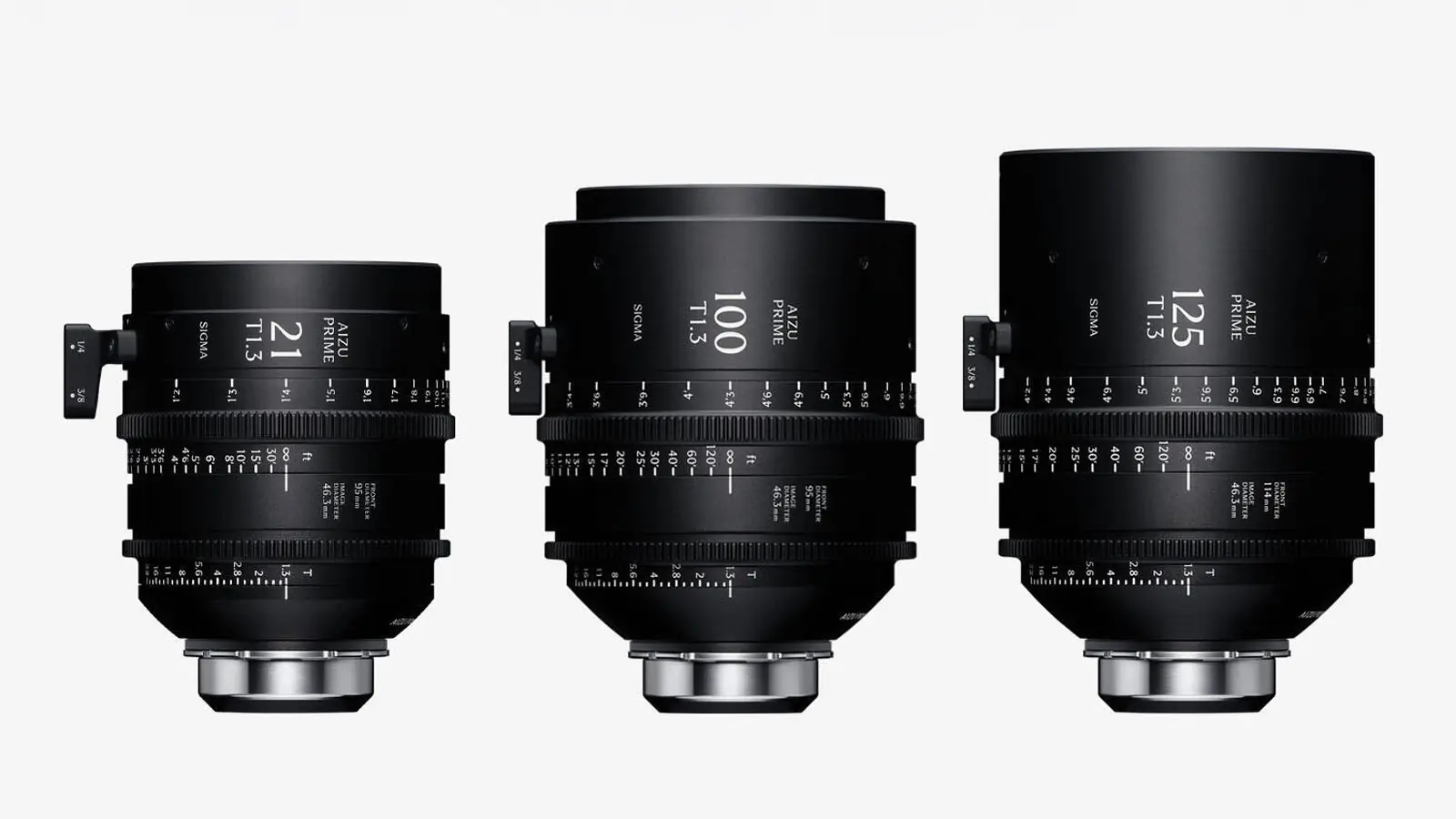
- Sigma adds the Aizu Prime 21mm, 100mm and 125mm lenses with a shared T1.3 maximum aperture.
- The launch is scheduled for November 2026 in PL and Sony E-mount.
- The lineup grows to eleven lenses, while the 18mm is not included in the new launch announcement.
- US pricing is set at $9,799 per lens.
Sigma is scheduling the launch of the Aizu Prime 21mm, 100mm and 125mm T1.3 LF for November 2026, expanding its cinema lens lineup towards both wider angles and longer telephoto focal lengths.
In an announcement dated September 1, the company confirmed the launch schedule for three lenses that form part of the original Aizu Prime Line roadmap. All three will be offered in PL and Sony E-mount, with large-format coverage and a shared T1.3 maximum aperture.
For cinematographers and equipment rental companies, the significance lies in expanding an entire lens set: the new focal lengths provide more options for spacious wide shots and tight close-ups without moving to a different lens family. The same maximum speed remains available at both ends of the expansion.
From eight lenses to eleven — but not yet twelve
When the series was introduced in June 2025, the plan included twelve focal lengths spanning 18mm to 125mm. As we noted in our original coverage of the Sigma Aizu Prime lineup, the first phase covered eight lenses, ranging from 25mm to 75mm.
With November’s additions, the lineup will comprise eleven models spanning 21–125mm. The 18mm remains part of the original roadmap but is not included in this launch announcement. The planned 18–125mm range should therefore not be confused with the lenses that now have an announced release schedule.
Why a shared T1.3 maximum aperture matters in practice
A T-stop accounts for actual light transmission through a lens, rather than aperture geometry alone. Having the same T1.3 maximum value across different focal lengths makes it easier to maintain exposure when changing lenses, with all other conditions held constant. Its value therefore extends beyond shallow depth of field and blurred backgrounds.
The new Aizu lenses have a 46.3mm image circle. According to Sigma, they cover full-frame and Super 35 formats, as well as larger capture areas such as ARRI ALEXA LF Open Gate. The company also describes an optical design developed specifically for cinema, aiming for consistent colour rendering, contrast and flare behaviour across the lenses.
Its stated priorities include minimising distortion and focus breathing, meaning changes in framing as focus is adjusted. This is particularly relevant in shots where focus moves from one person or object to another.
The differences that matter when building a camera rig
All three lenses have a 13-blade iris, a T1.3–T22 aperture range, 270° of focus rotation and 70° of iris rotation. They do not, however, share the same dimensions or weight. Their published specifications are as follows:
| Lens | Minimum focusing distance | Front diameter | Weight PL / Sony E |
|---|---|---|---|
| Aizu Prime 21mm T1.3 LF | 0.35m | 95mm | 1.6 / 1.7kg |
| Aizu Prime 100mm T1.3 LF | 1m | 95mm | 2.2 / 2.3kg |
| Aizu Prime 125mm T1.3 LF | 1.25m | 114mm | 2.2 / 2.3kg |
The difference requiring attention is the 125mm lens’s 114mm front diameter, compared with 95mm on the other two. This is an external diameter, not a filter thread size. In practice, the matte box and available adapter rings need to be checked before compatibility with an existing rig is taken for granted.
PL and Sony E take different routes for metadata
The specifications make a clear distinction between the two mounts. The PL versions support Cooke /i and ZEISS eXtended Data, through a compatible lens mount or a four-pin LEMO connection. On the Sony E versions, metadata transmission and recording use the E-mount communication protocol with compatible camera bodies.
eXtended Data adds information about lens distortion and shading that is useful in visual effects work. This data helps post-production teams match digital elements to the characteristics of the captured footage. Available functionality therefore needs to be checked for the specific combination of lens, camera and recording workflow.
Launch and pricing
Sigma America has announced a price of $9,799 per lens, with availability beginning in November 2026. Sigma Germany confirms the same launch window, without specifying an exact release day.
As an indicative European reference, German retailer Teltec lists the 125mm T1.3 LF in Sony E-mount at €9,418.99 including local VAT. This is the price of a particular version at a specific retailer, not confirmed Greek pricing or local availability.
Sigma also states that product appearance and specifications may change before release.
What we think
The expansion’s real value is that an Aizu set gains more framing options without switching lens families. A shared T1.3 maximum aperture matters, but the less eye-catching details are equally useful to a production: matte box compatibility, additional weight and proper metadata support. The choice needs to be based on the complete system, not maximum aperture alone.
Frequently asked questions
When will they launch, and which mounts will be available?
The Aizu Prime 21mm, 100mm and 125mm T1.3 LF are scheduled for November 2026 in PL and Sony E-mount versions.
Will the lineup now cover 18mm to 125mm?
Not yet, based on the announced release schedule. The eleven lenses span 21mm to 125mm. The 18mm belongs to the original roadmap but is not included in the November launch announcement.
Does the 125mm require a different matte box?
Not necessarily, but compatibility needs to be checked. The 125mm has a 114mm front diameter, while the 21mm and 100mm have 95mm fronts, so a different adapter ring or mounting arrangement may be required.