

Summary
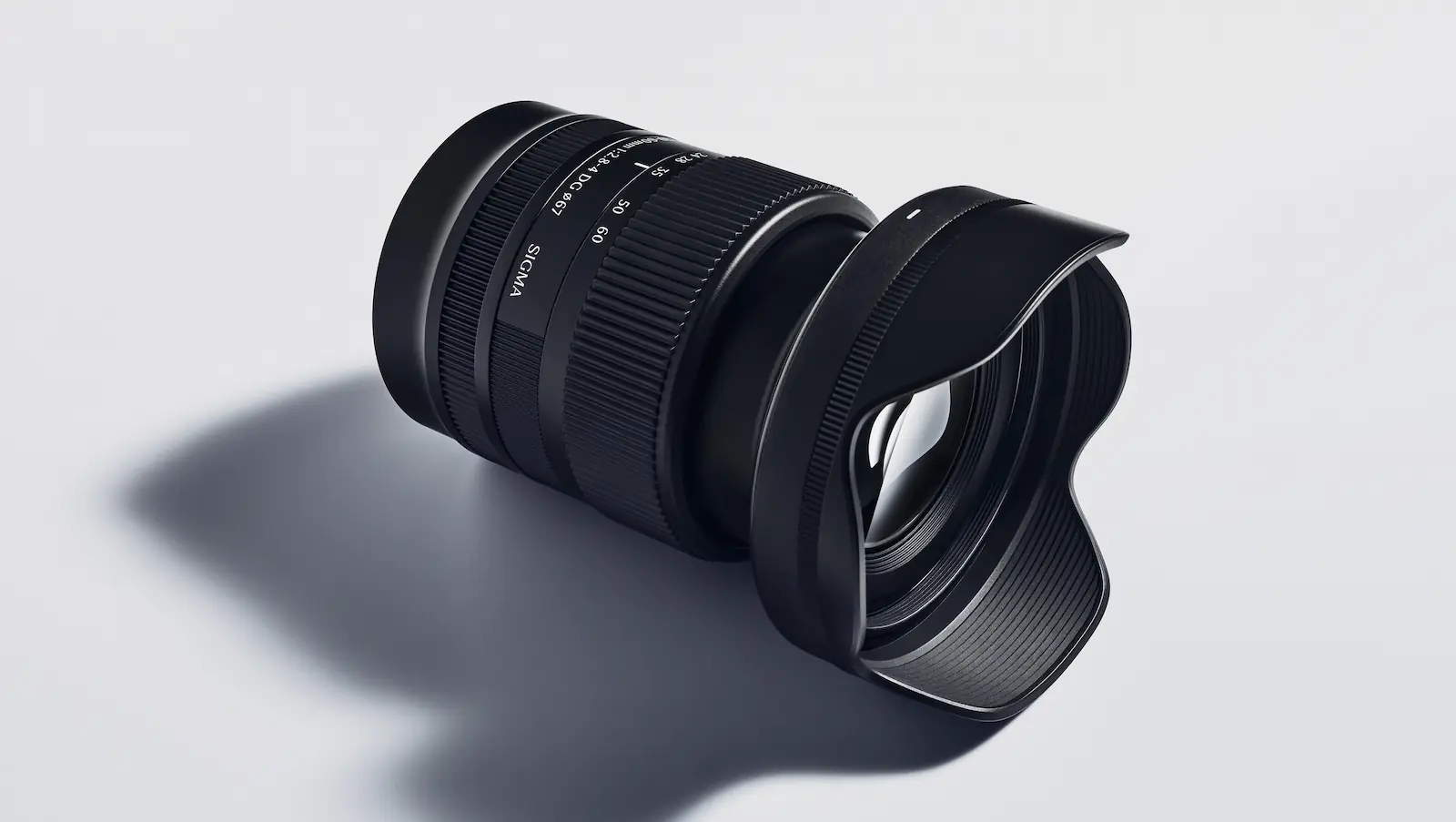
Sigma has announced the 20–60mm F2.8–4 DG | Contemporary, a full-frame zoom for Sony E and L-Mount that combines ultra-wide 20mm coverage with a weight starting at 375 grams.
The new lens was unveiled on September 8, 2026, with the company’s global announcement setting its launch for September 30. It offers a 3x zoom range and a variable maximum aperture, from f/2.8 at 20mm to f/4 at 60mm.
The interest lies in the choice of focal range. Rather than following the familiar 24–70mm route, Sigma provides more room at the wide end. That has practical value for interiors, landscapes and everyday photography where the photographer cannot simply take a step back.
More in the frame at 20mm, with specific trade-offs
The 20mm setting allows more of the surroundings to be included around a subject, while 60mm provides tighter framing without changing lenses. The compromise is twofold: less reach than a 24–70mm and no constant f/2.8 aperture.
At the long end, f/4 is one stop slower than f/2.8. Photographers who need a fast aperture throughout the zoom range for events or moving subjects in low light therefore do not get the same exposure flexibility here. Similarly, when zooming during video recording, f/4 is the widest nominal aperture setting that can be maintained across the entire range.
Different weights for Sony E and L-Mount
The Sony E version weighs 375g and measures 88mm in length, while the L-Mount version weighs 385g and measures 86mm. Both have a diameter of 72.2mm and accept 67mm filters. The distinction matters because the 385g figure highlighted in the main announcement specifically refers to L-Mount.
The optical construction comprises 15 elements in 13 groups, including three aspherical elements and three SLD glass elements. The diaphragm has nine rounded blades.
Close-up shooting and video features
The minimum focusing distance reaches 15.8cm at 28mm, while the highest magnification is achieved at a different focal length: 1:2.3 at 35mm, or approximately 0.43x. At 60mm, magnification remains 1:2.9. This is not a 1:1 macro lens, but the specifications add flexibility for photographing small objects and details.
Autofocus is driven by an HLA — High-response Linear Actuator — linear motor. Sigma also says the lens is designed to reduce focus breathing, the change in framing that occurs when focusing distance changes, a feature of particular interest for video.
The construction offers dust and splash resistance, along with a water- and oil-repellent coating on the front element. The company makes clear that the lens is not waterproof.
Where it sits against Panasonic and Sony
For L-Mount, the most direct comparison is the Panasonic Lumix S 20–60mm F3.5–5.6, which weighs 350g. The new Sigma adds 35g in the same mount but provides a wider maximum aperture at both ends. At 60mm, the difference between f/4 and f/5.6 amounts to approximately one stop.
For Sony E, the Sony FE 20–70mm F4 G reaches further and maintains a constant f/4 aperture, with a weight of 488g. The Sigma is 113g lighter in its Sony E version and offers f/2.8 at 20mm, but stops at 60mm. This represents a different balance of features, not an automatic advantage for either lens over the other.
Sigma itself already has a different answer for photographers who prioritise a broader range: the 20–200mm Contemporary previously featured in a PTTL video. That lens focuses on a 10x zoom range, while the new 20–60mm limits telephoto coverage in favour of a more compact, faster-aperture design.
Price and availability
Sigma’s official German website lists a price of €849. This is a German-market price, not a confirmed Greek retail price; local pricing and deliveries in Greece require separate confirmation.
The global launch date is September 30, 2026, while Sigma America announces US availability from October 6, priced at $849. The rollout schedule is therefore not identical in every market.
What we think
The 20–60mm has a clear focus: it targets photographers who use the wide end more often and care about the weight they carry. PTTL considers this combination more interesting than simply having “f/2.8” in the name. Its real value, however, will depend on optical performance and behaviour in practice, not just its small size.
Frequently asked questions
Does it maintain f/2.8 throughout the zoom range?
No. The maximum aperture is f/2.8 at the wide end of 20mm and reaches f/4 at 60mm.
Was it announced for Canon RF or Nikon Z?
The September 8 announcement covers Sony E and L-Mount versions only.
Can it replace a 1:1 macro lens?
Not in terms of maximum magnification. It reaches 1:2.3 at 35mm, offering close-up capabilities but not life-size reproduction on the sensor.