

Summary
- Adam Chambers discusses his early career in Hollywood
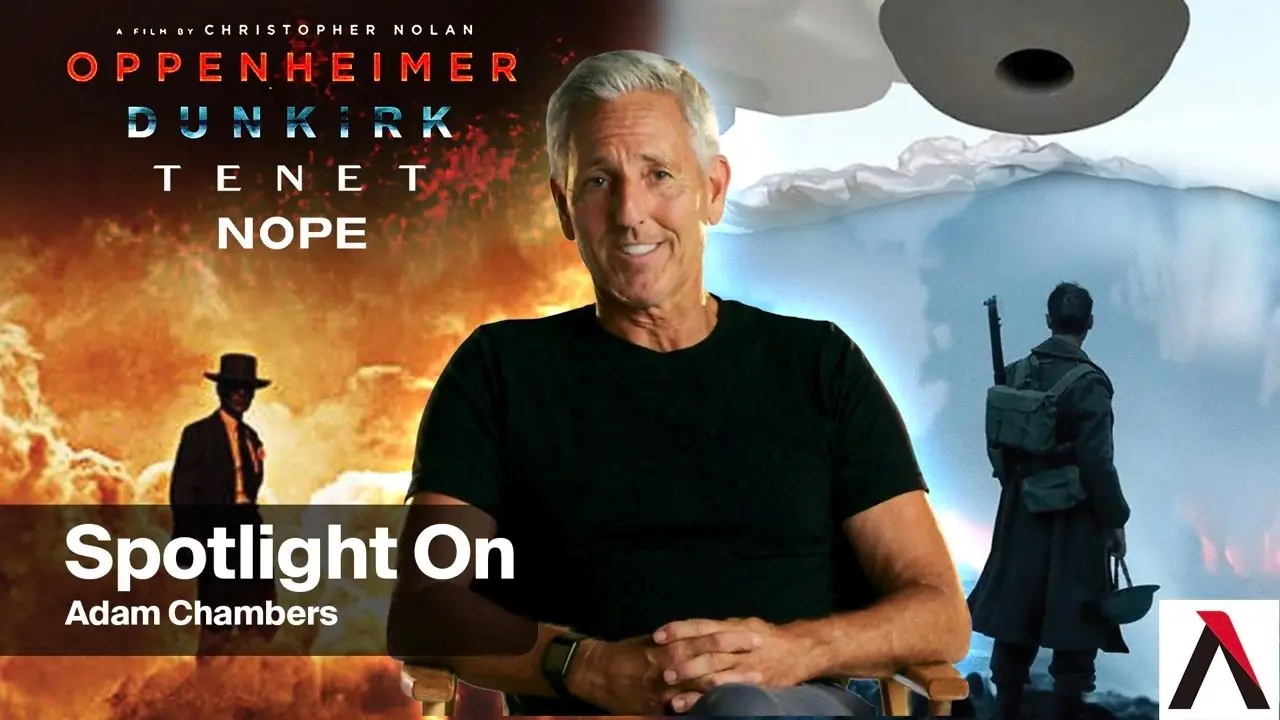
- His credits include Dunkirk, Nope and Oppenheimer
- He has worked with Christopher Nolan and Hoyte van Hoytema
- He also participated in the production of The Odyssey
- The new film is not the main subject of the interview
- Large-scale film sets require speed, precision and endurance
Adam Chambers reveals the journey that led him to some of Hollywood’s largest film productions.
Aputure has released a new interview with Adam Chambers, a CLT and ICLS member, in which the experienced lighting professional discusses his early days in the industry, his collaboration with Hoyte van Hoytema and Christopher Nolan, and his involvement in films including Dunkirk, Nope and Oppenheimer.
The discussion is particularly interesting because it offers a look at the daily reality of technical crews working on productions of enormous scale, where speed, precision, endurance and complete coordination are essential for every shot.
Adam Chambers’ Journey in Hollywood
Adam Chambers looks back at the beginning of his career and explains how he found his way into the Hollywood film industry.
His professional development eventually brought him alongside acclaimed cinematographer Hoyte van Hoytema and director Christopher Nolan, contributing to some of the most demanding productions of recent years.
His credits include Dunkirk, Nope and Oppenheimer, while Chambers also participated in the production of The Odyssey, Nolan’s latest film. The Odyssey is not a central subject of this particular discussion, but it is mentioned as the most recent major chapter in his professional career.
Working With Hoyte van Hoytema
Chambers explains that working with Hoyte van Hoytema requires constant focus and exceptionally fast reactions from every member of the crew.
On these sets, the pace remains relentless, with technicians required to move quickly and adapt immediately to the needs of each shot.
The process leaves little room for delays. Precision, discipline and the ability to carry out instructions rapidly are crucial, especially when a production involves complex scenes, large locations and demanding equipment.
The Pace of Christopher Nolan’s Film Sets
The environment described by Adam Chambers is very different from the image of a slow and carefully controlled film set.
On Christopher Nolan’s productions, the crew operates at high speed, constantly trying to remain one step ahead of the requirements of the next shot.
This intensity requires physical endurance, clear thinking and trust between the different departments. Every change in lighting, camera position or actor placement must be completed without interrupting the overall flow of production.
From Dunkirk to Oppenheimer
Chambers’ career includes films with very different technical and narrative demands.
Dunkirk relied heavily on real locations, natural environments and complex filming conditions. Oppenheimer was another large-scale production, with a strong emphasis on cinematography and large-format film.
His credits also include Jordan Peele’s Nope, a film with a distinctive visual identity and demanding night and exterior scenes.
His involvement in The Odyssey shows that his collaboration with Nolan and van Hoytema’s team has continued, although the new film is not discussed in detail in this particular video.
The Unseen Work of Film Crews
One of the most important elements of the interview is its focus on the people working behind the camera.
Audiences see the finished result, but they rarely understand how quickly lighting must be set up, equipment must be moved and the entire set must be adapted for a new shot.
Chambers highlights the importance of teamwork and experience. On productions of this scale, no department can operate independently. Success depends on collaboration, clear communication and the ability of technicians to solve problems under pressure.
What It Takes to Work at This Scale
Working on major film productions involves much more than knowing how to use lighting equipment.
It requires an understanding of the image, fast decision-making, endurance during long shooting days and the ability to adapt to constantly changing conditions.
Adam Chambers’ experience shows that progress in the film industry depends both on technical ability and on consistency, reliability and the capacity to work with demanding filmmakers and experienced crews.
What We Think
Adam Chambers’ interview provides a valuable look at the reality of large-scale film production and reminds viewers that every impressive image depends on a highly coordinated technical crew. His involvement in Dunkirk, Nope, Oppenheimer and The Odyssey highlights the importance of experience and endurance at this level of filmmaking.
Frequently Asked Questions
Who is Adam Chambers?
Adam Chambers is a film lighting professional and a member of CLT and ICLS, with experience on major Hollywood productions.
Which films has he worked on?
His credits include Dunkirk, Nope and Oppenheimer, while he also participated in the production of The Odyssey.
Is The Odyssey discussed in the interview?
No. The film is mentioned as part of Adam Chambers’ recent professional career, but the main focus is on his journey, previous productions and the working methods of large film crews.
Which filmmakers has he worked with?
He has worked with director Christopher Nolan and cinematographer Hoyte van Hoytema.
What do productions of this scale require?
They require speed, precision, physical and mental endurance, as well as excellent coordination between every department.