Summary
- The Sony IMX742 measures just 1 × 1 mm and has 720 × 720 effective pixels.
- It supports 30 or 60 fps with digital image output and transmission up to 5 metres in Sony’s own test.
- Designed for single-use medical endoscopes, the sensor is scheduled for sample shipments in November 2026.
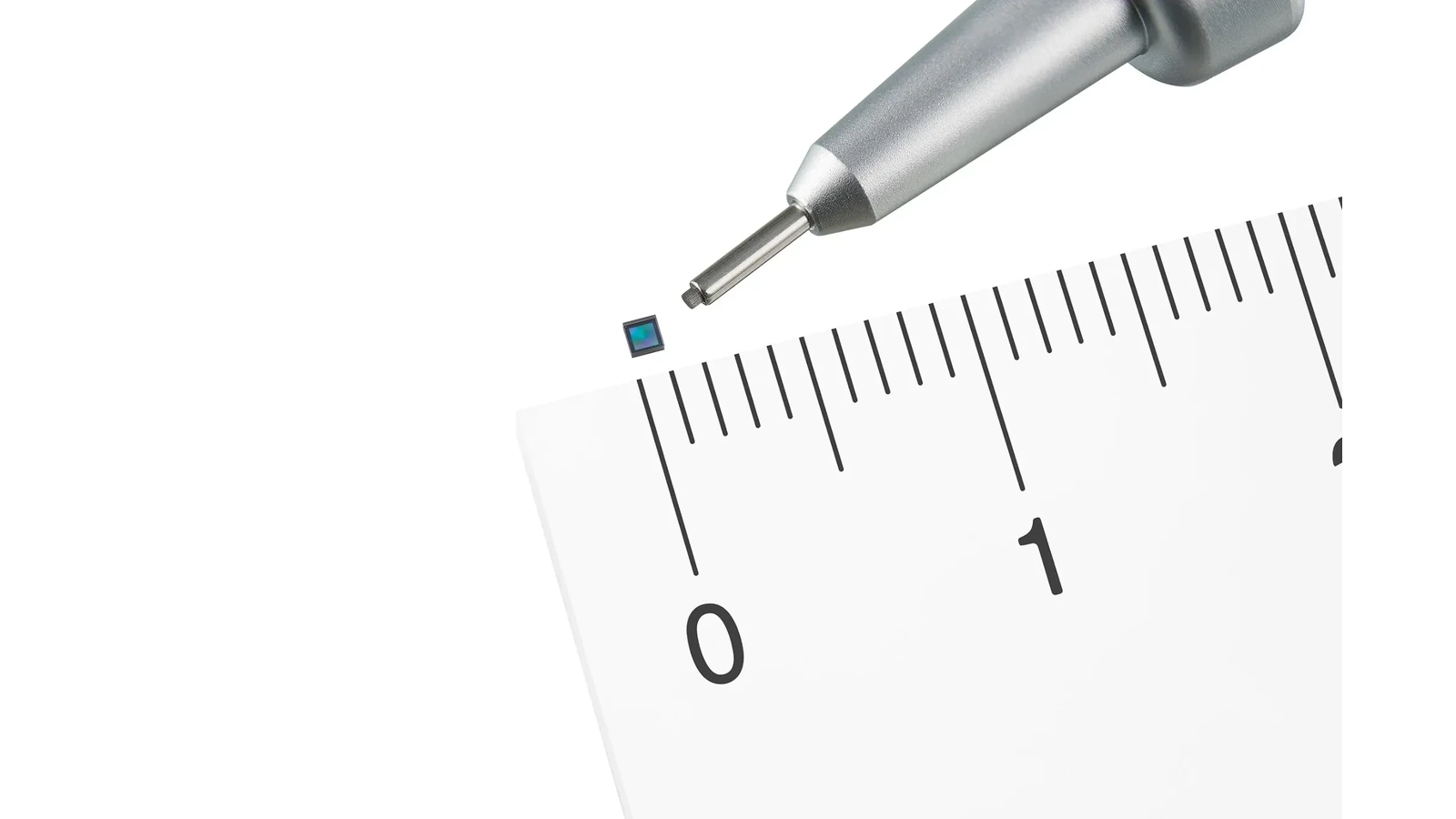
Sony has developed a CMOS image sensor measuring just 1 × 1 millimetre that captures up to 60 frames per second and transmits a digital image signal along a five-metre cable.
Announced on October 22, 2026, the Sony IMX742 is designed for thin, single-use medical endoscopes. It offers approximately 0.51 effective megapixels — hardly a headline resolution for a conventional camera, but a significant engineering feat when the entire chip must fit within a single square millimetre.
720 × 720 pixels on a one-millimetre chip
The IMX742 has 720 × 720 effective pixels, each measuring 1 µm, a back-illuminated structure and a Bayer colour filter. Its image diagonal is 1.02 mm (1/17.7-type), while the chip itself measures 1 × 1 mm and comes in a six-pin wafer-level chip-scale package.
The challenge was to fit an analogue-to-digital (A/D) converter inside the sensor without consuming too much of the pixel area. Sony says it miniaturised the peripheral circuits and integrated conversion and digital output into this exceptionally small package.
Miniaturisation and control of light at pixel level are distinct but equally interesting areas of sensor research. A Sony patent describing reflective walls between pixels, for instance, explores a different way of reducing optical losses. Sony has not stated that this patented design is part of the IMX742.
60 fps digital imaging over a five-metre cable
The sensor supports 30 or 60 fps and outputs images digitised on the chip itself. That avoids carrying a vulnerable analogue signal along a long cable, an especially useful property inside a narrow endoscope illuminated by a small LED light source.
Sony’s proprietary bidirectional link carries video data and control signals through the same cable. The company says stable transmission over 5 metres was verified in its own evaluation environment using AWG44 cable. This is a result under specific test conditions, rather than a guarantee for every endoscope design.
In Sony’s published comparison images, an equivalent conventional analogue output shows visible grain and vertical bands, while the IMX742 sample appears cleaner. These are manufacturer-provided comparisons, not an independent laboratory test.


More information here.
Why it is intended for single-use endoscopes
Sony is targeting instruments such as bronchoscopes and ureteroscopes, where a narrow tip, limited illumination and dependable image transmission matter. Single-use endoscopes also reduce the need to reprocess and disinfect the same instrument between procedures.
The IMX742 is an imaging component, not an approved medical device. Sony supplies it for integration into complete systems, which are subject to their own evaluation and approval requirements.
Availability
Sample shipments are scheduled to begin in November 2026. No European retail price was announced: this is a sensor supplied to system manufacturers, not a consumer camera product.
What we think
What stands out is how Sony managed to fit not just the pixels but also the signal-conversion electronics onto a one-millimetre chip. Anyone who works with cameras knows how troublesome an image signal can become when it has to travel between a sensor and another electronic module. In an endoscope, that distance and the extremely limited space are parts of the same engineering challenge.
The 0.51 MP figure is not something to compare with a mirrorless camera or smartphone. Here, it matters much more that a doctor can see a clear, smooth image in an exceptionally narrow and dark space. It is a useful reminder for all of us working with imaging equipment: the best sensor for a job is not necessarily the one with the most megapixels, but the one that meets the demands of that particular task.
Frequently asked questions
Does 60 fps mean high-resolution video?
No. The 60 fps figure describes frame rate. The IMX742 produces an image of 720 × 720 effective pixels, or approximately 0.51 MP.
Does the IMX742 use a global shutter?
The official specification lists rolling shutter and global reset, not a conventional global shutter with simultaneous readout of all pixels.