Summary
- Google updated its privacy policy on October 16, 2026.
- Data voluntarily connected from Photos, Gmail and Drive may influence ad personalization.
- Google says advertisers cannot access the original personal content.
- Gemini Personal Intelligence is not yet available in Greece.
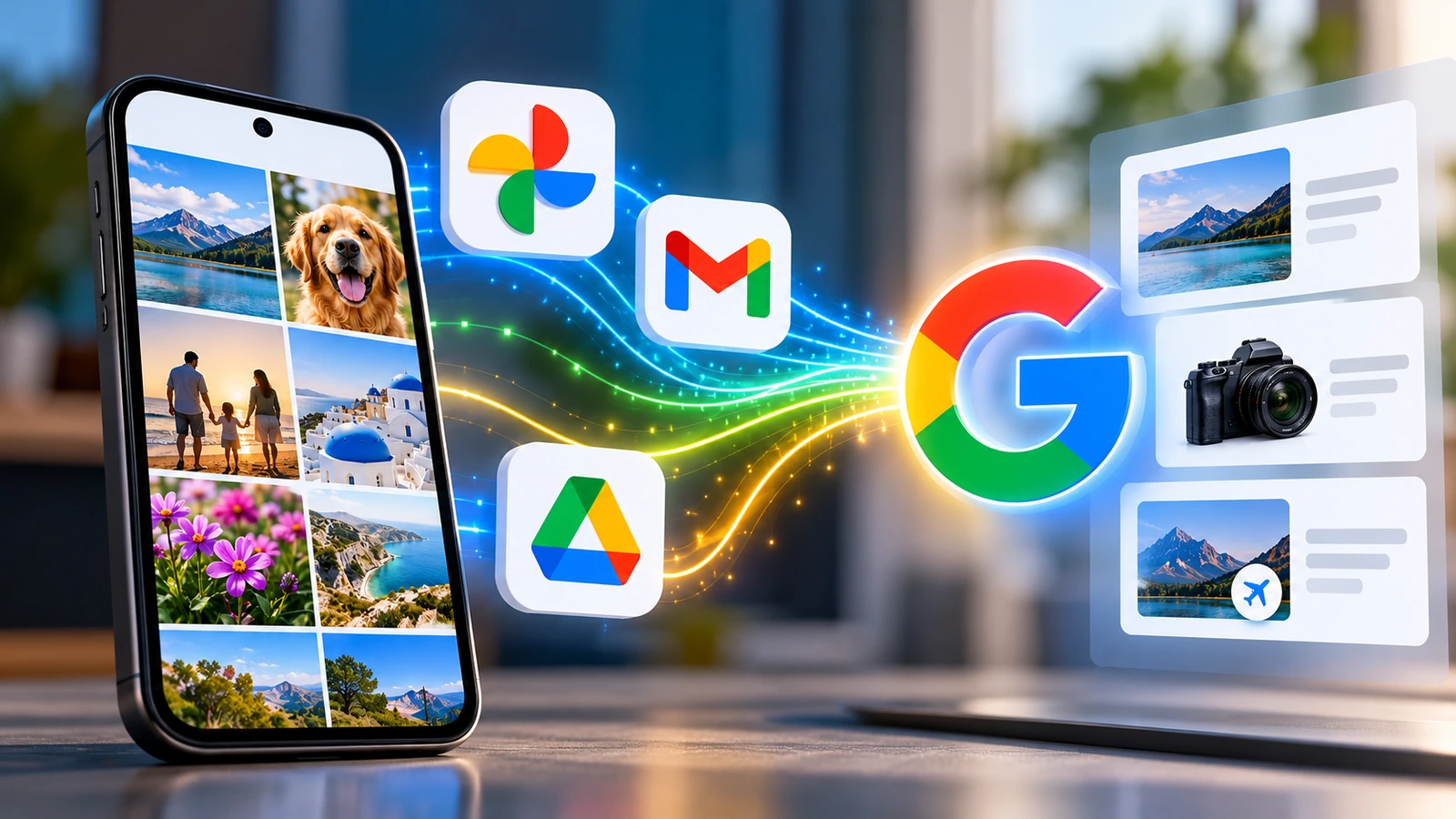
Google has opened a new path for personal information to influence advertising: data from Google Photos, Gmail and Drive may help personalize ads under specific conditions, when users choose to connect their services.
The revised privacy policy took effect on October 16, 2026. It does not mean Google automatically uses every photo stored in the cloud to target ads. The change applies when users allow other Google services to access information from their personal apps.
What changed in Google’s privacy policy
Previously, the policy stated without this exception that content in Gmail, Drive and Photos was not used for personalized advertising. The new wording retains the restriction but adds an important condition: if users choose to make data available from these services to other Google services that support personalized ads, that protection has an exception.
The policy explicitly names Search and Gemini Apps as examples of services that may, with permission, access data from Google Photos or Google Workspace. For Search, Google says that some of the permitted information may be used to personalize content, including ads.
Advertisers do not receive your photos
With Personal Intelligence, Google services can use summaries, excerpts and inferences derived from connected photos, emails and files. These derived signals may also influence the ads users see. Google says ads are not based directly on the Gmail inbox or the Google Photos library and that advertisers do not gain access to either.
That distinction matters, but it does not eliminate the privacy concern. A service can infer interests and needs from personal content without sharing the original photograph. Google also says it does not personalize ads using sensitive categories, including health, religion or sexual orientation.
What it means in Greece and for Google Photos users
According to Google’s help documentation, the Gemini Personal Intelligence feature for connecting personal apps is not currently available in the European Economic Area, which includes Greece. The global privacy-policy update is not an announcement that this particular feature has launched there.
For photographers handling personal or client archives, the implications deserve attention. Google Photos libraries may include family photographs, locations, trips and work-related imagery. The earlier integration of Personal Intelligence with Google Photos and Nano Banana demonstrated the creative possibilities of using personal context; this update raises a more specific question about how that context might be used beyond the creative tool.
How to manage connected apps and ads
Where Personal Intelligence is available, Gemini connections can be managed through Settings → Personal Intelligence → Connected Apps, allowing individual apps to be disconnected. Google says Search users can also change or disconnect their content-app connections. Wider ad personalization settings are available in My Ad Center. The actual options depend on the country, service and account.
Simply storing photos in Google Photos does not, by itself, mean opting into this cross-service connection. When an AI feature requests access to personal apps, it is worth reviewing exactly what has been connected rather than assuming one general privacy switch controls everything.
What we think
For photographers, Google Photos is often far more than a gallery. It can hold private moments, trips, faces and images that clients have entrusted to us. Using inferences from that archive to select a more relevant advertisement is a different purpose from the one for which we uploaded the files.
An opt-in connection is essential, but a consent toggle is not enough. Users should be able to understand exactly what it enables, which services gain access and how to stop that data use. When the same company operates both a creative AI tool and an advertising platform, the boundary between them needs to be especially clear.
We would happily use a tool that saves time finding files or creating images. But we would not grant it access to an entire professional archive without knowing which additional uses that decision permits. Convenience is worth having only when control remains firmly with the person who owns the images.
Frequently asked questions
Does Google automatically use all my photos to target ads?
No. The new exception concerns data that users choose to connect to other Google services that support personalized advertising.
Can advertisers access my photos or emails?
Google says no. Advertisers do not receive access to Google Photos libraries or Gmail inboxes. Information derived from connected content may nevertheless be used for personalization.
Is Gemini Personal Intelligence available in Greece?
Google says this particular personal-app connection feature is not yet available in the European Economic Area, including Greece.