Summary
- Blackmagic announced a seventh-order Ambisonic microphone with 108 MEMS capsules.
- The device produces 64 channels of 32-bit audio and uses Apple technology.
- Availability is planned for December 2026.
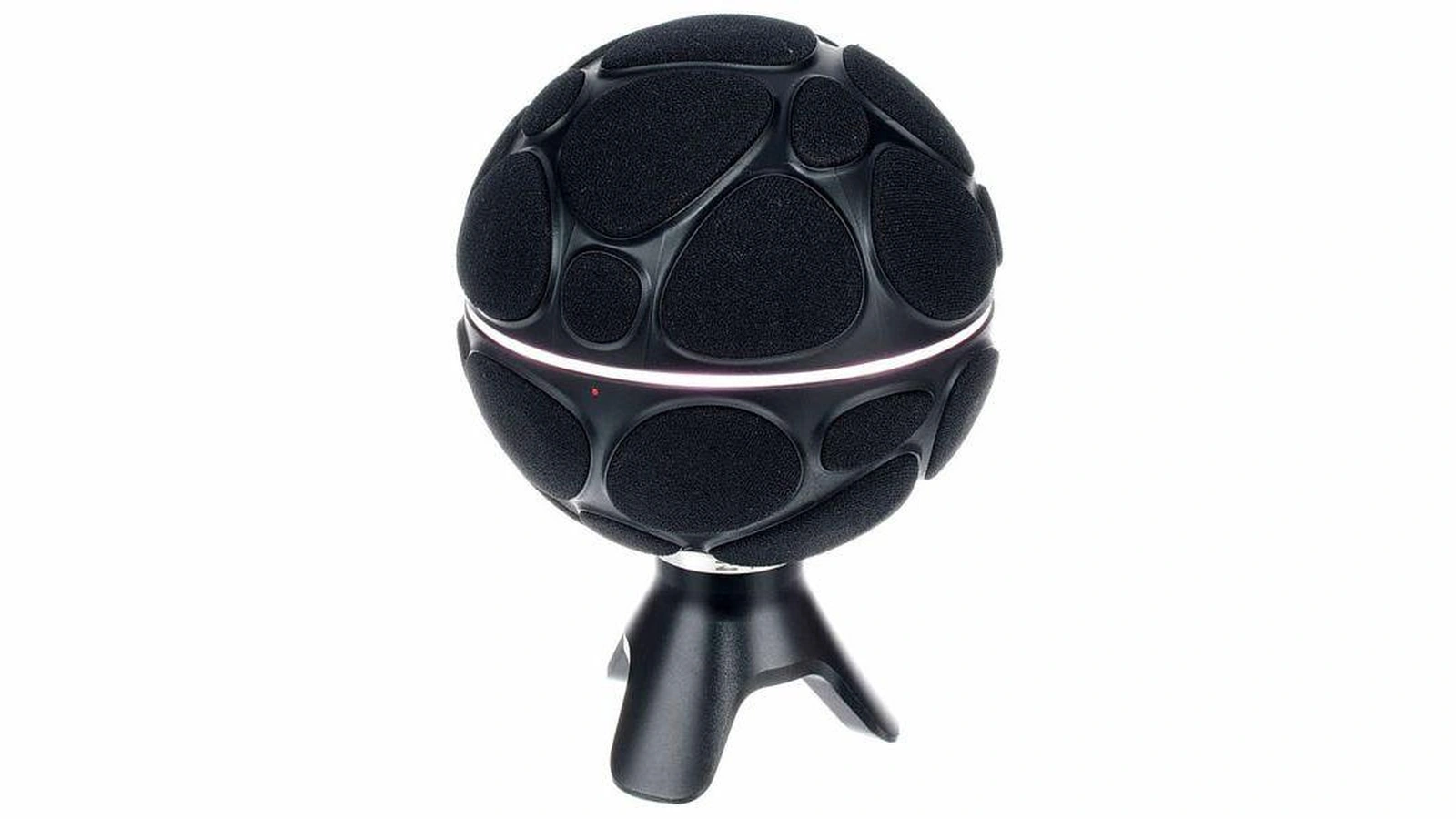
Blackmagic Design is entering the microphone market with a product quite unlike conventional video recording tools. Announced on 11 November 2026, the Blackmagic Ambisonic Microphone features 108 digital MEMS capsules and captures seventh-order Ambisonic spatial audio. The company describes it as the world’s first microphone with this capability. Availability is planned for December.
108 capsules, 64 audio channels
The capsules are integrated into a compact metal body to capture sound from every direction. An onboard processor converts the signals from all 108 capsules into 64 channels of 32-bit audio in real time. The USB-C connection carries audio and powers the device, without a separate encoding unit or dedicated driver.
Ambisonics describes the three-dimensional sound field around the recording position rather than assigning each channel to a particular loudspeaker. Unlike a first-order system such as the four-channel Shure MV360 and MV360+, seventh order uses 64 components for more detailed spatial representation. This enables greater directional precision, although actual performance also depends on the microphone’s acoustic characteristics and decoding.
Apple’s contribution and the Vision Pro connection
According to Blackmagic Design CEO Grant Petty, the microphone grew out of the collaboration with Apple on the URSA Cine Immersive. Apple licensed its array geometry and Ambisonic encoding filters, while Blackmagic handled the engineering and product design.
When connected to the URSA Cine Immersive, spatial audio is recorded directly into the camera’s immersive files in sync with the picture. This integration complements the Apple Immersive Video workflow supported by DaVinci Resolve Studio for productions intended for Apple Vision Pro.
The microphone can also connect to a computer for recording and live mixing with Fairlight Live, or to an iPhone through the Blackmagic Camera app. The company has also announced a forthcoming USB-to-SMPTE ST 2110 converter for broadcast and networked productions. Recording requires a connected host, as the microphone is not a standalone recorder.
Price and availability
Release is planned for December 2026. On Blackmagic’s official Finnish website, the version with a mount is listed at €1,475 and the complete kit at €1,925, before VAT. The kit adds a windshield and a locking USB-C cable. A specific Greek price has not been confirmed.
The official US website lists $1,909 and $2,405 respectively. The $1,695 price cited in the original announcement refers to the microphone before local duties and taxes.
More information here.
What we think
For a wildlife documentary, a concert or an immersive production, environmental sound is part of the storytelling. Capturing such a complex sound field over one connection, without a separate processing unit on set, is Blackmagic’s substantive advantage. We would not replace dialogue or directional microphones with this array, however. We would use it alongside them to retain independent control over voices and ambience in the mix.
Before investing in a 64-channel system, we would want to know its self-noise, maximum sound pressure level and wind performance, details that have not been published in the available specifications. Equally important is checking support for all 64 channels throughout the workflow up to the final file. For a conventional stereo video production, a simpler system may be more practical.