Summary
- ESA unveiled new images of the crater on Dimorphos.
- The face struck by DART has flattened.
- AFC photographed the system from 29 kilometres away.
- Hera is scheduled to move closer in December.
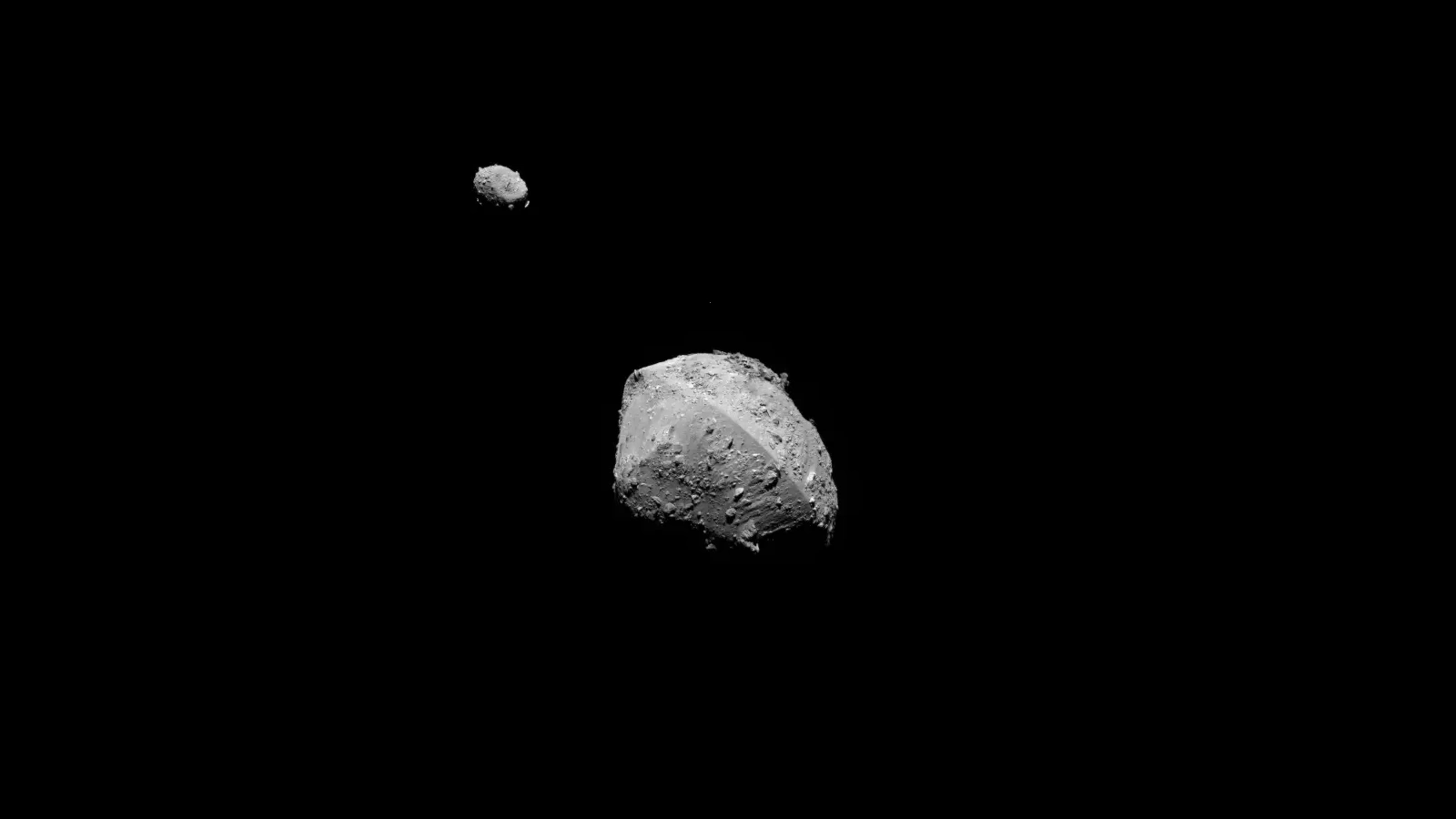
Four years after NASA’s DART struck Dimorphos, ESA unveiled the first close-up images revealing the impact site on 25 November 2026. The struck face of the small asteroid has flattened into a stadium-sized crater spanning its full width.
ESA’s presentation of the new images is available in the video below.
What changed on Dimorphos
On 26 September 2022, NASA deliberately collided DART with Dimorphos. It shortened the moonlet’s orbital period around the larger Didymos by about 33 minutes. It was the first asteroid-deflection experiment using a spacecraft impact.
DART had a mass of 580 kilograms and struck at about 6.1 km/s. ESA has also published an animation of the event, not actual footage of the collision from that viewpoint.
https://www.esa.int/media/animation-of-dart-hitting-dimorphos
Dimorphos is 151 metres across and Didymos is 730 metres across. Their average separation is about one kilometre. In the new photograph the smaller body is at upper left. An elongated feature is visible in the centre of the crater, whose nature has yet to be established.
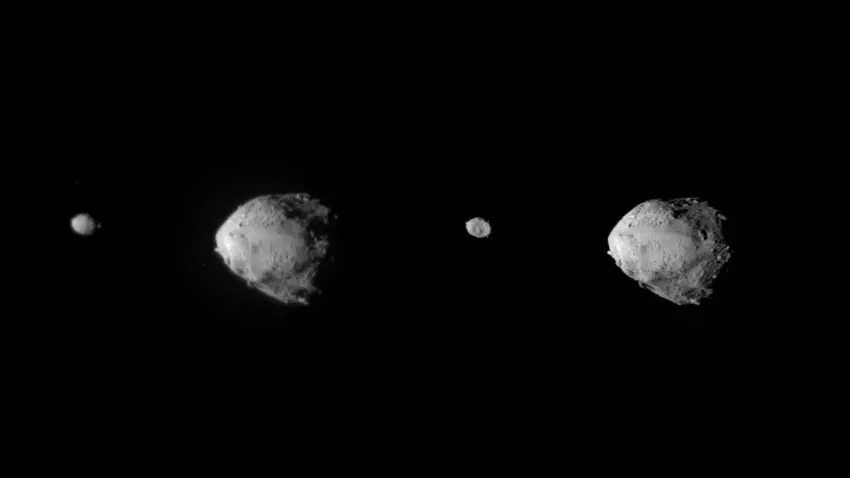
For the before-and-after comparison, Hera’s team sought to reproduce the viewpoint of DRACO, DART’s camera. Didymos appears largely unchanged, and the same boulder fields remain recognisable elsewhere on Dimorphos. The flattened impact face, by contrast, is conspicuous.
The 2024 prediction that did not hold
In February 2024, a Nature Astronomy study by Sabina Raducan and colleagues found that their simulations produced overall deformation rather than a conventional crater. The model best matching the observations available at the time indicated a body with very low cohesion. The new images show that reshaping and a recognisable crater coexist. That challenges the specific prediction about morphology, not necessarily every conclusion of the study.
A one-megapixel camera as a scientific instrument
The photograph from 7 November was taken from 29 kilometres away, at a spatial resolution of 2.7 metres per pixel. The Asteroid Framing Camera (AFC) comprises two 1020 × 1020-pixel monochrome visible-light cameras for scientific imaging and navigation.
The first close-up photograph of Didymos had already shown its rocky terrain. Later, stereoscopic images by Brian May and Claudia Manzoni used different viewpoints to convey depth. Here, matching the viewpoint of an earlier photograph serves a different purpose: detecting actual changes.
AFC is complemented by the Hyperscout H multispectral instrument, which records 25 spectral bands, and JAXA’s TIRI thermal infrared instrument. Information about shape, spectral behaviour and surface temperature can therefore be studied together.
Irregular rotation and hundreds of boulders
Successive images show that Dimorphos is no longer rotating regularly. Its tumbling motion is particularly apparent in this ESA sequence.
https://www.esa.int/media/about-us/directorates/operations/space-safety/hera/dimorphos-orbiting-didymos-seen-from-south
Long exposures from Hyperscout H also revealed hundreds of metre-scale boulders orbiting the system. Their presence must be taken into account when planning the next approaches.
Moving closer in December
Hera, launched on 7 October 2024, is in its initial survey phase. From its current range of 25–30 kilometres, it is scheduled to approach to about 13 kilometres in December. January 2027 is the planned deployment date for two small spacecraft, Juventas and Milani, to investigate the interior, materials and dust of the system.
The crucial question for planetary defence is how an asteroid’s mass and internal structure affect the effectiveness of such a deflection. DART’s success is the starting point for that investigation.
What we think
Looking at the two comparison images as photographers, their most important quality is not spectacular detail. It is the effort to preserve the same imaging geometry. A single photograph can show us a flattened face, but an older frame from a similar viewpoint helps us understand what actually changed.
That is a useful lesson for anyone documenting change in nature, landscapes or scientific missions. Repeatable framing, recording the distance and knowing the actual spatial resolution matter more than dramatic digital zoom. The 2.7 metres per pixel tells us exactly the sampling scale the image can support.