Summary
- Sony has introduced the ECM-AX10 for spatial audio recording on smartphones.
- Its four capsules support Ambisonics, binaural and stereo.
- Spatial Audio Video Tool enables capture, editing and export with some restrictions.
- The estimated European price is €199.
Sony has introduced the ECM-AX10, a 24-gram USB-C smartphone microphone designed to capture not just sound, but a sense of the space and direction around a scene.
Announced on 8 October 2026, it targets vloggers and mobile filmmakers who want the ambience of a street, concert or sports scene to remain part of the story. Sony describes it as the first Eclipsa Audio-certified smartphone microphone.
Sony’s product introduction and a recording comparison offer a look at its approach.
Four capsules and three ways to record
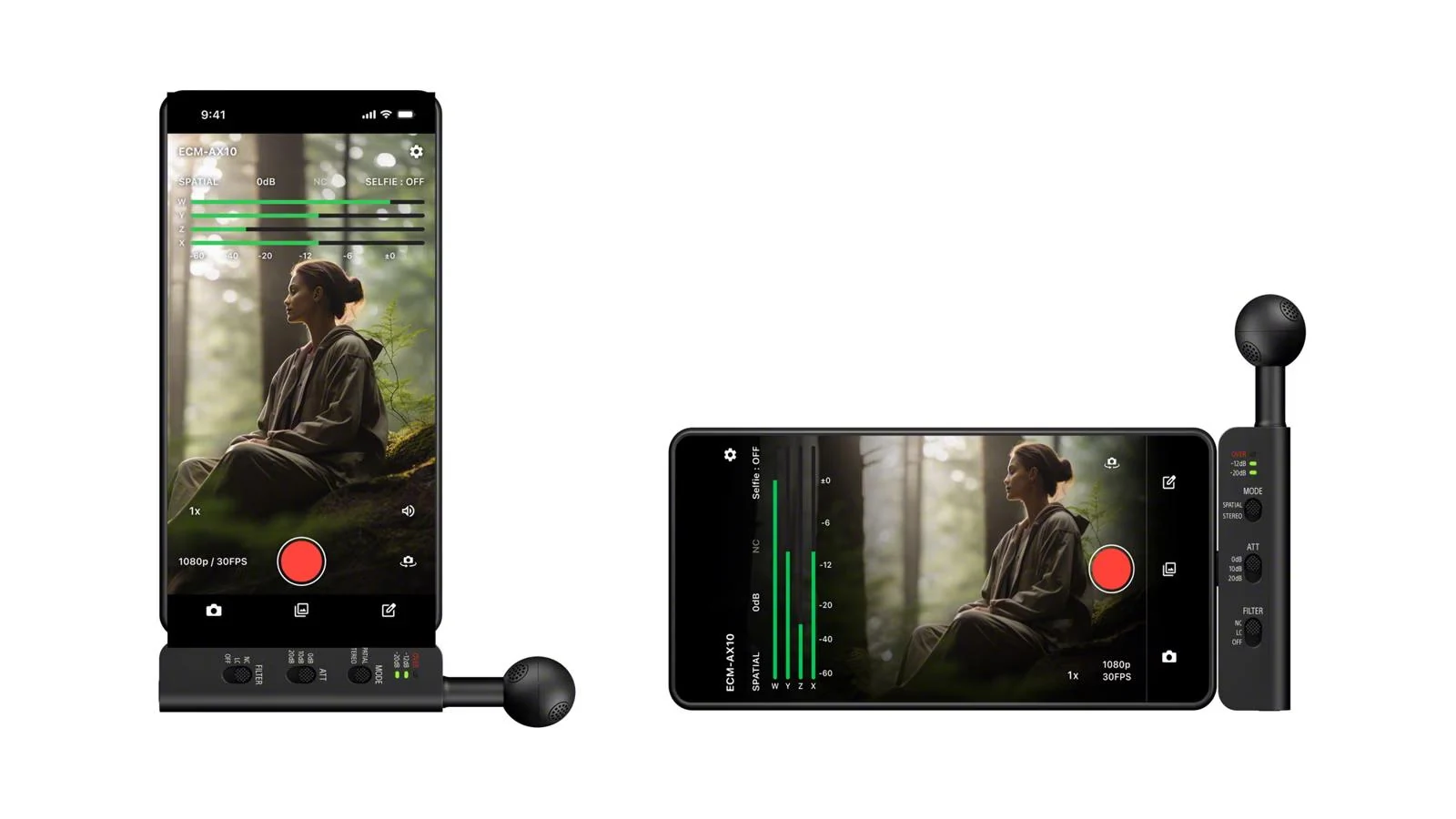
Four omnidirectional capsules sit in the ECM-AX10’s spherical microphone assembly. Ambisonics captures directional information in four channels for spatial production and playback. This is particularly relevant when the location itself matters to the story, rather than only the voice in front of the camera.
Binaural mode creates a two-channel headphone-oriented spatial mix without requiring an Eclipsa Audio-compatible platform. Standard stereo works for ordinary headphones and speakers. Depending on the recording settings, the microphone supports 48 kHz audio at 16-bit, 24-bit or 32-bit float.

What changes in a smartphone workflow
Sony’s Spatial Audio Video Tool handles video capture, audio monitoring, simple editing and export. Compatible Ambisonics recordings can be delivered with Eclipsa Audio for immersive playback on YouTube. Eclipsa Audio uses the open IAMF specification; it is more than a conventional stereo effect.
There is an important workflow restriction. Outside Sony’s app, selecting SPATIAL records binaural rather than four-channel Ambisonics. The app can edit footage recorded within the app, not video imported from other camera apps. Sony also says 4K recording support in Spatial Audio Video Tool is planned from December 2026, rather than currently available.
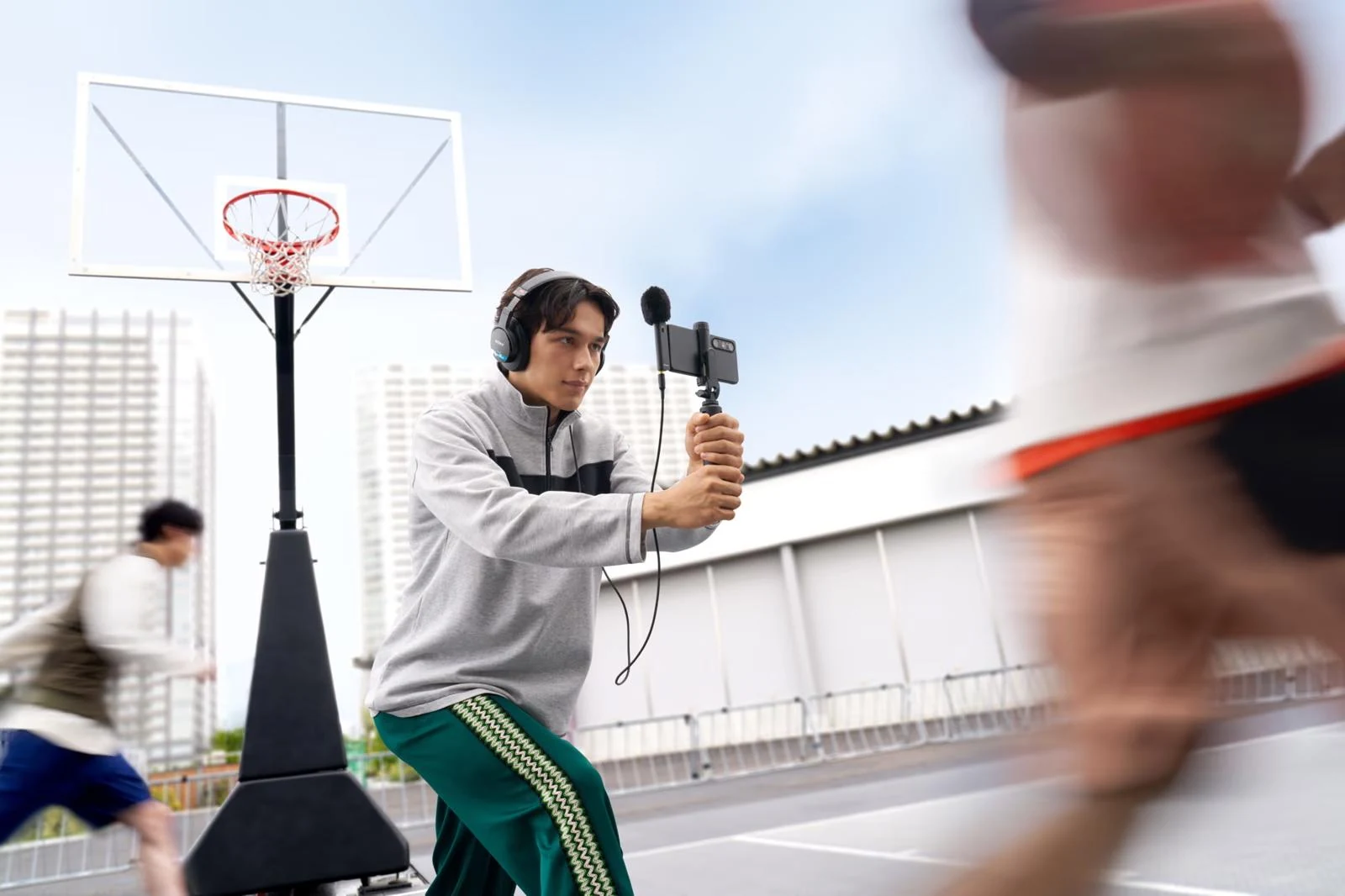
On-device controls include stereo/spatial switching, 0/10/20 dB attenuation, low-cut and noise-cut filters and a selfie setting that adjusts recording orientation when the camera faces the operator. It has a 3.5 mm headphone monitoring output, a six-axis motion sensor and USB-C power from the attached device. Noise-cut is unavailable in Ambisonics mode.
Sony specifies a 20 Hz–20 kHz frequency response and maximum sound pressure handling of at least 120 dB SPL. A windscreen, cold-shoe holder and USB-C cable are included, allowing it to be mounted on a rig rather than protruding from the phone.
Compatibility, price and availability
Sony lists iOS 18 or later or Android 14 or later with USB-C as minimum requirements. This does not guarantee that every qualifying phone has been tested. Sony publishes a model-specific compatibility list and notes that recording performance varies with the smartphone.
The European announcement gives October 2026 availability and an estimated price of around €199. More details are available on the Sony ECM-AX10 product page.
What we think
The ECM-AX10 is compelling because it treats environmental sound as part of the visual storytelling. In a street documentary, a city walk or a live performance, where a sound comes from can tell us as much as the shot itself. That is a different goal from a directional microphone designed to isolate speech.
It is not a replacement for a shotgun or wireless lavalier when dialogue intelligibility is the priority in a noisy location. Sony offers other tools for that job, including the professional ECM-778 shotgun microphone. This is for creators who want to preserve the space around their subject and have a delivery format that can use it.
The main limitation is software: the most ambitious recording option relies on a particular app, with its own editing and capture-resolution restrictions. At €199, the decision should depend on whether the audience’s playback environment and the production workflow genuinely benefit from spatial audio. Otherwise, a conventional microphone may offer better value.
Frequently asked questions
Can I use it with my phone’s regular camera app?
Yes. Sony says it works with other video and audio recording apps, but SPATIAL mode outside Spatial Audio Video Tool records binaural rather than four-channel Ambisonics.
Will it work with every USB-C phone?
Not necessarily. The minimum operating-system requirements apply, and checking Sony’s tested-device list is recommended. The company does not guarantee performance on untested models.