Summary
- Interstellar marks 12 years since its theatrical release.
- DNEG has revisited its award-winning visual effects.
- Gargantua was created with simulations informed by general relativity.
- The production combined IMAX film, on-set projections and digital effects.
Twelve years after Interstellar reached cinemas, DNEG is revisiting the extraordinary shots from Christopher Nolan’s film—and the unusual meeting of filmmaking and science that made them possible.
The film opened widely in the United States on 7 November 2014. On 9 November 2026, visual effects studio DNEG marked the anniversary by sharing selected shots from its Oscar- and BAFTA-winning work.
Gargantua: the science behind the image
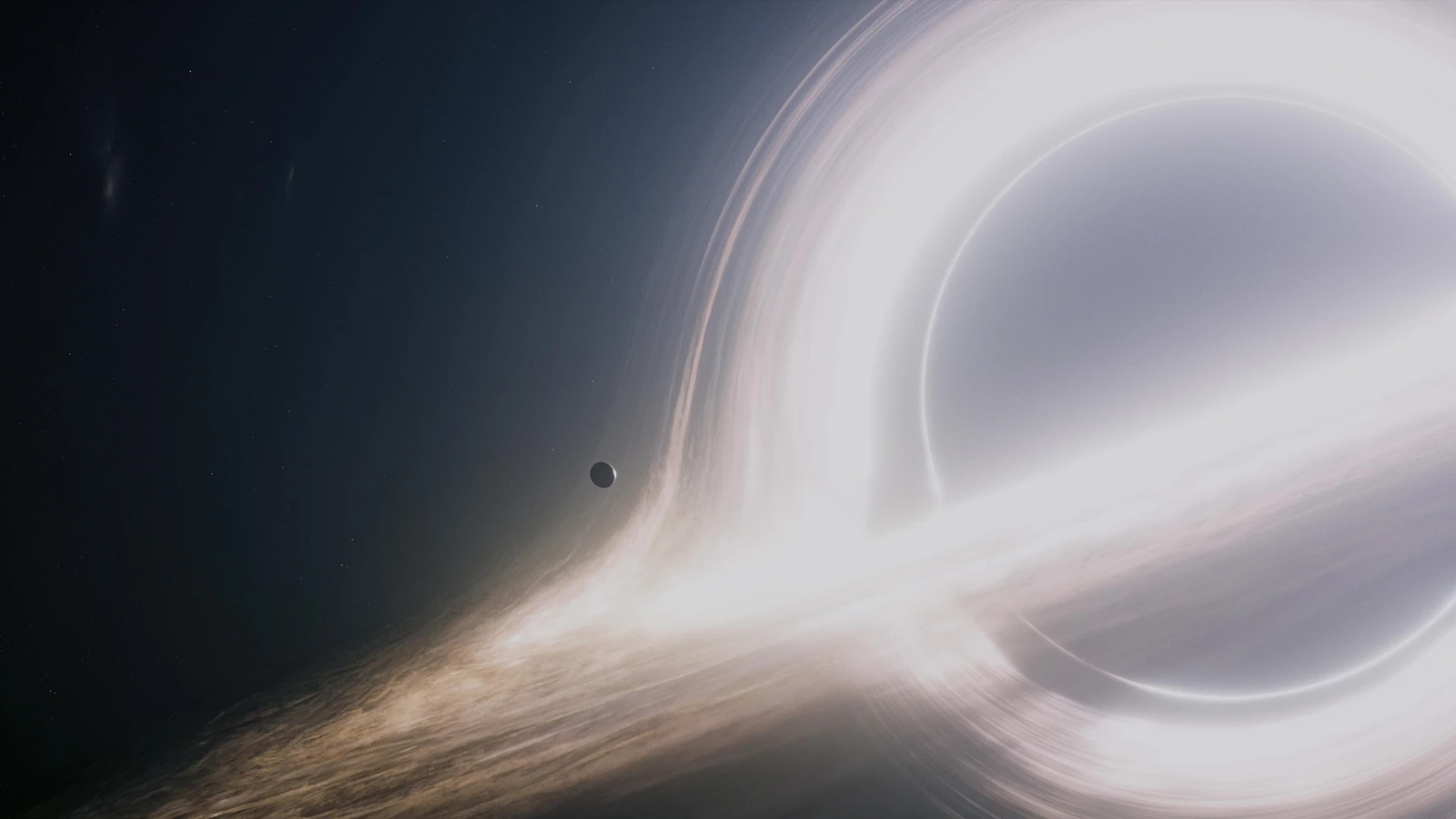
Gargantua was not designed simply to look spectacular. The team at the then Double Negative worked with theoretical physicist and scientific adviser Kip Thorne to base the behaviour of light around a spinning black hole on general relativity.
The team developed the Double Negative Gravitational Renderer (DNGR). Rather than tracing only individual light rays, it calculated bundles of rays bending through curved spacetime. This helped create smooth, flicker-resistant moving images at IMAX quality.
The striking accretion disk seems to wrap above and below the black hole because gravity bends the light reaching the camera. It was not an entirely literal scientific visualization: the filmmakers also made choices about colour and other visual properties to keep the result legible to audiences.
The collaboration continued beyond the film. The team published scientific papers describing gravitational lensing around Gargantua and the rendering of the wormhole, turning a VFX production challenge into a contribution to research.
Frozen planets, robots and sets without green screen
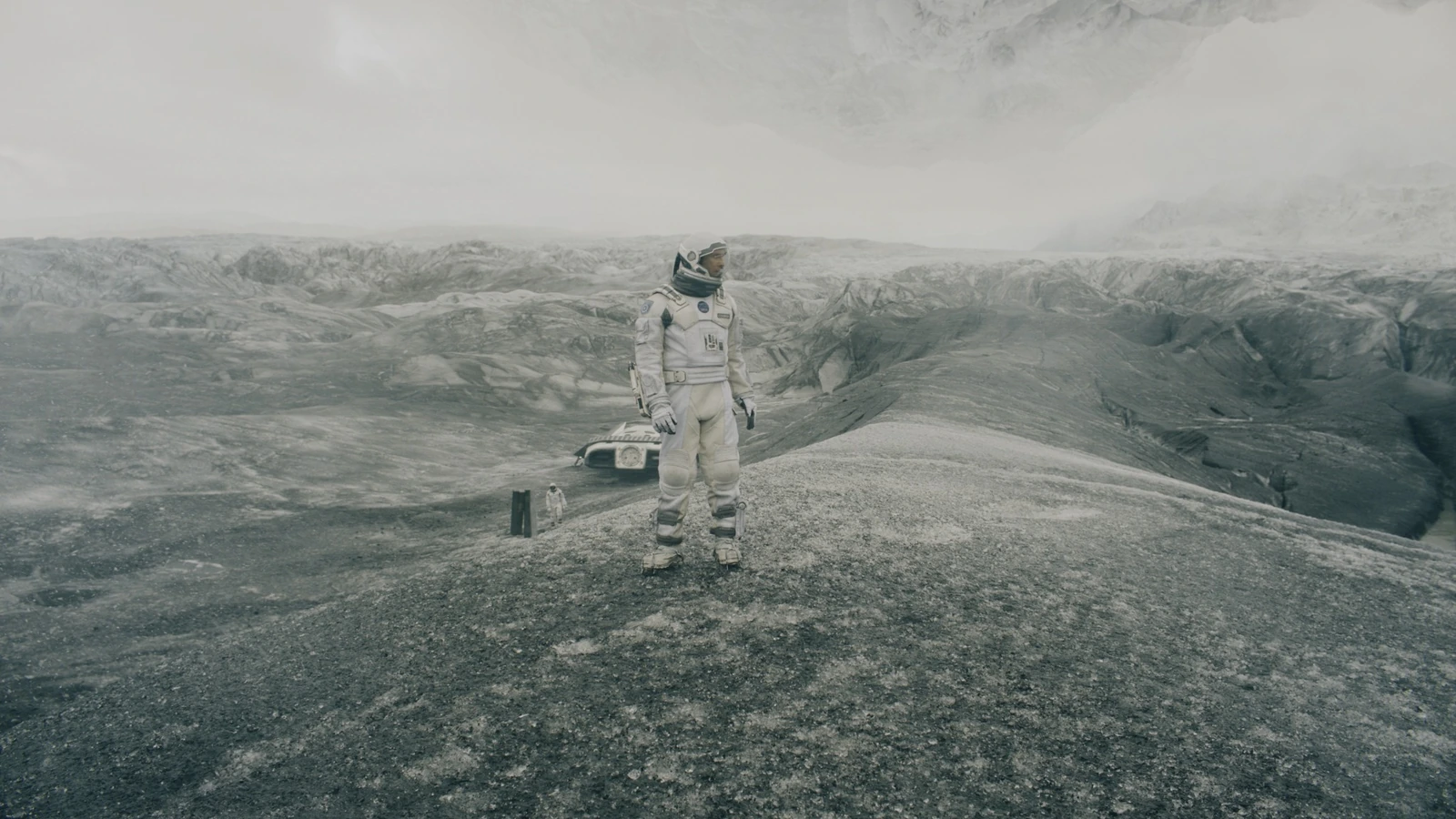
DNEG’s contributions extended well beyond Gargantua: the Endurance spacecraft, the robots TARS and CASE, the four-dimensional Tesseract and the alien landscapes all formed part of its work. Huge waves and frozen clouds had to support both the scale and the drama of the story.
One particularly useful production choice was to project digital space vistas on set instead of using green screens for the space sequences. Actors and cameras could work with visible surroundings, while light and reflections were already present during photography.
Photochemical film alongside visual effects
The visual identity of Interstellar also owes much to cinematographer Hoyte van Hoytema and the use of photochemical film, including 65 mm IMAX. Nolan combined large-format film photography with complex digital effects, rather than treating the two approaches as incompatible.
The Nolan–van Hoytema collaboration continued on later productions, with the special large-format black-and-white stock made for Oppenheimer offering another example of their commitment to analogue cinematography.
What we think
Twelve years on, the remarkable thing about Interstellar is not simply the scale of its effects. Gargantua emerged from an ongoing conversation between scientists and artists, with real physical constraints translated into images that served the story.
For filmmakers, the on-set projection approach is just as compelling. When performers, lighting and camera share a visible reference, the scene has a better chance of feeling coherent from the moment it is shot, long before the final VFX pass.
The film also makes a strong case for choosing techniques around the viewing experience. Film, practical elements and simulations did not need the same origins. They needed to feel as though they belonged to the same world.