Summary
- Laura Mulvey spoke at the 67th Thessaloniki International Film Festival on November 12.
- She revisited the male gaze through Hitchcock’s films. She discussed how digital viewing changes spectatorship.
- She also highlighted the rediscovery of women filmmakers.
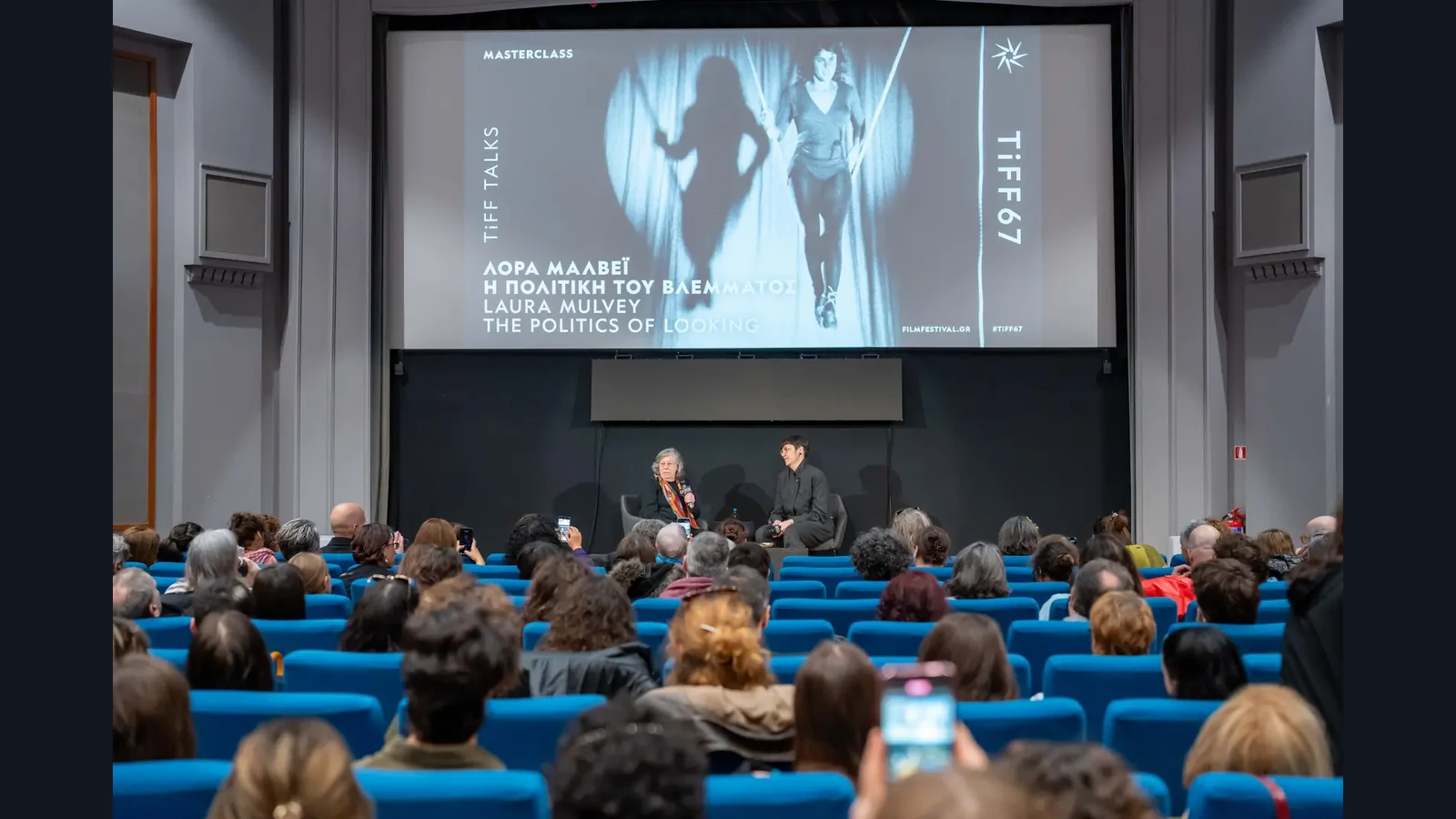
Laura Mulvey, the theorist who changed how we read the cinematic gaze, came to Thessaloniki to discuss the connections between images, power, desire and spectatorship.
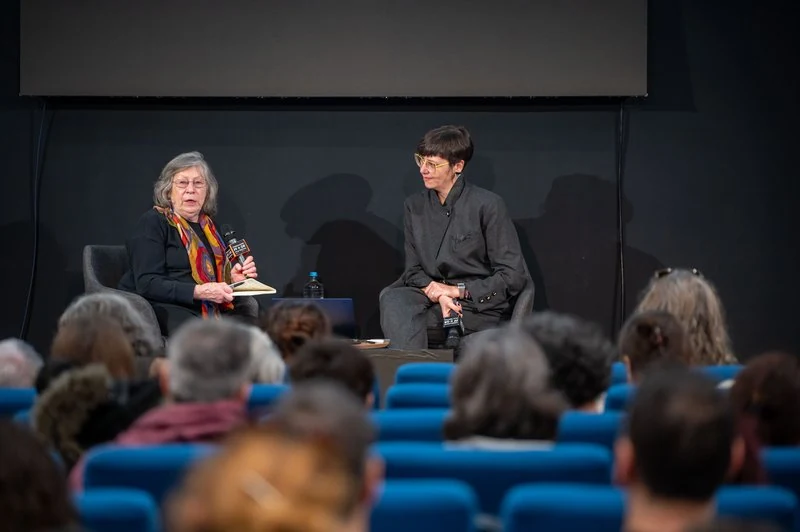
Her masterclass, “The Politics of Looking,” took place on November 12, 2026, before a packed Pavlos Zannas theater as part of the 67th Thessaloniki International Film Festival. The conversation was moderated by Geli Mademli, and the Mulvey spotlight was curated by the Festival and Georgia Korossi.
From 1975 to today: understanding the male gaze
In 1975, the British filmmaker and theorist published her essay “Visual Pleasure and Narrative Cinema.” Examining classical Hollywood, she described how films frequently give male characters the power to drive the action while presenting women as spectacles to be looked at. This organization of cinematic vision became widely associated with the “male gaze.”
Mulvey told the audience that her essay grew out of the women’s liberation movement and was a political intervention rather than a conventional academic study. She also acknowledged its historical limits: it focused on classical Hollywood and did not incorporate queer perspectives or gender fluidity.
Hitchcock and the camera’s gaze
Mulvey turned to Alfred Hitchcock’s “Notorious” (1946) to explain the mechanics. Its opening introduces male journalists and the movie camera as an instrument of looking. The arrival of a woman shifts the scene toward spectacle while establishing her as central to the narrative.
Another shot places Cary Grant in dark silhouette in the foreground, while the illuminated Ingrid Bergman moves in the background and the camera follows her. Lighting, framing and camera movement establish who looks and who is placed under scrutiny.
Digital cinema changes the viewer’s position
One of Mulvey’s most compelling points concerned the ability to pause, slow down and revisit moving images. Where theatrical projection once imposed its own continuous time, digital tools let viewers examine a glance, gesture or composition frame by frame.
Mulvey connected that change to a more open cinephilia shaped by curiosity and different experiences of spectatorship. She also discussed the stronger presence of women filmmakers today: there is no single “female aesthetic,” but there are stories and experiences that have long gone unrepresented.
Rediscovering women filmmakers
The discussion also touched on the restoration of “Eva” (1953) by pioneering Greek director Maria Plyta. Mulvey recalled the efforts made in 1972 to screen films by women and how difficult it was at the time even to locate copies.
She pointed to Dorothy Arzner’s “Dance, Girl, Dance” and “Meshes of the Afternoon” as examples of how film history can be reconsidered when overlooked works are restored, screened and discussed again.
What we think
The male gaze is not just a theoretical label. It is about concrete creative decisions: where we position the camera, whose viewpoint we follow, who drives the scene and who is primarily there to be seen. Script, blocking, lighting and editing all shape that relationship.
The Hitchcock example is particularly useful for image-makers. Put two people in the same frame, keep one in silhouette and illuminate the other, and the audience immediately receives a message about who is looking and who is being observed. That may be a deliberate, powerful storytelling choice, but it is worth understanding what that choice communicates.
Mulvey’s observations about digital slow motion also point to a practical exercise. Pause a scene, study a camera movement, and ask why the shot pushes us toward one character’s perspective. It is a valuable habit for filmmakers and cinematographers alike.