Summary
- MiniMax announced H3-Image on November 11, 2026.
- The model supports approximately 16MP images, editing and up to 16 visual references.
- The company advertises sub-10-second 4K generation, while the accompanying chart reports varying times depending on the task.
- Model weights are available, but local deployment has significant computing requirements.
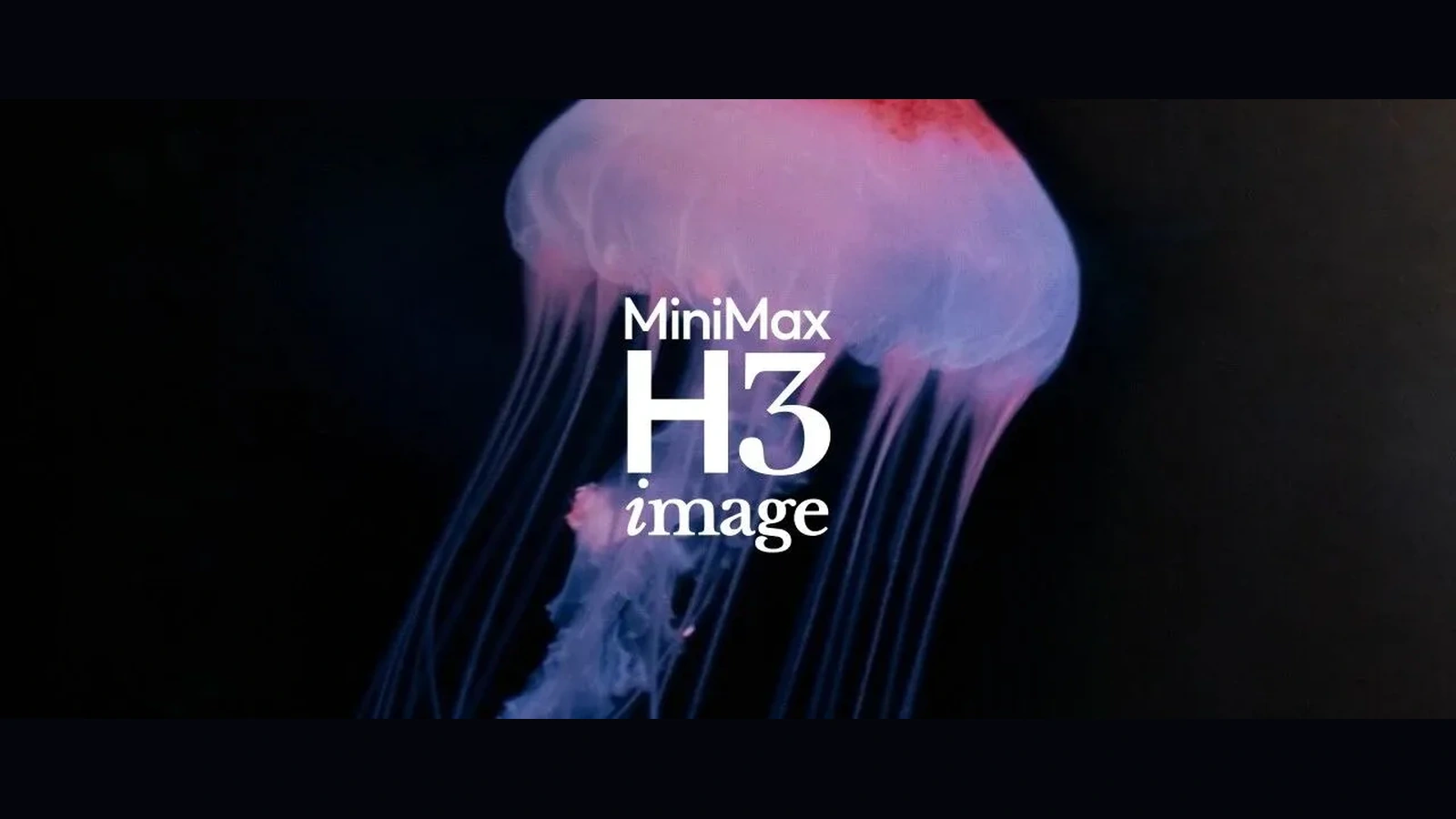
MiniMax has introduced H3-Image, a new AI model for creating and editing roughly 16-megapixel images, combining high resolution, fast generation and support for up to 16 reference images.
Announced on November 11, 2026, the model is claimed to generate a 4096 × 4096 image in under 10 seconds. That figure is a MiniMax performance claim, not an independently verified time for every task or hardware setup.
What H3-Image does and why 16 references matter
H3-Image brings text-to-image, reference-guided generation and image editing into the same model. Creators can supply different references for the subject, color palette, composition or environment, then ask the model to combine those elements in one new image. The 16-reference limit is especially relevant to concept art, product design and campaigns that need a consistent visual identity.
The model is designed to follow detailed directions about object relationships, viewpoints and reflections, as well as targeted edits to existing images. MiniMax emphasizes preserving core elements of a scene while carrying out requested changes. Fidelity to source photos is also a central focus of ChatGPT Images 2.5.
The official product page lists JPEG, PNG and WebP export, 1K, 2K and 4K options, aspect ratios from 1:3 to 3:1, and batches of 1–10 images. Here, “4K” does not necessarily mean a conventional 3840 × 2160 UHD frame: a square 4096 × 4096 output contains around 16.8 million pixels.
More information here.
What the speed comparisons show
MiniMax says H3-Image Standard is about 1.5–2 times faster than comparable alternatives, while Highspeed can be about 3–4 times faster, with results varying by task. In the comparison chart supplied with this story, Highspeed is listed at 10.3 seconds for 4096 × 4096 text-to-image, compared with 16.0 seconds for Standard. These figures should not be confused with the headline “under 10 seconds” claim, and they are not our own measurements.
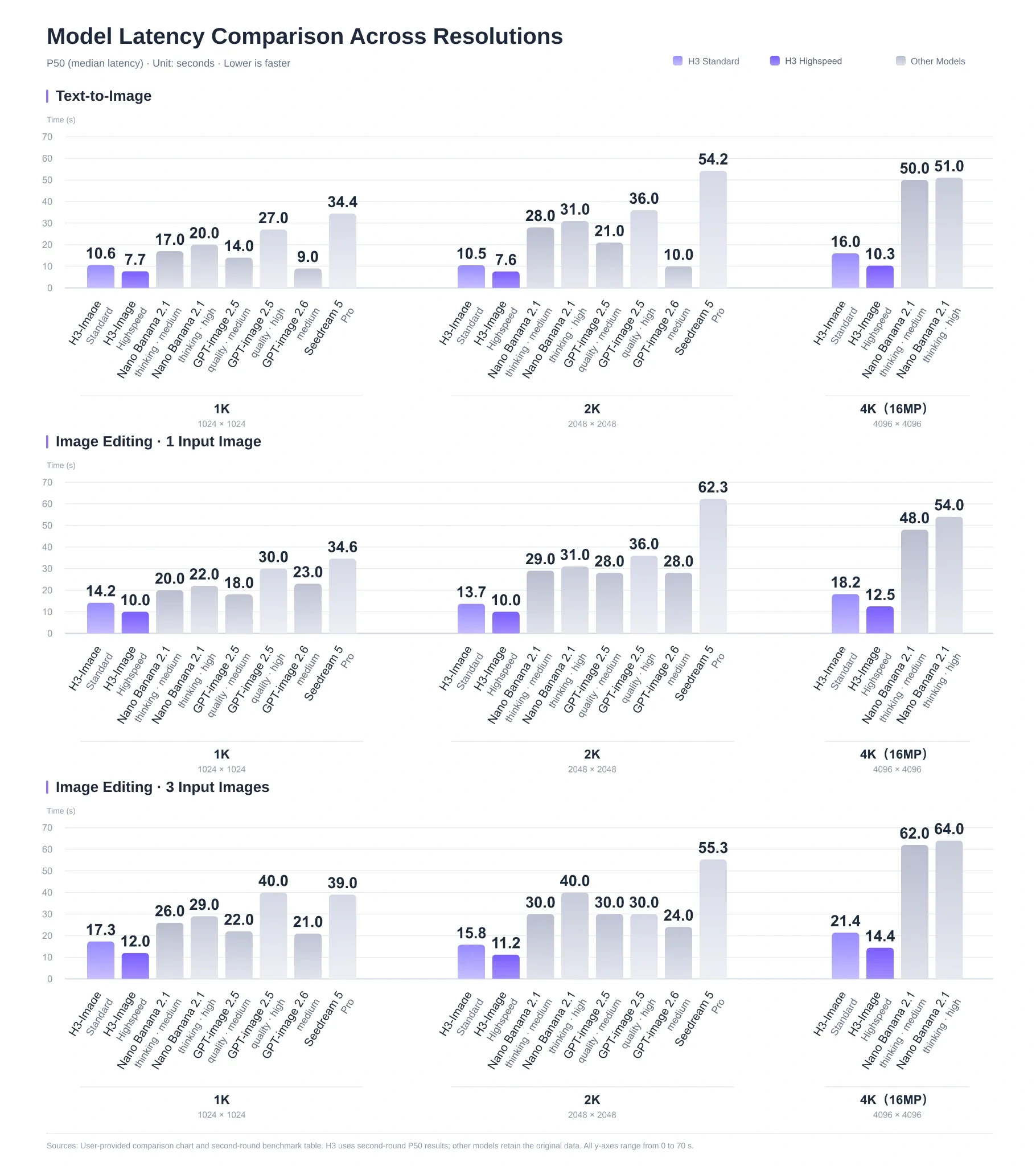
The chart also reports longer times for image editing, especially with three input images. That distinction matters in practice: a fast single generation does not tell us how quickly an entire workflow with edits, revisions and reference images will run.
Open weights, access and pricing
MiniMax has released H3-Image weights on Hugging Face, allowing developers to deploy and adapt the model in their own environments. It is an open-weight release under a dedicated community license, not a promise that every commercial use is unrestricted. Its technical documentation lists substantial model files and a separate text encoder, making local deployment more suitable for powerful accelerator-based systems.
For creators who do not want a local deployment, the company offers the model through MiniMax API Platform, MiniMax Code and Hailuo AI. MiniMax says its pricing is roughly 50–70% of comparable services and offered a 50% launch-week discount on requests at 4K and above, though that does not amount to one universal price for every use case. No separate official European price was identified.
The emphasis on visual consistency reflects a broader shift from one-off AI image generation toward controlled composition. Canva Craft offers another example, with a different focus on layout and design.
What we think
If you are building storyboards, pitching a concept or creating a series of images around the same product, combining many references may be more valuable than shaving another two seconds off one prompt. In production, the hard part is often not getting one attractive image. It is keeping the same object, visual style and framing intact when revisions arrive.
Releasing the model weights is also useful for studios and developers who want tighter control over the pipeline. But this is hardly a casual laptop installation: infrastructure is a serious consideration. For most photographers and designers, an online service is a more realistic place to start.
We would pay particular attention to how reliably revisions hold together: how many attempts does it take to preserve the product, keep important objects in place and produce an image the client can actually use? That total working time is more meaningful than the latency of a single demonstration.
Frequently asked questions
Does H3-Image really generate 4K images?
MiniMax specifies output at 4096 × 4096 pixels, or around 16.8 megapixels, with other aspect ratios available too. Those dimensions describe the image file, not guaranteed visual quality for every composition.
Is it free, and can I run it on my computer?
The model weights can be downloaded under a dedicated license, but local inference requires substantial computing resources. MiniMax also provides hosted services subject to their own terms and pricing.
Are all images ready in under 10 seconds?
Not as a universal rule. MiniMax advertises that performance for high-resolution generation, while the comparison chart shows varying times for Standard, Highspeed and editing tasks with input references.