

Summary
- ChatGPT Images 2.5 offers up to 50% lower latency than Images 2.0
- It improves the preservation of people, subjects and details from reference photos
- Multi-turn editing makes more targeted changes without undoing previous edits
- Sketch, Templates, image comments and prompt sharing are being added
- GPT-Image-2.5 Flare and Sunburst are available through the API
- Images 2.5 is rolling out across all ChatGPT tiers while existing image limits remain
- OpenAI continues to use C2PA metadata and invisible SynthID watermarking
- More faithful reference photos and more precise editing
- Sketch reduces the dependence on long prompts
- Templates, comments and prompt sharing
- Better layouts, styles and transparent backgrounds
- From Images 2.0 to Images 2.5
- GPT-Image-2.5 Flare and Sunburst in the API
- Availability and pricing
- Safety, deepfakes and image provenance
- What we think
- Frequently asked questions
OpenAI has introduced ChatGPT Images 2.5, bringing up to 50% faster generation, greater fidelity to reference photos, more precise multi-turn editing and new tools including Sketch, Templates and image comments.
The new version was announced on September 8, 2026 and is available across ChatGPT, ChatGPT Work and Codex on desktop, mobile and web. OpenAI is also releasing two new API models, GPT-Image-2.5 Flare and GPT-Image-2.5 Sunburst. The company says people now create more than 3 billion images every week across ChatGPT Images and GPT-Image models in the API.
The most meaningful change is not simply better-looking final images. OpenAI is targeting problems that regularly affect real creative workflows: edits that alter elements users never asked to change, faces that gradually lose their likeness through repeated revisions, and images that deteriorate as the editing sequence grows longer.
More faithful reference photos and more precise editing
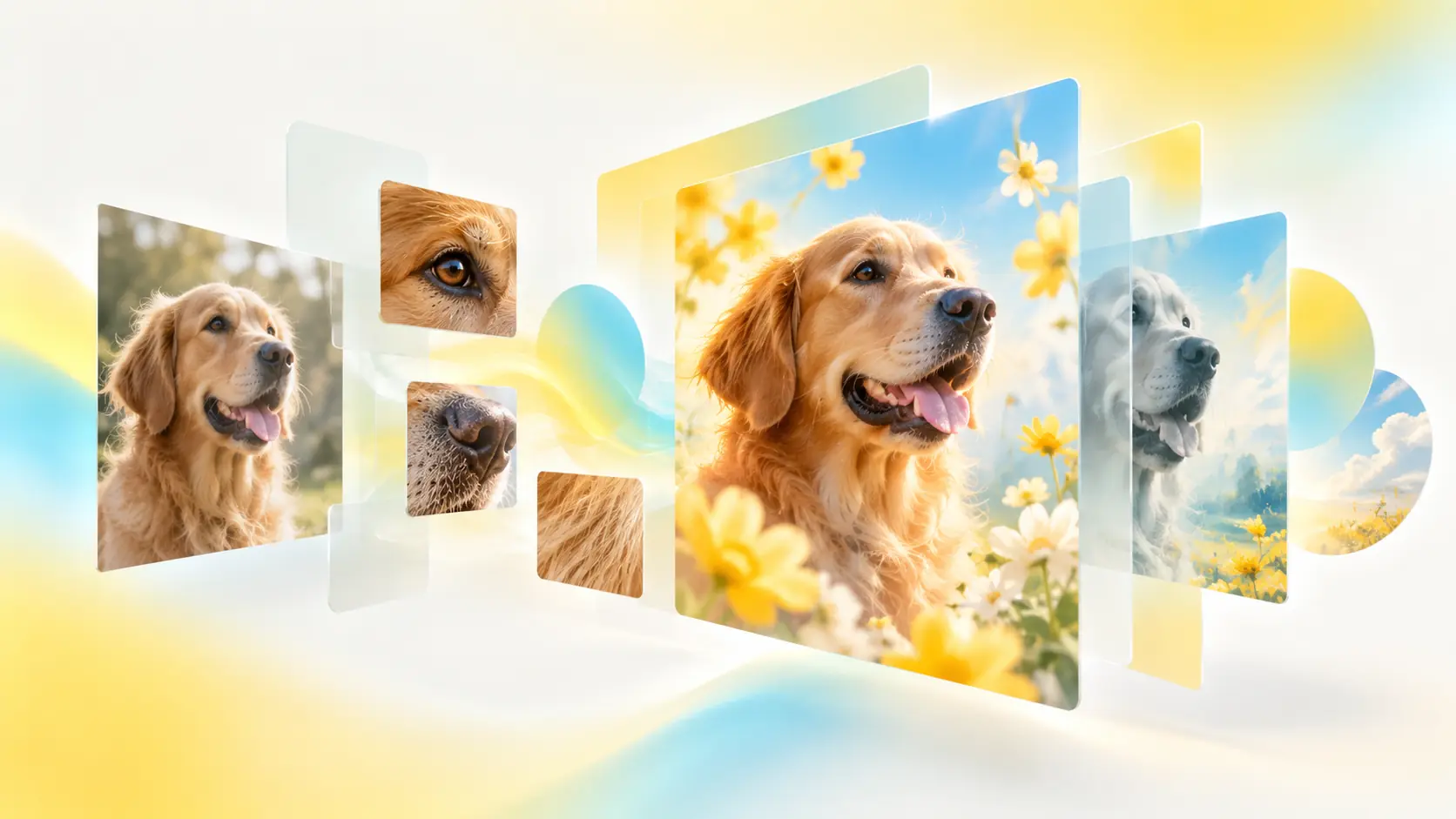
One of the main goals of Images 2.5 is to preserve the original subject more effectively when a reference photo is used. OpenAI says it delivers more natural lighting, richer textures and a better chance of keeping the distinctive characteristics of a person, animal or other subject recognizable when the setting, visual style or composition changes.
Even more important for photo editing is the model’s improved ability to understand what it should not change. A request to replace a product, background, piece of text or individual element can be carried out without unnecessarily rebuilding the rest of the image or altering its composition.
The improvement extends to multi-turn editing. During longer conversations, previous changes are more likely to remain consistent, with each new edit building on the previous state without the same degree of quality degradation. For creators producing multiple versions of an asset, this could prove more important than another simple increase in photorealistic quality.
In an early hands-on test, Axios reported noticeably stronger preservation of the likeness of people and pets across transformations. This was an external test rather than a PTTL review, but its findings point in the same direction as OpenAI’s claims.
Sketch reduces the dependence on long prompts
One of the most interesting additions is Sketch. Users can make a rough drawing directly in ChatGPT and use it as a visual guide for the final image, adding text to specify the desired style and other details.
Its significance is that spatial information no longer needs to be communicated entirely through words. A rough room layout, the outline of a piece of clothing or the position of objects in a composition can be expressed visually instead of through complicated descriptions such as “move the object on the left slightly higher and behind the other one.”
According to the official release notes, Sketch can be accessed on mobile by typing @ and selecting Sketch.
Templates, comments and prompt sharing
Images 2.5 also introduces Templates for popular formats such as posters, merchandise and product imagery. Rather than beginning every project with a blank prompt, users can select a type of creative output and then add messaging, design elements and stylistic instructions.
Users can also place comments directly on an image, allowing instructions to be connected to a specific location rather than described only through text in the conversation. On mobile, OpenAI says generated images can be opened full-screen for editing and comments.
Prompts can now be included when an image is shared, allowing other users to reuse the same creative concept with their own photographs and details.
Better layouts, styles and transparent backgrounds
OpenAI says Images 2.5 is better at understanding complex visual instructions, managing more complicated layouts and improving infographic accuracy. It also reports improvements in transparent-background generation and greater consistency when following a defined visual direction.
This is particularly relevant for content creators, designers and commercial workflows where an image has to follow a specific hierarchy, composition or brand treatment instead of functioning merely as a standalone AI-generated picture.
OpenAI also says images involving real-world information can contain more accurate content. That does not mean an AI-generated infographic or other visual should automatically be treated as a reliable factual source; the underlying information still needs independent verification.
From Images 2.0 to Images 2.5
Images 2.5 arrives only a few months after Images 2.0. As PTTL explained in its detailed coverage of ChatGPT Images 2.0, the previous major update emphasized better instruction following, composition, text rendering and reasoning capabilities.
With version 2.5, the focus shifts further toward the everyday production process: shorter waits, more stable subject identity and more surgical changes to existing images.
OpenAI claims up to 50% lower latency compared with Images 2.0. GPT-Image-2.5 Flare is positioned as the default choice for most applications, while Sunburst is designed for cases where maximum editing precision is more important, at the cost of longer generation times.
GPT-Image-2.5 Flare and Sunburst in the API
Developers now have two different options.
GPT-Image-2.5 Flare is the faster model and is intended for everyday image generation, social content, product experiences, visual search, rapid prototyping and high-volume generation. OpenAI says it provides higher-quality images than GPT-Image-2 with 50% lower latency.
GPT-Image-2.5 Sunburst is described by OpenAI as its most capable model for image generation and editing and targets workflows where editing precision matters more than speed, including polished product imagery and production-ready creative.
Both accept text and image inputs and support low, medium, high, xhigh, max and auto quality levels.
Availability and pricing
ChatGPT Images 2.5 began rolling out on September 8, 2026 across all ChatGPT tiers as well as ChatGPT Work and Codex on web, desktop and mobile. OpenAI has not announced a separate charge for Images 2.5 inside ChatGPT, while existing image-generation limits remain unchanged. Templates are not yet available in Work mode.
There is no separate Greek or European price for Images 2.5 as a ChatGPT feature. The official ChatGPT Images 2.5 product page confirms availability across all tiers.
In the API, Flare and Sunburst currently share the same official price per 1 million tokens: $5 for text input, $1.25 for cached text input, $8 for image input, $2 for cached image input and $30 for image output.
Using the latest ECB reference rate available before publication, dated September 9, 2026, when €1 equalled $1.1652, those figures convert to approximately €4.29, €1.07, €6.87, €1.72 and €25.75 respectively per 1 million tokens.
It is worth noting that the listed per-token rates for the new models are twice the equivalent GPT-Image-2 rates, which are listed at $2.50 for text input, $4 for image input and $15 for image output. That does not necessarily mean that each generated image costs twice as much, because the final cost depends on token usage and generation parameters.
Safety, deepfakes and image provenance
Greater photorealistic capability also creates greater risks. In the Images 2.5 system card, OpenAI itself acknowledges that increased realism could, without safeguards, enable more convincing deepfakes involving real people, places or events.
The system uses checks before generation, on image inputs and on the final output. OpenAI also says it continues to include C2PA provenance metadata and is adding invisible watermarking using Google DeepMind’s SynthID across ChatGPT, Codex and the API.
In OpenAI’s automated adversarial evaluations, the final unsafe outcome shown to users was 1.09% for Sunburst and 1.41% for Flare, compared with 1.64% for Images 2.0. The company stresses that these tests intentionally use challenging prompts designed to generate policy-violating content and therefore do not reflect how frequently such requests occur in normal production traffic.
What we think
Images 2.5 appears to target the point at which AI image generators begin to be judged as genuine production tools rather than machines for creating impressive one-off pictures: whether they can repeatedly edit the same asset without losing control of its composition and subject identity.
For photographers, designers and content creators, the biggest promise may not be additional photorealism but greater precision in small edits and better preservation of the source material. How reliably that works in demanding real-world projects will need to be established through independent testing. In the API, meanwhile, the higher per-token pricing means Flare’s real production efficiency will also deserve close examination.
Frequently asked questions
Is ChatGPT Images 2.5 available to free users?
OpenAI says Images 2.5 is rolling out across all ChatGPT tiers. Existing image-generation limits still apply and may differ depending on the plan.
How much faster is it than Images 2.0?
OpenAI claims up to 50% lower latency compared with Images 2.0. Actual generation times may vary depending on the request and workflow.
What is the difference between Flare and Sunburst?
Flare prioritizes speed and is intended for most everyday and high-volume applications. Sunburst targets more demanding editing workflows that require greater control, with longer generation times.
Is there an additional charge for Images 2.5 in ChatGPT?
No separate Images 2.5 fee has been announced inside ChatGPT. Through the API, Flare and Sunburst are billed according to OpenAI’s official token-based pricing.