

Summary
- Chandra observed unexpected brightness variations in supernova remnants.
- The study is based on 14 years of data from galaxy M83.
- More than 20 objects showed unusual behavior.
- Scientists are investigating the cause of the variations.
- The findings may lead to new models of supernova evolution.
NASA has announced an unexpected discovery from its Chandra X-ray Observatory that challenges what astronomers thought they knew about the evolution of supernova remnants.
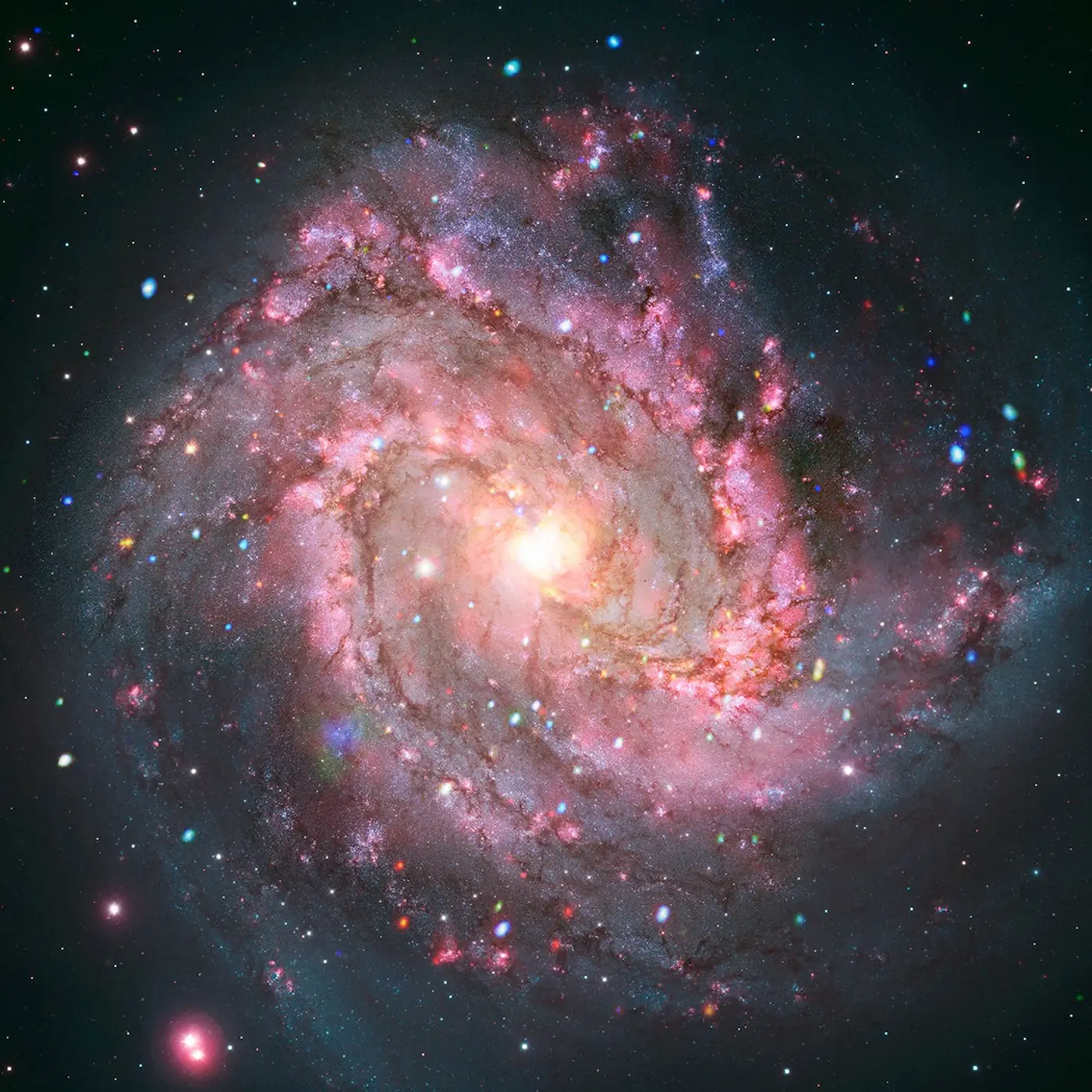
Scientists studying the nearby galaxy Messier 83 (M83) found more than 20 known remnants of exploded stars showing significant changes in their X-ray brightness. This behavior is unusual because supernova remnants are generally expected to fade gradually over time.
The discovery is based on Chandra observations spanning 14 years, from 2000 to 2014. The results were presented at the American Astronomical Society meeting in Pasadena and published in The Astrophysical Journal.
What scientists observed
Supernova remnants are the debris left behind after the explosive death of a star. They usually form clouds of extremely hot gas that emit X-rays and gradually lose brightness.
However, Chandra observations revealed that roughly half of the X-ray sources associated with supernova remnants in M83 undergo significant brightness changes, something not predicted by conventional models describing the evolution of these objects.
Possible explanations
Researchers are considering several scenarios to explain the phenomenon. One possibility is that the remnants are colliding with dense clouds of gas in their surroundings, triggering sudden changes in X-ray emission.
Another possibility is that some of these objects contain stellar remnants such as neutron stars or black holes that influence the observed radiation. Scientists continue to analyze the data to determine the exact cause of the variations.
Why M83 matters
Galaxy M83 is located about 15 million light-years from Earth and is known for its high rate of star formation. This environment produces a large number of supernovae, making it an ideal laboratory for studying the aftermath of stellar explosions.
The long-term monitoring of the galaxy by Chandra allowed researchers to detect phenomena that would be impossible to observe over shorter timescales.
What we think
The new study demonstrates that even phenomena considered well understood can still hold surprises when observed over long periods. Chandra’s findings suggest that the evolution of supernova remnants may be far more complex than astronomers previously believed.
Frequently Asked Questions
What is a supernova?
A supernova is the explosive destruction of a star, releasing enormous amounts of energy and material into space.
What is Chandra?
It is NASA’s X-ray observatory that studies some of the most energetic phenomena in the Universe.
Where is galaxy M83 located?
It is approximately 15 million light-years away from Earth.
Why is this discovery important?
Because it suggests that supernova remnants may evolve in ways not predicted by current theoretical models.