Summary
- NASA revisits Endeavour’s final ferry flight in 2012.
- Photographers and a videographer worked from escort aircraft.
- The route was planned around iconic California landmarks.
- The preparation explains how the famous pictures were captured.
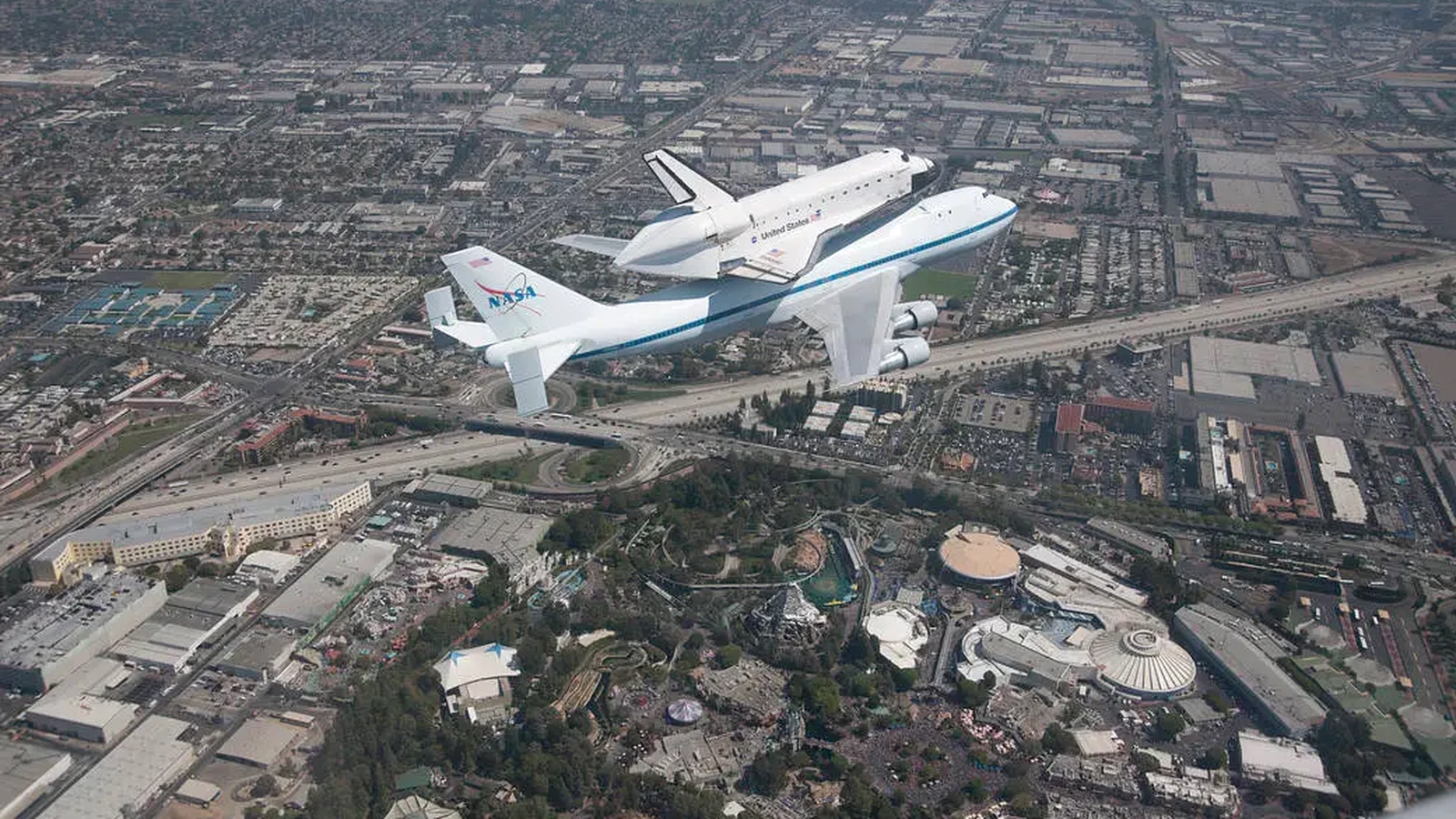
How do you photograph a space shuttle mounted on a Boeing 747 as it flies over Disneyland? NASA revisits the pictures — and the people who made them — from Endeavour’s final ferry flight.
On September 21, 2012, Endeavour made its final aircraft ferry flight atop the specially modified Shuttle Carrier Aircraft. Marking its new presentation at the California Science Center in Los Angeles, NASA published recollections on November 12, 2026 from three visual storytellers who planned and documented the extraordinary assignment.
A ferry flight turned into a photographic event
The 747 carrying Endeavour flew past landmarks including Disneyland, the Hollywood sign, Griffith Park, the Los Angeles Memorial Coliseum, Santa Monica Pier and the Golden Gate Bridge. The featured photograph over Disneyland in Anaheim was taken by Jim Ross on September 21, 2012.
The route was planned as more than a simple delivery: pilots and the imaging team coordinated the flyovers to frame the orbiter against recognizable places. Endeavour had flown 25 space missions and helped build the International Space Station.
Photography and video from fighter jets
NASA Armstrong’s imaging crew included photographers Jim Ross and Carla Thomas and videographer Lori Losey. They worked from the rear seats of escort F/A-18 and F-15 aircraft. Losey had proposed using two chase aircraft around Los Angeles, dedicating one to still photography and another to video.
Changing altitudes and positions between the airplanes was central to the compositions. The team had to place the huge 747 and orbiter against the urban landscape while all the aircraft were moving, with only a brief window to capture each frame.
The planning behind the photographs
Carla Thomas had previously flown the entire route in a Los Angeles Police Department helicopter to identify obstacles and camera angles. The Hollywood sign required particular care because of the hillside, power lines and antennas. Planning also involved the FAA, Los Angeles International Airport, the California Science Center and Johnson Space Center.
Jim Ross particularly remembers the excitement of people watching below, while Thomas recalls the crowds gathered at California’s State Capitol in Sacramento. Their stories reveal what spectacular aviation photographs rarely show: the extensive preparation behind an image that looks spontaneous.
NASA photography is not limited to aircraft operations. Even aboard the ISS, Don Pettit’s Milky Way photography illustrates how carefully planning, technique and equipment must come together.
What we think
These photographs are a great lesson in the importance of imagining the frame before raising the camera. Keeping Endeavour sharp from a moving fighter jet was only part of the challenge. The photographers had to be in exactly the right position, at exactly the right moment, with a recognizable background that could give the subject both scale and context.
Separating the stills and motion-picture crews into different aircraft also makes perfect sense to anyone who has worked on a production. When an event will happen only once, one camera position cannot always serve two very different storytelling needs. NASA treated the flyover as a carefully planned visual production, and the results make that clear.