

Summary
- Don Pettit photographed the Milky Way from the ISS Cupola using a Nikon Z9 and an Arri Zeiss 15mm lens.
- A mechanical sidereal tracker compensated for the Space Station’s movement.
- The unusually clear image prompted skepticism among some social media users.
- Camera exposure settings explain why stars are absent from many other space photographs.
- The tracker returned to the Rochester Institute of Technology after Expedition 72.
- The equipment behind the photograph
- Why the ISS’s movement creates star trails
- How the mechanical sidereal tracker works
- Images before and after using the tracker
- Why stars are not always visible in photographs from space
- Photography as part of space exploration
- What we think
- Frequently asked questions
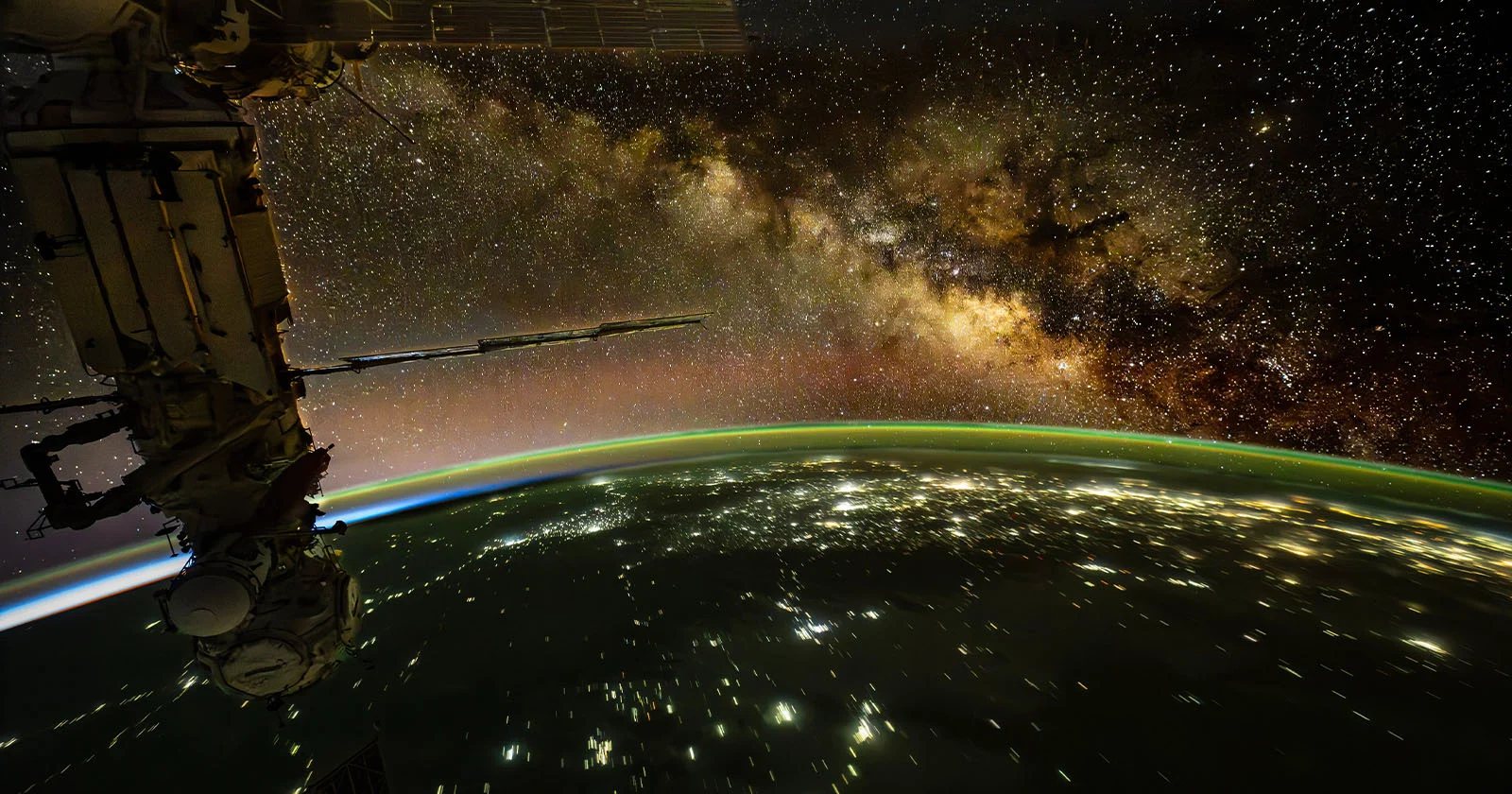
Astronaut Don Pettit has presented a striking photograph of the Milky Way from the International Space Station, explaining the custom mechanical device that allowed him to record the stars without motion trails.
Pettit published the image on July 31, 2026. It was captured from the ISS Cupola using a Nikon Z9, an Arri Zeiss 15mm lens at T1.8, and a custom-built sidereal tracking mechanism. The astronaut described it as one of his favorite photographs among the approximately 1.2 million RAW files from his latest mission.
The photograph prompted skepticism among some social media users, mainly because stars are not visible in many photographs and live broadcasts from space. The explanation lies in camera exposure settings: according to NASA, short exposures used for the bright Earth or illuminated spacecraft components usually fail to record the much dimmer stars.
I finally have all 1.2 million raw image files from my latest mission to ISS! Here is a sample of one of my favorite Milky Way photos, taken from the Cupola with Nikon Z9, Arri Zeiss 15mm lens, T1.8 with custom sidereal drive that cancelled out star motion relative to our orbit. pic.twitter.com/Sjm4UFgOs6
— Don Pettit (@astro_Pettit) July 31, 2026
The equipment behind the photograph
Pettit used a Nikon Z9 combined with an ultra-wide Arri Zeiss 15mm lens set to T1.8. The wide aperture allowed the sensor to collect more light from the night sky, but it was not enough on its own to keep the stars as clean points of light.
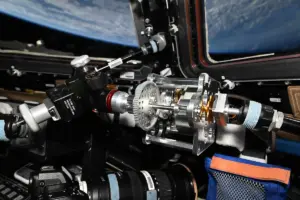
The key component was a custom mechanical tracker mounted in front of a Cupola window. It compensated for the ISS’s rotational movement relative to the star field, allowing the camera to follow distant stars during the exposure.
Why the ISS’s movement creates star trails
The International Space Station completes an orbit around Earth approximately every 90 minutes and continuously adjusts its orientation so that its underside remains pointed toward the planet.
During a long exposure, this change in orientation causes stars to appear as curves or lines instead of fixed points of light. The effect is familiar from several of Pettit’s earlier photographs, in which the Station’s movement transforms the stars into dramatic trails.
How the mechanical sidereal tracker works
The mount was built by the Rochester Institute of Technology and rotates in accordance with the ISS’s roughly 90-minute cycle. It uses a gear with between 60 and 90 teeth to compensate for the movement that would otherwise appear in the photograph.
Pettit described the device as an analog sidereal tracker powered by a rotational coil spring. It was machined from aluminum and contains no electronic systems, a design choice that helped it meet NASA’s strict requirements for electrical equipment transported to the Station.
Images before and after using the tracker
Following the reactions, Pettit published behind-the-scenes images of the mechanism on August 1, along with examples of a ten-second exposure taken before and after it was activated.
The comparison demonstrated the device’s role: without compensation, the stars became lines, while the tracker kept them noticeably more stable. After Expedition 72, the mount was returned to the Rochester Institute of Technology, where it is displayed for the public.
Before and after examples of the star tracker in use over a 10sec exposure pic.twitter.com/X00dGJXmC6
— Don Pettit (@astro_Pettit) August 1, 2026
Why stars are not always visible in photographs from space
The absence of stars from a space photograph does not mean they were outside the camera’s field of view. A camera must be exposed according to the brightest part of a scene.
When exposure is set for Earth’s bright surface, the Moon, an astronaut, or a sunlit section of the ISS, the dim stars may not be recorded at all. Longer exposures, wider apertures, and suitable motion tracking can reveal far more detail in the sky.
Photography as part of space exploration
Pettit considers photography an important way of sharing the experience of space missions with the public. This particular image combines the Milky Way, city lights on Earth’s night side, and parts of the ISS in the foreground.
Beyond its visual impact, the photograph demonstrates a practical solution to an unusually difficult imaging problem, using gears, a spring, and precise synchronization instead of electronic systems.
What we think
Pettit’s photograph demonstrates that an image that looks unusual is not necessarily fabricated. The technical description, comparison photographs, and established principles of camera exposure provide a consistent explanation for the result. Even more significant is the creative engineering solution that allowed a commercial camera to overcome the unusual challenges of orbital photography.
Frequently asked questions
Which camera was used to capture the image?
Don Pettit used a Nikon Z9 with an Arri Zeiss 15mm lens set to T1.8.
Why are stars absent from many photographs taken in space?
Exposure settings are usually optimized for the bright Earth, the Moon, or the spacecraft. Stars are much dimmer and may not be recorded with a short exposure.
How did Pettit keep the stars stationary?
He used a mechanical sidereal tracker that rotated the camera to compensate for changes in the ISS’s orientation during the exposure.
Was the mechanism electronic?
No. According to Pettit, it was an analog aluminum mechanism powered by a rotational spring and gears.
Where is the tracker now?
After Expedition 72, it was returned to the Rochester Institute of Technology, where it is displayed for the public.