Summary
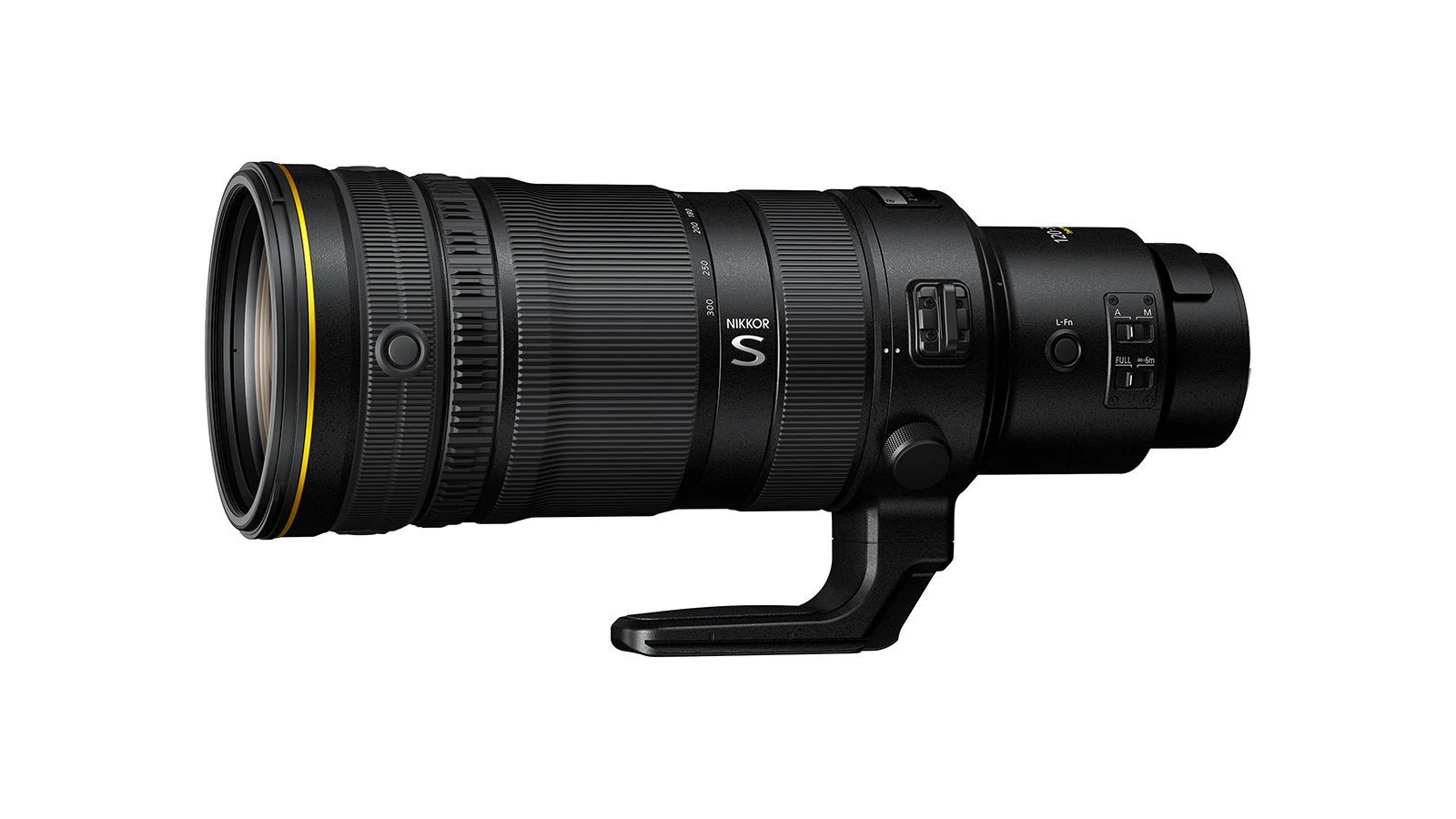
- Nikon has unveiled the professional NIKKOR Z 120-300mm f/2.8 TC VR S for Z-mount cameras.
- Its built-in 1.4× teleconverter extends the range to 420mm at f/4.
- The lens features Silky Swift VCM autofocus, up to 6.5 stops of stabilization and a weight of 2,735g.
- A French price of €15,749 has been reported, but no official Greek price is confirmed.
Nikon officially announced the NIKKOR Z 120-300mm f/2.8 TC VR S on October 29, 2026, a professional telephoto zoom that reaches 420mm through a built-in 1.4× teleconverter and is aimed primarily at sports and wildlife photographers.
This S-Line lens for full-frame Nikon Z cameras maintains an f/2.8 maximum aperture from 120mm to 300mm. Engaging the teleconverter changes the range to 168–420mm at f/4, allowing photographers to reframe quickly without taking the camera away from their eye.
From 300mm to 420mm with a switch
Nikon calls this the world’s first interchangeable zoom lens to combine a constant f/2.8 maximum aperture with a built-in 1.4× teleconverter, based on its own research as of October 29, 2026. The converter can be engaged using a control on the lens rather than removing equipment in the middle of a shoot.
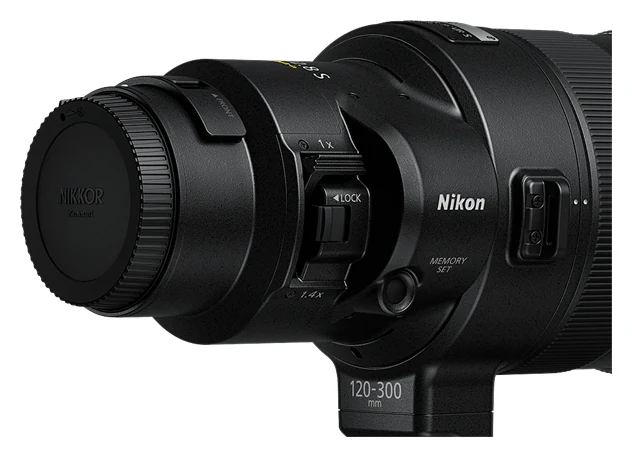
A photographer can cover a match at 120–300mm f/2.8 and extend the reach to 420mm f/4 when the action moves farther away. That saves time in the field, although the converter naturally costs one stop of maximum aperture.
Autofocus, optics and stabilization
The optical design uses 30 elements in 24 groups. Nikon’s Silky Swift VCM (SSVCM) system is designed for fast, smooth autofocus on moving subjects, while Meso Amorphous Coat and ARNEO Coat aim to reduce reflections, ghosting and flare.
Nikon rates vibration reduction at up to 6.5 stops with a compatible camera supporting Synchro VR. Both focusing and zooming are internal, so the lens stays the same length during operation, useful in restricted shooting positions and when working with a monopod or support.
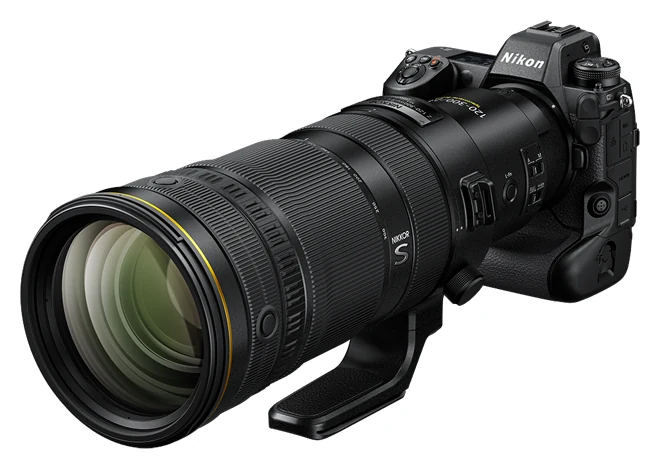
The lens is approximately 353.5mm long and 128mm in maximum diameter, accepts 112mm front filters and has an Arca-Swiss-compatible tripod foot. Minimum focusing distance varies with zoom position, from about 0.98m at 120mm to 2m at 300mm.
Lighter than the DSLR-era 120–300mm
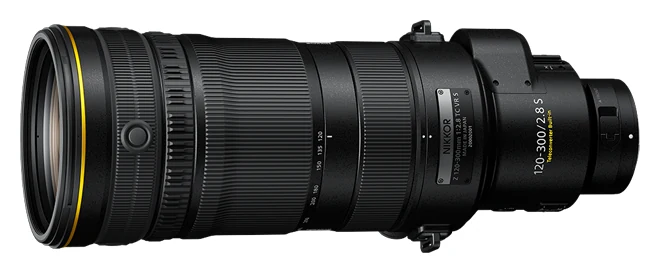
Its DSLR-era predecessor, the AF-S NIKKOR 120-300mm f/2.8E from 2020, weighed about 3,250g. The new Z-mount model is 515g lighter despite adding a built-in teleconverter.
At 2,735g this is still a substantial specialist lens, not something most photographers will carry casually all day. For press photographers, however, the weight reduction and integrated zoom/converter handling could make a meaningful difference.
Sports, wildlife and practical trade-offs
The 120–300mm range covers subjects at changing distances, from athletes on the field to unpredictable wildlife. The f/2.8 aperture is especially valuable in indoor arenas, evening events and situations that call for fast shutter speeds.

For wildlife photographers, 420mm f/4 provides additional reach without a lens swap, but a longer prime may still be better for small or very distant animals. Reach, versatility and carrying weight all matter when choosing equipment.
More information here.
Price and availability
Nikon USA lists an official preorder price of $13,999.95. A French retail price of €15,749 has been published, with availability expected from November 12, 2026, while the Japanese launch is scheduled for November 13. An official Greek price has not yet been confirmed.
What we think
For photographers shooting matches from a fixed position, this is an appealing combination. You get f/2.8 while the action is nearby, then flip to 1.4× when it moves away, without changing how you hold the camera. Sometimes the missed frame is not about having too little reach; it is about spending too long changing equipment.
At roughly €15,700 in France, this sits firmly in the territory of professional agencies, working sports photographers with demanding assignments and highly specialized wildlife shooters. It makes little sense as an upgrade solely to gain more focal length.
We like that Nikon reduced weight versus its DSLR predecessor without giving up the constant f/2.8 zoom. Even so, we would think carefully about carrying 2.7kg, the reach an assignment really needs, and the fact that the converter takes you to f/4. On some jobs the flexibility could be worth every gram; on others, a different combination of telephoto lenses may be more practical.