

Summary
- More than half of British holidaymakers retake holiday photos to get the right shot.
- 54% say they need two to three attempts for the correct image.
- 31% take at least four frames of the same scene.
- Around four in ten recent holiday photos were taken mainly for others to see.
- Popsa warns that the search for the perfect image can disconnect travelers from the actual moment.
Α new study shows that many travelers are spending more energy on capturing the “perfect” holiday photo.
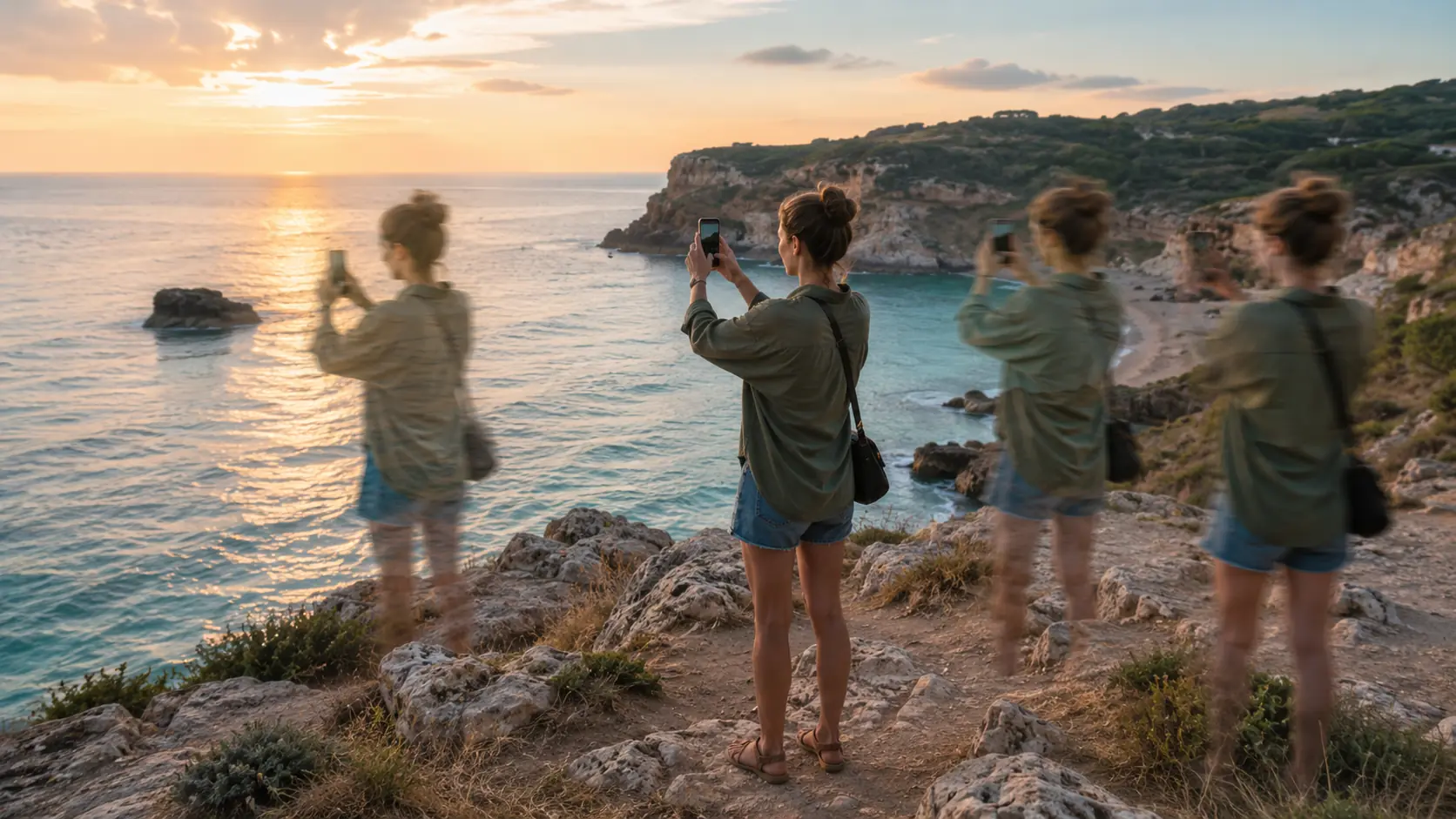
More than half of British holidaymakers appear to be caught in a loop of repeated shots, trying to get the right image instead of enjoying the moment.
The finding matters because it shows that travel photography, especially in the social media era, is not always used as a way to preserve memories, but often as a tool for public presentation.
What the study found
According to a study conducted for Popsa, a photobook creation app, 54% of the 2,000 adult respondents said they take two to three attempts to capture the “right” holiday photo.
At the same time, 31% said they take at least four frames of the same shot. Experts describe this behavior as a “holiday photo perfection loop,” a cycle in which travelers repeat a photo until they feel the image is good enough.
Photography as public image
The study also shows that travelers are not taking photos only to preserve personal memories. On average, around four out of their last ten holiday photos were taken primarily for others to see.
In fact, 10% of respondents said all ten of their last holiday photos were taken with the intention of sharing them. This shows how strongly online visibility now influences the way people photograph their travels.
Losing the moment
Liam Houghton, founder and CEO of Popsa, notes that many people are experiencing moments through the lens of how they will appear to others, rather than how they will be remembered.
According to him, the point is not to stop taking pictures. The goal is for photos to have meaning and help people relive an experience, rather than distract them from it.
What this means for travel photography
Travel photography has always been connected to memory, exploration and personal perspective. But when the shot is mainly taken for audience reaction, the way the trip is experienced also changes.
The pressure for flawless composition, the right pose and an image suitable for social media pushes many travelers into repeated takes. As a result, photography becomes less spontaneous and more part of a process of controlling one’s image.
What we think
Holiday photography has value when it keeps an experience alive, not when it turns it into a staged obligation. At pttl, we believe the best travel photo is not always the most technically perfect one, but the one that is genuinely connected to the moment.
Frequently asked questions
What is the “holiday photo perfection loop”?
It is the tendency to take repeated photos of the same moment until the photographer feels they have captured the ideal shot.
How many people took part in the study?
The study was based on responses from 2,000 adults in Britain.
How many people take multiple photos of the same shot?
54% said they need two to three attempts, while 31% said they take at least four frames.
Why is this linked to social media?
Because many travelers take photos not only for personal memories, but also for others to see through online sharing.
Should we stop taking holiday photos?
No. The issue is not photography itself, but the balance between documenting a moment and actually experiencing it.