Summary
- Nikon has withdrawn Ning Xu’s first place in Small World in Motion 2026.
- Its review found a breach of the generative AI rules.
- Nguyen Nam Nhat from Vietnam is the new winner.
- Nikon says its rules and evaluation procedures need to be revisited.
The dispute over Ning Xu’s award-winning video has ended with a new winner: Nikon has withdrawn first place in Small World in Motion 2026 after finding that the entry breached its generative AI rules.
The official statement was published on October 9, 2026, following a review of the video and supporting materials and consultation with members of the judging panel. The decision concerns Nikon’s microscopy video competition, rather than its still-photography contest.
On October 2, we reported that Nikon was re-examining the entry following concerns about AI. No final decision had been announced then. Nikon has now revised the rankings, moving original runner-up Nguyen Nam Nhat into first place.
What Nikon actually decided
Nikon says the decision concerns only the submitted video’s eligibility under the competition rules. It explicitly states that the ruling should not be taken as a judgment of the entrant’s professional reputation, scientific contributions or intentions.
That distinction matters. The statement confirms a breach of the generative AI rules, but does not publish a detailed technical assessment identifying the elements that prompted disqualification. It therefore does not substantiate a broader claim that Xu’s entire research work was fabricated.
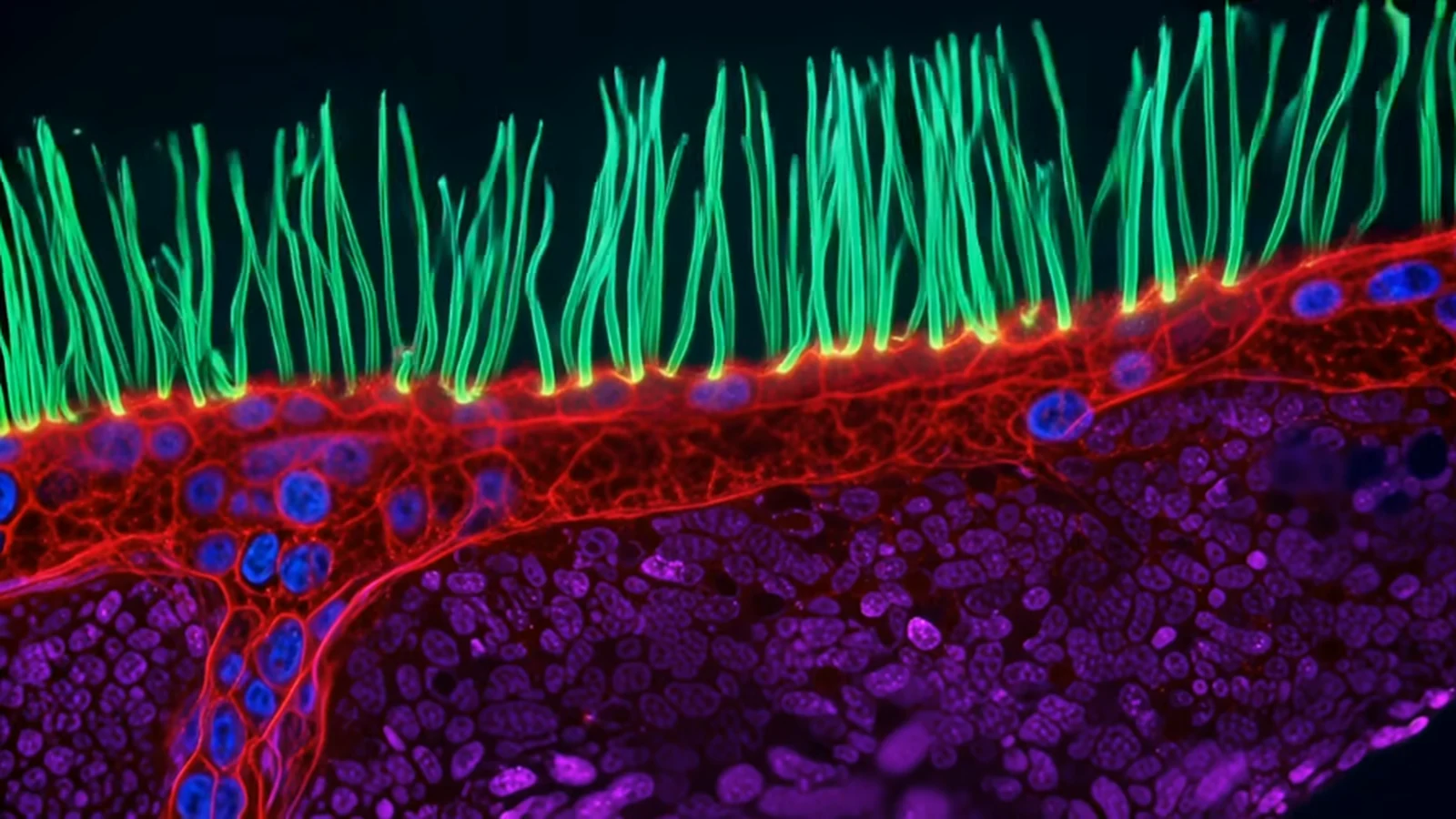
The disputed entry had been presented as footage of moving airway cilia in a child with primary ciliary dyskinesia. Earlier in the dispute, Xu acknowledged using AI during processing, while maintaining that it had not generated the original experimental video, the cilia or their movement. Nikon’s final assessment found the entry incompatible with the competition’s rules.
The new winner and revised top five
Nguyen Nam Nhat’s video, from Chu Se in Gia Lai, Vietnam, shows a tiny roundworm and a single-celled Dileptus exploring their surroundings. It was recorded using differential interference contrast microscopy, or DIC, with a 40× objective lens. The technique reveals detail in transparent specimens through differences in the optical path of light.
Watch the new winner’s video on Nikon’s official website.
| Place | Creator | Video subject |
|---|---|---|
| 1 | Nguyen Nam Nhat | Roundworm and Dileptus |
| 2 | Benedikt Pleyer | Jellyfish larvae in water droplets |
| 3 | Dr. Andrew Moore | Synchronized division of neighboring cells |
| 4 | Dr. Patrick Hickey | Mitochondria and chloroplasts in Callisia repens leaf cells |
| 5 | Dr. Igor Adameyko | A Cyerce kikutarobabai sea slug in motion |
Nikon will also revisit its evaluation process
Nikon acknowledges that rapid advances in imaging and artificial intelligence pose new challenges. It says the incident has highlighted the need to revisit the rules and evaluation procedures for both Small World and Small World in Motion. It has not yet announced a specific replacement framework or implementation schedule.
For creators entering competitions with authenticity requirements, the practical lesson is clear: keep the original material and be able to explain every processing step. Calling a workflow “AI-assisted” does not, by itself, establish that the finished work meets a particular competition’s rules.