Summary
- SynthID Detector is now available worldwide in English.
- It checks compatible watermarked content from Google and its partners.
- A negative result does not establish that a file is authentic.
An image may look convincing, but Google’s SynthID Detector looks for something the eye cannot see: a digital watermark embedded by compatible AI tools.
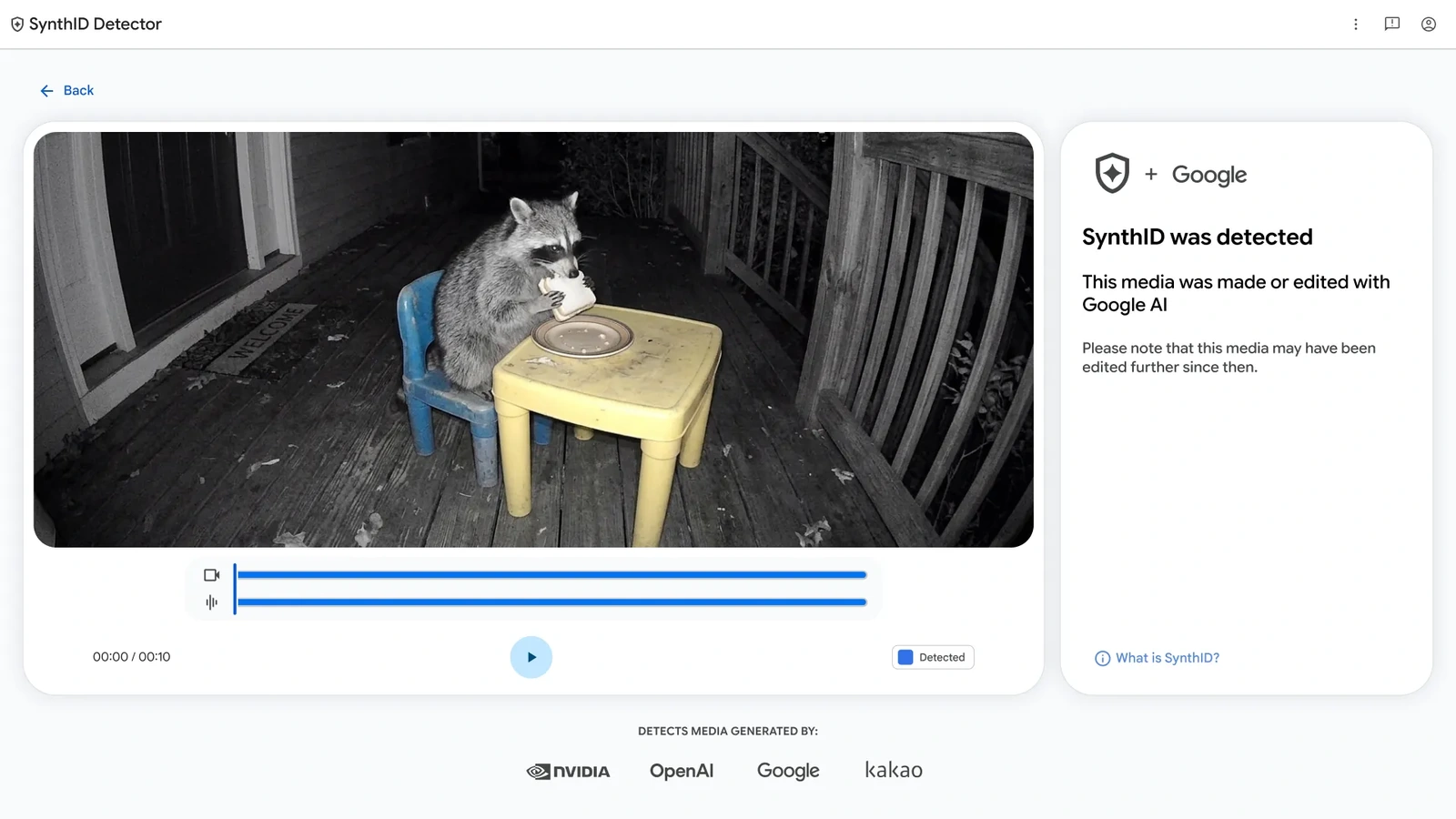
Since October 7, 2026, the tool has been available worldwide in English to check images, video and audio. The announcement names Google, OpenAI, NVIDIA and Kakao, with Apple coming soon. Users can access it through SynthID Detector.
The watermark is embedded in the content
SynthID embeds an imperceptible signal into generated media itself. It is neither a visible corner logo nor simply information stored in metadata. Google says it is designed to withstand common changes, including cropping, filters and compression, without compromising image quality.
Detector scans the file for that signal. In its original 2025 introduction, Google explained that the system could highlight image regions or audio segments where the watermark was detected. The initial release was aimed at early testers, with journalists, media professionals and researchers able to request access.
The official screenshot of the new version shows a raccoon video alongside separate visual and audio indicators. The result identifies creation or editing with Google AI, while noting that further edits may have occurred. That detail matters: detection points to the media’s origin or processing, rather than necessarily documenting the file’s entire history.
No watermark does not mean authentic
SynthID Detector is not a universal detector for every AI creation. It checks compatible, watermarked content. Naming a company as a partner does not automatically establish coverage of every historical file or every model it offers.
The signal’s resilience also has limits. Google acknowledges in its SynthID documentation that repeated alterations may prevent detection. A negative result therefore cannot, by itself, establish that a photograph depicts a real scene or that a video is unedited.
Scale and practical value for creators
According to Google, SynthID has been applied to more than 180 billion images and videos, as well as 240,000 years of audio. The company also says its built-in verification features in Search, Gemini and Chrome regularly handle more than one million requests a day.
For photographers, filmmakers and editors receiving third-party media, this adds a specific check before using it. In our view, it becomes more useful when combined with tracing the original source and examining the original file: Detector’s result is one piece of evidence, not a reason to end the investigation.