

Summary
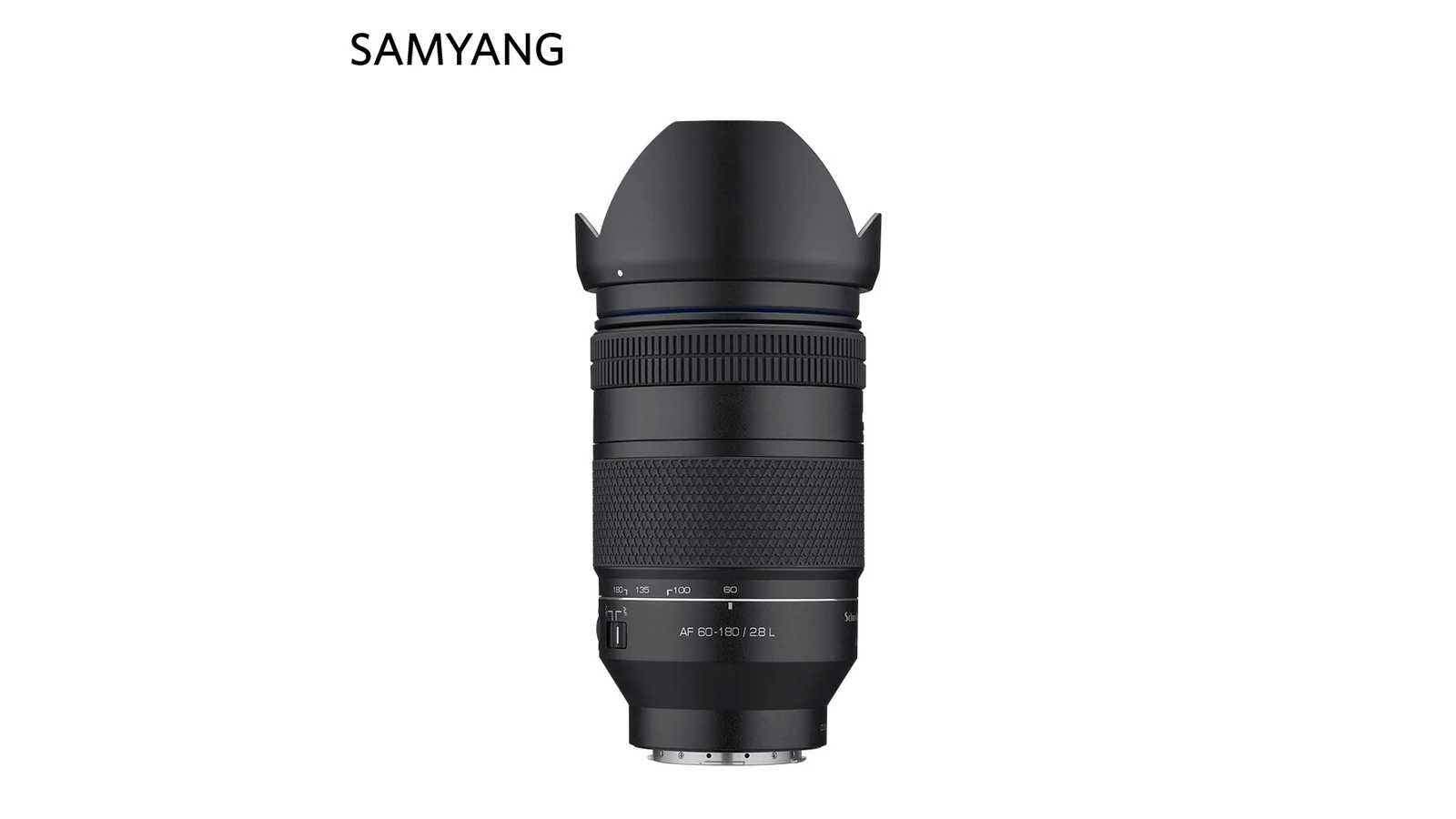
The Samyang AF 60-180mm F2.8 is expanding to L-Mount, combining a constant f/2.8 aperture with a weight of only 727.8 grams in a system where more affordable fast telephoto options remain limited.
The full-frame autofocus zoom was co-engineered by LK Samyang and Schneider-Kreuznach and forms the telephoto part of the Compact Zoom Series. With the 14-24mm F2.8, 24-60mm F2.8 and 60-180mm F2.8, the range can now provide continuous 14-180mm coverage through three fast zoom lenses.
The L-Mount version is intended for full-frame Leica, Panasonic Lumix and Sigma bodies. Its recommended European price is €1,049 including VAT, with availability expected in early September. A separate official Greek price or exact local release date has not been announced.
A different rival to the 70-200mm F2.8
Samyang does not copy the established 70-200mm range exactly. It begins at 60mm, providing a slightly wider view for environmental portraits, events and video, but ends at 180mm. The missing final 20mm is exchanged for substantially lower weight and smaller dimensions.
Many traditional 70-200mm F2.8 lenses exceed one kilogram. At 727.8 grams, the Samyang is easier to use through a long wedding, travel assignment, documentary or handheld video shoot. The practical trade-off is whether the photographer regularly needs the additional reach from 180 to 200mm.
Key specifications
| Coverage | Full-frame L-Mount |
|---|---|
| Focal range | 60-180mm |
| Aperture | f/2.8 to f/22 |
| Optical construction | 17 elements in 14 groups |
| Special elements | 1 HR, 7 ED and 2 aspherical |
| Diaphragm blades | 9 |
| Minimum focus | 0.35m at 60mm / 0.79m at 180mm |
| Maximum magnification | 0.26x at 60mm / 0.21x at 180mm |
| Filter | 77mm |
| Length | 147-172.4mm |
| Weight | 727.8g without caps and hood |
The optical design includes seven ED elements for chromatic-aberration control, two aspherical elements and one HR element. UMC coating is used to reduce reflections and ghosting.
Floating focus and close-up capability
The lens uses a floating focus system in which element groups move in different relationships during focusing. The aim is to maintain optical performance from close focus to infinity rather than optimising the design for only one distance.
At 60mm it focuses from 0.35 metres and provides 0.26x magnification, approximately 1:3.8. It is not a macro lens, but allows useful close frames of details, food, small products and portrait features without changing lenses. At 180mm, minimum focus increases to 0.79 metres with 0.21x magnification.
Autofocus and handling
Focusing uses a Linear STM motor intended to provide fast and smooth movement for stills and video. The barrel includes an AF/MF switch, AFL button and zoom lock, while the focus ring allows direct manual intervention depending on camera operation.
Samyang specifies weather sealing against moisture, light rain, snow and dust. This does not make the lens waterproof, but improves practicality outdoors. The official specifications do not list built-in optical stabilisation, so stabilisation depends on the camera body or physical support.
Why it matters for L-Mount
L-Mount offers strong premium choices, but fewer affordable full-frame f/2.8 telephoto zooms than Sony E-mount. Samyang’s arrival increases competition in a category widely used by professional photographers and hybrid creators.
The 60-180mm can pair with the 24-60mm F2.8 without a gap and with the 14-24mm F2.8 to create a three-lens 14-180mm kit. The Compact Zoom Series prioritises portability rather than preserving the traditional 24-70mm and 70-200mm boundaries.
Price and availability
The Samyang AF 60-180mm F2.8 L on the manufacturer’s official product page is expected in Europe from early September, with a recommended retail price of €1,049 including VAT.
The final price and exact release date at Greek retailers may differ according to distributor and stock. No dedicated Greek price has been announced so far.
What we think
The Samyang 60-180mm F2.8 has a clear identity: it sacrifices 20mm at the long end to cut weight considerably and keep the price below many professional alternatives. For travel, events and hybrid work, that may be more meaningful than the familiar 70-200mm label. The final assessment will depend on autofocus performance, sharpness at f/2.8 and focus-breathing control.
Frequently asked questions
Which cameras is it designed for?
Full-frame and APS-C L-Mount bodies from Leica, Panasonic Lumix and Sigma.
Does it keep f/2.8 throughout the zoom range?
Yes. The maximum aperture remains f/2.8 from 60 to 180mm.
Does it have optical stabilisation?
The official specifications do not list a built-in optical stabilisation system.
How much does it cost in Europe?
The recommended price is €1,049 including VAT, with availability from early September.