Summary
- The Seestar S30 Plus combines telephoto and wide-angle 2K cameras.
- It features 30 mm APO optics, FITS and app-controlled tracking.
- It weighs 1.65 kg and includes 64 GB of storage.
- Its European list price is €499, with a current €474 promotion.
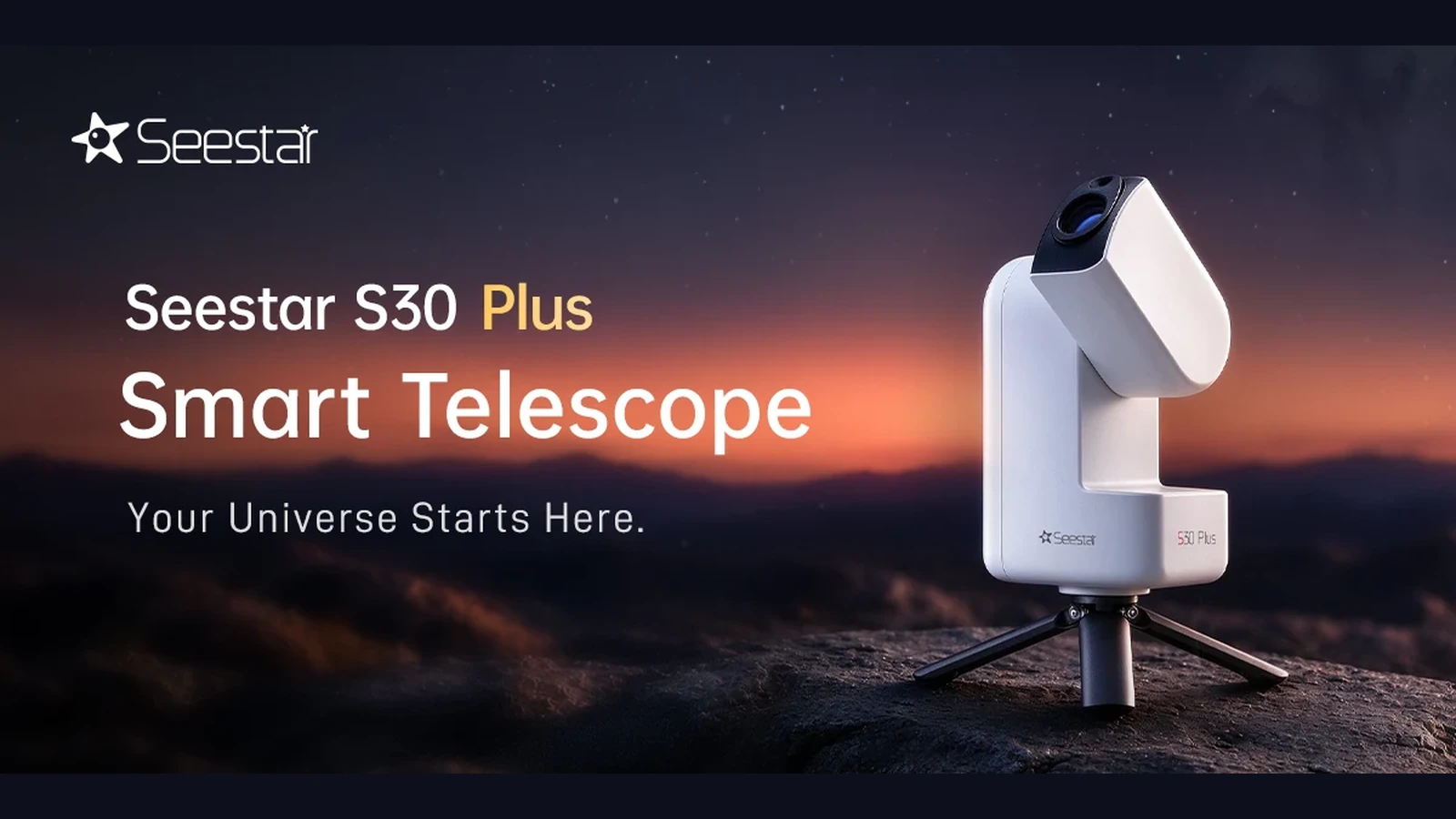
Astrophotography is getting more accessible with ZWO’s Seestar S30 Plus, a portable smart telescope featuring two 2K cameras, automatic celestial tracking and an official European list price of €499.
Announced internationally on November 10, 2026, the model combines a telephoto system for nebulae and galaxies with a separate wide-angle camera for the Milky Way, constellations and star trails. Control, image capture and basic processing all run through the Seestar smartphone app.
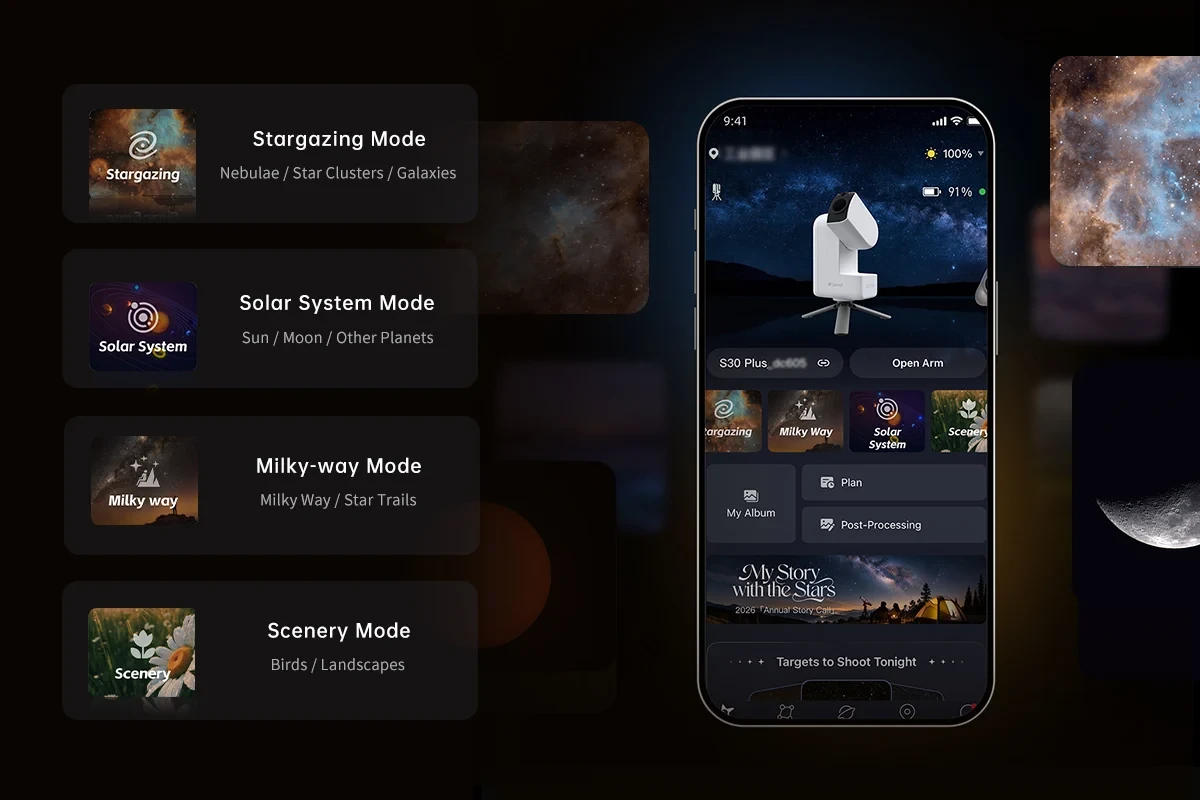
Two cameras, two different views
The main telephoto camera uses a 1/1.8-inch-type SC485SL sensor and produces 1440×2560-pixel images. Its four-element apochromatic optical system with ED glass has a 30 mm aperture, 160 mm focal length, f/5.3 focal ratio and a field of view of approximately 3 degrees. It is designed for nebulae, star clusters, galaxies and the Moon.
The second camera uses a 1/2-inch-type Sony IMX586 sensor and produces cropped 1440×2560-pixel portrait images. Its 6 mm f/1.75 lens covers a 43.5-degree field for wide nightscapes, sections of the Milky Way and star trails. These are separate shooting modes, not simultaneous capture from both cameras.
From choosing a target to exporting an image
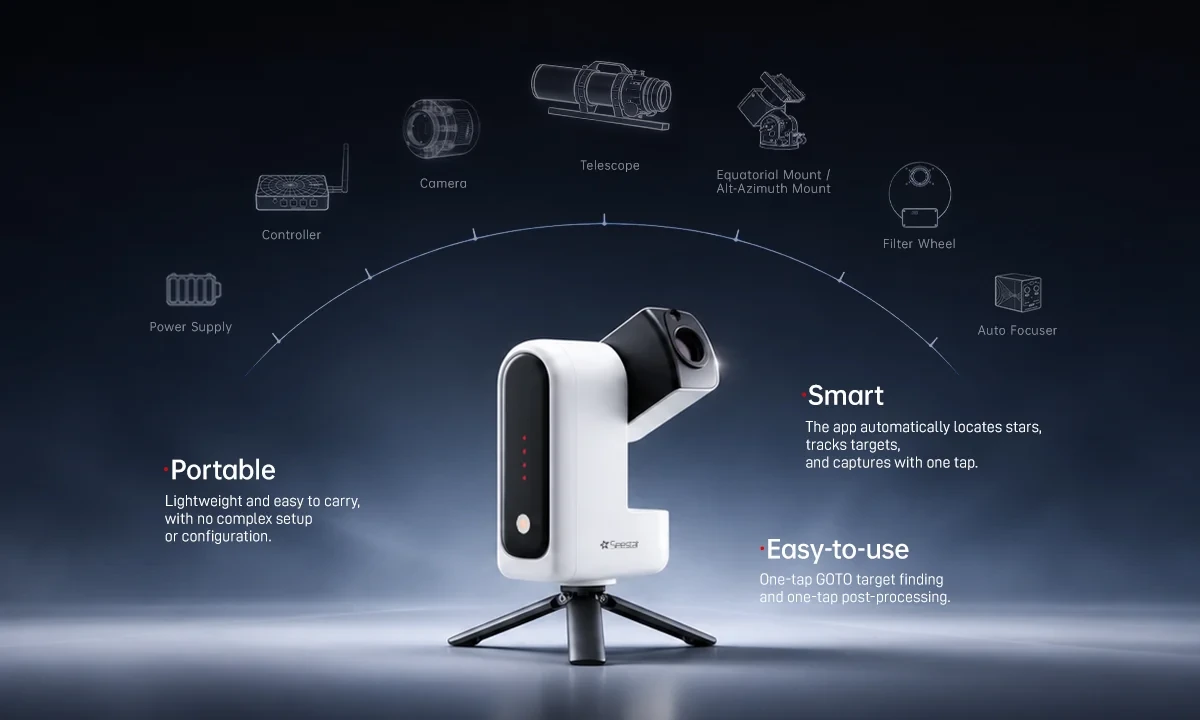
The app handles GoTo target selection, automatic centering, focusing, tracking and live stacking of successive exposures. It also supports constellation identification, Plan Mode automated sessions, mosaics for wider framing, Equatorial Mode and remote operation.
JPEG files are convenient for quick sharing, while FITS files let photographers perform their own calibration, stacking and processing using dedicated software. The built-in OIII/Hα dual-band filter is useful for emission nebulae under light pollution, but it does not benefit every astronomical subject in the same way.
Portability and what is included
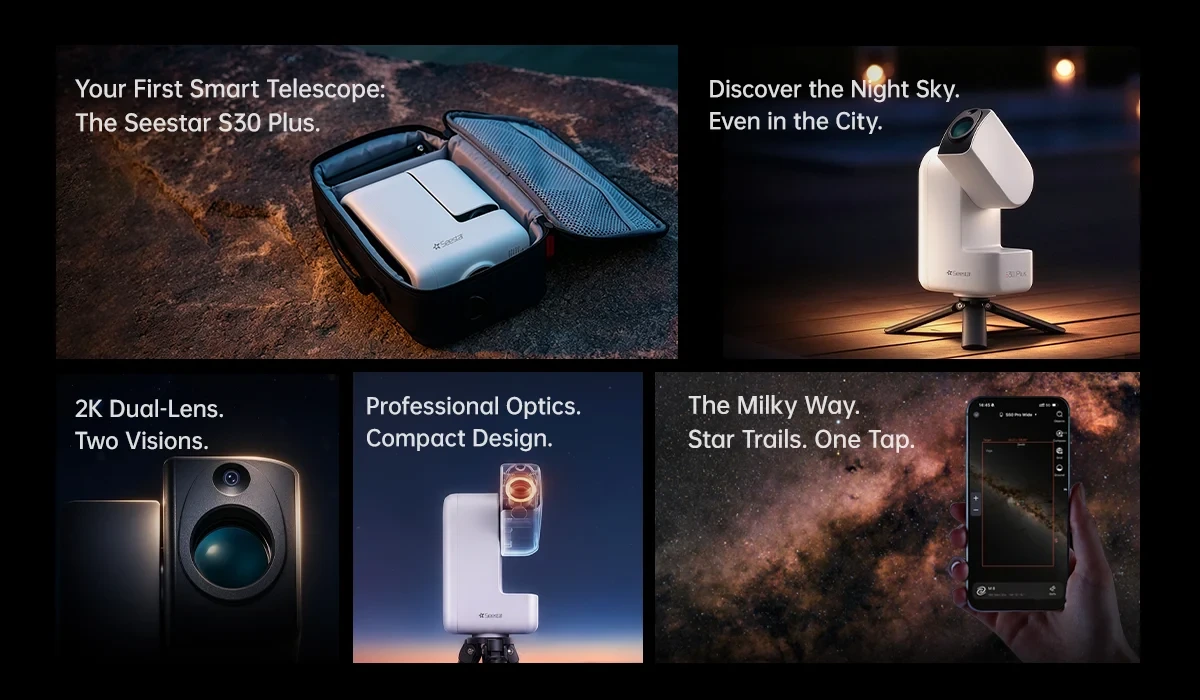
The telescope weighs 1.65 kg without its tripod and measures 210×140×80 mm when folded. It has 64 GB of built-in storage, with roughly 45 GB available to users, and a 6,000 mAh battery rated for up to six hours. Connectivity includes Wi-Fi, Bluetooth, NFC and USB-C.
The package includes an aluminum tripod, carrying case, magnetic solar filter, USB-C cable and guides. Solar observation must only be performed with the correctly fitted dedicated filter. Milky Way photography still benefits substantially from truly dark skies despite automated capture features.
Seestar S30 Plus versus S30 Pro
The S30 Plus mainly targets buyers seeking a lower entry price. The S30 Pro offers 4K resolution, a larger 1/1.2-inch-type 8.3 MP telephoto sensor, a 63-degree wide-angle field, 128 GB of storage and simultaneous dual-camera operation. The Plus is limited to 2K, 43.5 degrees and 64 GB. Both share a four-element apochromatic telephoto optical design.
Within the same range, the larger Seestar S50 Pro and its 50 mm optical system serve a different performance and price bracket, particularly for gathering light from faint targets.
More information here.
Price and availability
The official European list price is €499. On November 15, 2026, Seestar’s EU store displayed a promotional price of €474 and a preorder notice indicating shipping within seven days in order of receipt. Orders ship from a warehouse in Germany, with VAT included in the listed price.
What we think
For someone starting astrophotography, pressing the shutter is rarely the hardest part. Finding a target, setting up the mount, keeping stars tracked and then learning stacking takes work. The S30 Plus puts that workflow into one device and one app. That is a genuine practical benefit for beginners.
We especially like the fact that it does not force users to stop at a finished JPEG. FITS files provide a path toward more deliberate processing and a better understanding of what goes into the automated image.
If you already shoot the Milky Way regularly and need wider compositions or more room to crop, the S30 Pro has a clear advantage. The S30 Plus makes more sense as a first telescope or a light secondary travel setup than as an automatic replacement for an established astrophotography rig.
Frequently asked questions
Can I process the files myself?
Yes. The S30 Plus saves JPEG and FITS files, allowing further processing outside the app.
Can I photograph the Sun?
Yes, but only with the dedicated magnetic solar filter correctly installed according to Seestar’s instructions.
Is a tripod included?
Yes. The kit also includes a carrying case, solar filter and USB-C cable.