Summary
- The FCC conditionally authorised SpaceX’s Starmind with up to one million satellites.
- It imposed no additional conditions for optical astronomy.
- ESO projections indicate serious impacts on astronomical observations.
- Protecting the natural night sky requires binding rules.
On 25 November 2026, the US Federal Communications Commission (FCC) conditionally authorised SpaceX’s Starmind, a network of up to one million satellites in low Earth orbit designed to serve as orbital data centres for computing workloads, including artificial intelligence. The licence covers backup and emergency radio communications for a system whose primary communications will rely on optical links.
If the project is realised, the change will affect far more than astronomers. It will affect everyone who looks up at the sky and every photographer who tries to capture starlight without human interference. ESO explains what is at stake in this video.
https://www.eso.org/public/videos/eso2607a/
One million satellites
The decision specifies orbital altitudes ranging from 500 to 1,002 kilometres. To retain its licence, SpaceX must operate its first satellite by 25 November 2033, 10% of the network (100,000 satellites) by 2035, 50% by 2038 and the entire network by 25 November 2040. These are licensing deadlines, not a guarantee that the project will be realised.
The question is no longer whether there is room for a few thousand more satellites. It is whether we can accept an intervention on this scale in a natural environment visible from across the Earth.
Protecting the sky is not the priority
The FCC rejected the American Astronomical Society’s (AAS) petition to deny the application. It considered SpaceX’s commitment to coordinate with the National Science Foundation (NSF) sufficient and imposed no additional conditions to protect optical astronomy.
The FCC did not require further environmental review under the US National Environmental Policy Act (NEPA), and treated the AAS’s concerns about satellite heat emissions and infrared astronomy as falling outside the radio communications it regulates.
That is the most troubling aspect of the decision: the limited remit of a national regulator does not confine the real-world consequences of its choices to national borders.
The sky we are already losing
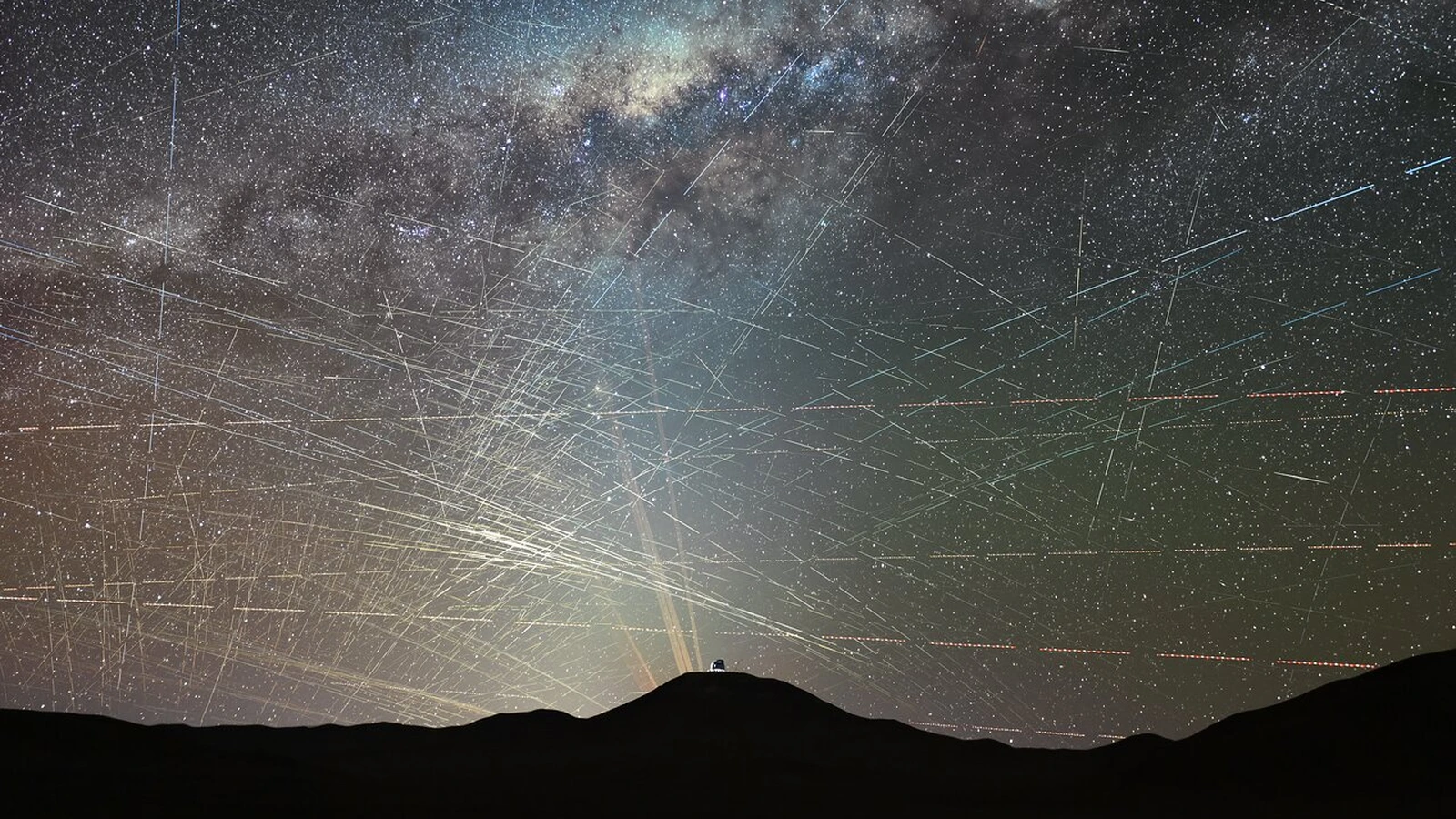
The photograph accompanying this article combines frames from a time-lapse recorded on 15 October 2025 in Chile’s Atacama Desert. It shows one hour of crossings, roughly two hours after sunset. Most trails come from satellites, with some produced by aircraft.
Even in such a remote area, far from city lights, the photograph reveals the extent of the interference that has already occurred. It does not depict the future Starmind network. It depicts a sky that existed before its approval.
What astronomers are warning about
In a study presented by the European Southern Observatory (ESO) in July 2026, astronomer Olivier Hainaut estimated that, with the full SpaceX constellation in orbit, images from the Very Large Telescope about two hours into the night could contain dozens of satellite trails and lose up to 28% of their field of view, even if the satellites were invisible to the naked eye. The simulation concerns the FORS2 instrument and those specific observing conditions, not every photograph of the sky.
Hainaut also notes that satellite light can raise the brightness of the sky background even when individual trails cannot be distinguished. He suggests an indicative ceiling of around 100,000 satellites in total, all fainter than apparent magnitude 7. He does not present this as an absolute safety threshold.
What this means for photography and video
In astrophotography, a satellite crossing the frame during a long exposure leaves a bright trail. Combining multiple exposures (stacking) can help reject those lines, provided there is enough uncontaminated data. As crossings become more frequent, however, collecting clean material becomes harder.
In night-time time-lapses, trails change from frame to frame. Removing them requires additional processing and may disrupt the natural continuity of a shot. An increase in background brightness is even harder to address: simply deleting lines cannot recover information that was never captured with sufficient signal in the first place.
What we think
The night sky does not belong to SpaceX, the FCC or any artificial intelligence company. It is humanity’s shared natural and cultural heritage. Its protection cannot be left solely to corporate commitments.
Artificial lighting in our cities has already deprived millions of people of the experience of a star-filled sky. Now we risk taking that experience away even from those who travel to the darkest places on the planet. It is unacceptable to treat our ability to observe the universe as collateral damage of technological development.
We need internationally agreed, binding limits on satellite numbers and brightness, independent measurements and assessments of cumulative effects before networks like this are deployed. The responsibility for protection should not be shifted onto astronomers, photographers and their editing software.
Otherwise, the photographs we take today of a natural star-filled sky may one day become historical documents of a world we chose to lose. And that is a sky we should never have to say goodbye to.