

Summary
- Spielberg gave Reece Feldman a tour of the non-public Amblin Hearth Archives
- The video reveals original items from E.T., Schindler’s List, Close Encounters, Indiana Jones and Jurassic Park
- The director traces the transition from models and practical effects to early CGI and Jurassic Park
- He accepts certain uses of AI but rejects using it to replace artists
- Disclosure Day is available digitally while North American 4K UHD Blu-ray and DVD editions arrive August 25 2026
- E.T.’s bicycle, the typewriter and Indy’s whip
- A compact lesson in the evolution of visual effects
- How storyboards helped keep Raiders on schedule
- Spielberg draws a clear line on artificial intelligence
- The archive preserves more than props
- Disclosure Day, UAPs and current availability
- What we think
- Frequently asked questions
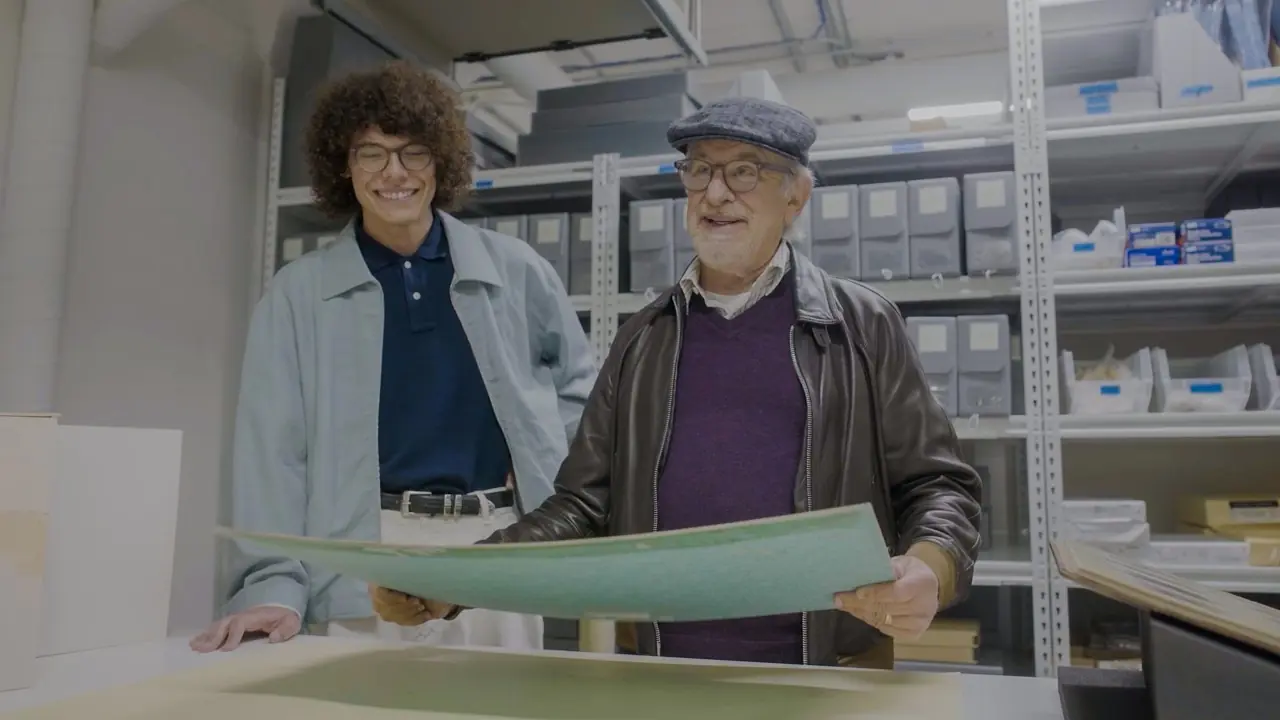
Steven Spielberg gave Reece Feldman a tour of the Amblin Hearth Archives, revealing decades of original props, artwork and filmmaking material while also laying out a clear position on the use of artificial intelligence in creative work.
The rare visit to the archive, which is not open to the public, moves from Elliott’s bicycle in E.T. and the typewriter from Schindler’s List to Raiders of the Lost Ark storyboards, Indiana Jones’ whip, Jurassic Park maquettes and items from Disclosure Day. Feldman’s video effectively becomes a guided tour through the physical history of Spielberg’s filmmaking career.
The importance of the material goes beyond nostalgia. The objects reveal cinema’s transition from handmade models, practical lighting and painted concept art to early computer graphics and eventually the digital creatures of Jurassic Park. It is inside this environment that Spielberg connects the creative history of filmmaking with today’s debate over generative AI and the role of the human artist.
E.T.’s bicycle, the typewriter and Indy’s whip
The tour begins with one of the most recognizable objects in Spielberg’s filmography: Elliott’s bicycle from E.T. the Extra-Terrestrial. Spielberg explains that during production, objects like this are simply treated as tools needed for a scene. Only the success of a film and the passage of time can transform them into pieces of cinema history. He also acknowledges that nostalgia is one reason he kept props, costumes and even vehicles from his productions.
The tour then reaches the distinctive tooth-shaped Jaws slate, whose original idea, Spielberg recalls, came from Bernie Adler. The archive also contains the typewriter used by Stern, the character played by Ben Kingsley in Schindler’s List. Later, Feldman is allowed to hold an original whip used in the first Indiana Jones film.
The collection does not contain everything, however. Near the end of the tour, Spielberg says that the Ark of the Covenant from Raiders is with George Lucas, while he has one of the fertility idols made for the movie.
A compact lesson in the evolution of visual effects
The material from Close Encounters of the Third Kind is particularly revealing. Spielberg shows models built before the modern digital era, explaining that in several cases the way real lights on the miniatures photographed was more important than extreme surface detail. The archive also contains original artwork by Ralph McQuarrie. The film’s large mothership model has been preserved by the Smithsonian National Air and Space Museum.
An even more intriguing detail concerns early CGI. Spielberg recalls that a computer-generated test was produced for Close Encounters in which a UFO travelled above a baseball stadium. According to him, generating that single shot required roughly two months of computer processing, and the result was not considered mature enough for inclusion in the finished film.
A few decades later, the Jurassic Park dinosaur maquettes show how dramatically the process had changed by the early 1990s. Industrial Light & Magic created physical maquettes that were then scanned so their shape, anatomy and even coloration could feed into the computer-generated creatures. It represents a fascinating transitional stage: the final image was digital, but it still began with a tangible object made by human hands.
How storyboards helped keep Raiders on schedule
The Raiders of the Lost Ark storyboards reveal another side of filmmaking. Spielberg explains that he sketched every sequence himself in simple form, with artists then transforming those drawings into more detailed storyboards.
The reason was highly practical. After earlier productions had exceeded their schedules and budgets, he had promised George Lucas that Raiders would stay within the agreed limits. Spielberg recalls being given an 84-day shooting schedule and completing the film in roughly 73 days, crediting extensive storyboard preparation as a major part of that efficiency.
For image-makers, this part of the tour is particularly useful. Storyboarding is not presented as a decorative stage of production but as a tool for turning visual intent into concrete decisions involving time, cost, shots and execution.
Spielberg draws a clear line on artificial intelligence
The most timely moment arrives when the discussion returns to the artwork stored in the archive. Spielberg stresses that everything around them was created by artists with their own visual perspective, and that even material feeding generative AI systems ultimately originates in human-made work.
His position is not a blanket rejection of the technology. Spielberg says he is not opposed to certain uses of AI, but draws a firm line when the technology is used to replace artists and their individual way of seeing the world.
The setting matters. He is not making the statement during an abstract software discussion but while surrounded by decades of concept art, models, sketches, costumes and handmade objects. The archive itself becomes a physical illustration of what he means by human creative identity.
The archive preserves more than props
The tour also reveals that archival work is not limited to storing objects. The Amblin Hearth Archives carry out in-house digitization of film material, including small-gauge film and some of Spielberg’s earliest 8mm work.
In one of the video’s most personal moments, Spielberg watches footage he shot as a teenager with his sisters. Film Stories notes that his reaction suggests he had not seen the material in decades. The scene highlights a less glamorous but essential role of a film archive: preserving fragile analogue material and transferring it into modern formats so it remains accessible.
The existence of an organized historical archive for Spielberg and Amblin is not new. Filmograph says DreamWorks Studios and Amblin Entertainment commissioned it to develop the visual identity for Spielberg’s historical archive department.
Disclosure Day, UAPs and current availability
The video was made around Disclosure Day and includes costumes and props from the movie, among them the off-world device that plays an important role in the story. Spielberg avoids revealing major plot details, stressing that the film itself was designed as a mystery.
While discussing UAPs, Spielberg also expresses his personal belief that there are people for whom the phenomenon is not a mystery, connecting that idea with the film’s whistleblower theme. This is Spielberg’s personal position, not scientifically confirmed evidence of extraterrestrial life. His long-standing interest in UFO reports and the historical background behind Close Encounters have also been extensively documented by Smithsonian.
Disclosure Day opened in theaters on June 12, 2026, and Universal now offers the movie for digital purchase or rental in supported markets. In North America, Universal Pictures Home Entertainment has scheduled its 4K UHD, Blu-ray and DVD editions for August 25, 2026. The home release also includes more than 50 minutes of material on the making of the film and a feature celebrating the Spielberg–John Williams collaboration. The announcement does not separately confirm a Greek physical release.
What we think
The real value of this tour is not simply that it reveals famous objects from historic movies. Placed next to one another, these artifacts show how the creation of cinematic images evolved: from miniatures, practical lights and painted concepts to CGI, digital preservation and now generative AI.
Spielberg’s position on AI carries greater weight precisely because he expresses it inside such an archive. Technology keeps changing, and he does not reject its use as a tool. What he defends is the human creative decision behind the final result. For photographers, filmmakers, designers and VFX artists, that may be the most important idea the video leaves behind.
Frequently asked questions
What are the Amblin Hearth Archives?
They are the historical archives preserving material from Steven Spielberg’s and Amblin’s filmmaking history, including props, costumes, artwork, storyboards and film. They do not operate as a public museum.
Which famous objects appear in the video?
Among them are Elliott’s bicycle from E.T., the Schindler’s List typewriter, models and artwork from Close Encounters, Raiders of the Lost Ark storyboards and a whip, and Jurassic Park dinosaur maquettes.
What did Spielberg say about AI?
He did not reject every use of artificial intelligence, but clearly opposed using it to replace artists and their individual creative perspective.
Was CGI used in Close Encounters of the Third Kind?
According to Spielberg, at least one early CGI test featuring a UFO above a baseball stadium was produced, but it did not appear in the finished movie. The film’s effects primarily relied on physical models, lighting and photographic techniques.
When is Disclosure Day coming to 4K UHD and Blu-ray?
Universal Pictures Home Entertainment has announced a North American 4K UHD, Blu-ray and DVD release for August 25, 2026. Other markets may follow different release schedules.