

Summary
- The video was recorded in Spain on August 12, 2026, at 8:28 p.m.
- local time
- A bright streak crossed in front of the Sun while the eclipse was in progress
- The Perseid peak made a meteor a plausible initial explanation
- The short angular trail and its brightness behavior raised doubts
- Cross-referencing flight data showed that it was an airplane contrail
A bright streak that crossed in front of the Sun while the recent solar eclipse was in progress in Spain looked like a strong candidate for a Perseid meteor, but NASA ultimately found a much more terrestrial explanation.
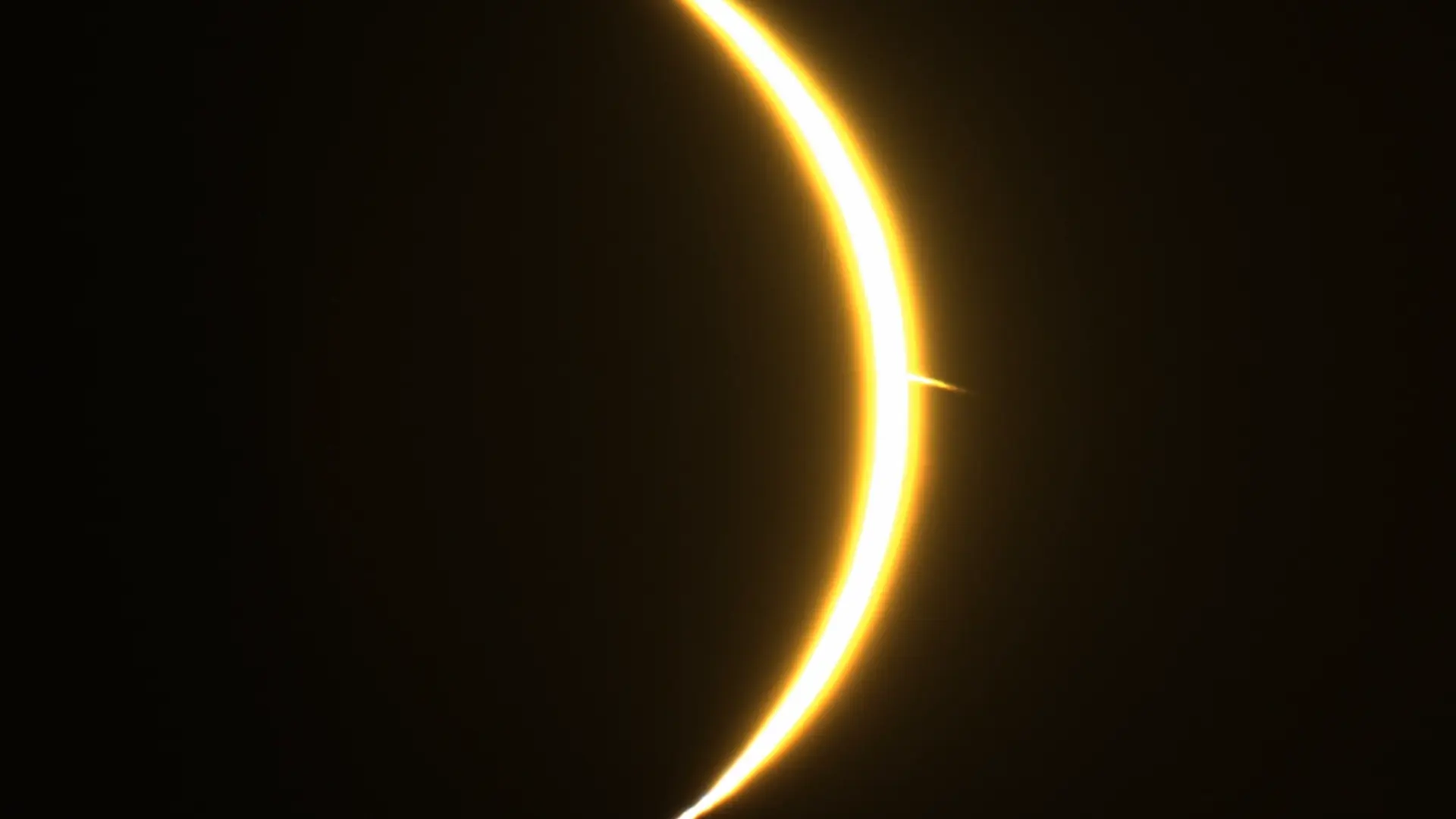
The video, selected by NASA as the Astronomy Picture of the Day for August 19, 2026, was recorded by Juan Pablo Castañeda in Spain on August 12 at 8:28 p.m. local time, at 24 frames per second. As the Moon covered part of the solar disk, a thin bright streak crossed in front of it, understandably raising the possibility that a meteor had been captured.
The timing made that hypothesis even more convincing: the August 12 total solar eclipse took place that same day, while the Perseid meteor shower was around its maximum activity. The initial impression, however, began to fall apart when researchers examined the apparent path of the streak, its brightness and independent aviation flight data.
Why it looked like a Perseid
The possibility of a meteor was not based solely on the streak’s appearance. NASA notes that if its apparent trajectory were traced backward, it could potentially be associated with the Perseids’ radiant in the region of the constellation Perseus.
Meteors belonging to a shower appear, because of perspective, to originate from a common region of the sky even though the actual particle trajectories are nearly parallel. Just one day earlier, PTTL covered NASA’s 2026 Perseid composite selected as an APOD, where this geometry is particularly easy to see.
The timing was also ideal for creating confusion. The International Meteor Organization states that the Perseids are active from July 17 through August 24, with maximum activity on August 13 and a characteristic entry velocity of about 59 km/s.
The details that did not fit
The first major clue against the meteor hypothesis was the length of the streak. According to APOD, its apparent path across the sky was shorter than the roughly 0.5-degree angular diameter of the Sun and Moon, which was considered shorter than expected for a meteor.
There was another, even more interesting observation. The brightness of the streak did not extend far beyond the solar disk. NASA points out that a meteor glowing as it travels through the atmosphere does not require sunlight in order to be visible. The fact that the streak stood out mainly while it was in front of the Sun therefore strengthened the possibility that reflected or scattered sunlight played a role in its appearance.
Flight data solved the mystery
The decisive answer came when the exact location, time and point in the sky where the streak appeared were cross-referenced with an aviation flight database. The result was clear: what looked like a possible Perseid was an airplane contrail.
The case is a striking example of how convincing a chance visual alignment can be. The same video combines the Sun, the Moon covering part of its disk and an aircraft contrail far closer to the observer. A two-dimensional image, however, cannot by itself reveal the enormous differences in distance between those elements.
The major August 12 eclipse
The video was recorded during the total solar eclipse of August 12, 2026. The path of totality crossed Greenland, Iceland, northern Russia, the Atlantic Ocean, Spain and a small part of Portugal. Across many other parts of the Northern Hemisphere, the event was visible as a partial eclipse.
In Spain, totality occurred late in the day and, in areas along the path, shortly before sunset. NASA also notes that across many parts of western Europe the Sun set while the partial phase of the eclipse was still in progress.
Earlier in August, PTTL had covered the month’s major skywatching events and what would be visible from Greece, with the eclipse and the Perseid peak among the highlights.
Why the image alone was not enough
In astrophotography, visual appearance is only part of the available information. Exact capture time, geographical coordinates, camera direction, angular motion and independent datasets can all be critical when identifying an object.
Here, several coincidences made the initial hypothesis look exceptionally reasonable: a real solar eclipse, the peak of a major meteor shower and a bright trail traveling in an apparently suitable direction. Cross-referencing flight data was ultimately what separated an impressive coincidence from a genuine meteor.
What we think
This APOD is valuable for more than the striking video itself. It demonstrates how easily timing and perspective can produce an entirely convincing but incorrect interpretation. In this case, the Perseid hypothesis had reasonable arguments behind it, but the trail’s geometry and, above all, independent flight data provided a much stronger answer.
Frequently asked questions
Was the object in the video actually a meteor?
No. NASA says that cross-referencing the time, location and direction with flight data showed that it was an airplane contrail.
Why was it considered a possible Perseid?
The video was recorded while the Perseids were around their maximum, and the streak’s apparent trajectory could potentially be associated with the shower’s radiant.
When and where was the video recorded?
It was recorded in Spain on August 12, 2026, at 8:28 p.m. local time. NASA gives the capture location as 40°34’30.3″N, 1°12’28.8″W.
What eclipse was taking place that day?
A total solar eclipse occurred on August 12, 2026, with the path of totality crossing parts of Spain among other regions.
When did the 2026 Perseids peak?
The main peak occurred on the night of August 12–13, with the International Meteor Organization listing August 13 as the date of maximum activity.