

Summary
- NASA begins its live broadcast of the total solar eclipse at 8:15 p.m.
- Greek time.
- Greece will not experience totality, and the eclipse will only be visible for a few minutes mainly in western and northwestern areas.
- In Corfu, the partial eclipse will last approximately from 8:33 p.m.
- to 8:40 p.m.
- In Igoumenitsa it will be visible for about five minutes and in Ioannina for about three minutes.
- Today’s eclipse is not visible from Athens.
- NASA will also conduct scientific observations with a WB-57 aircraft and scientific balloons.
- What will be visible from Greece
- NASA’s livestream begins tonight at 8:15 p.m.
- What makes today’s eclipse unusual
- The WB-57 will chase the Moon’s shadow
- Scientific balloons in Iceland and Spain
- Why totality matters to scientists
- Eye protection is essential even in Greece
- What we think
- Frequently asked questions
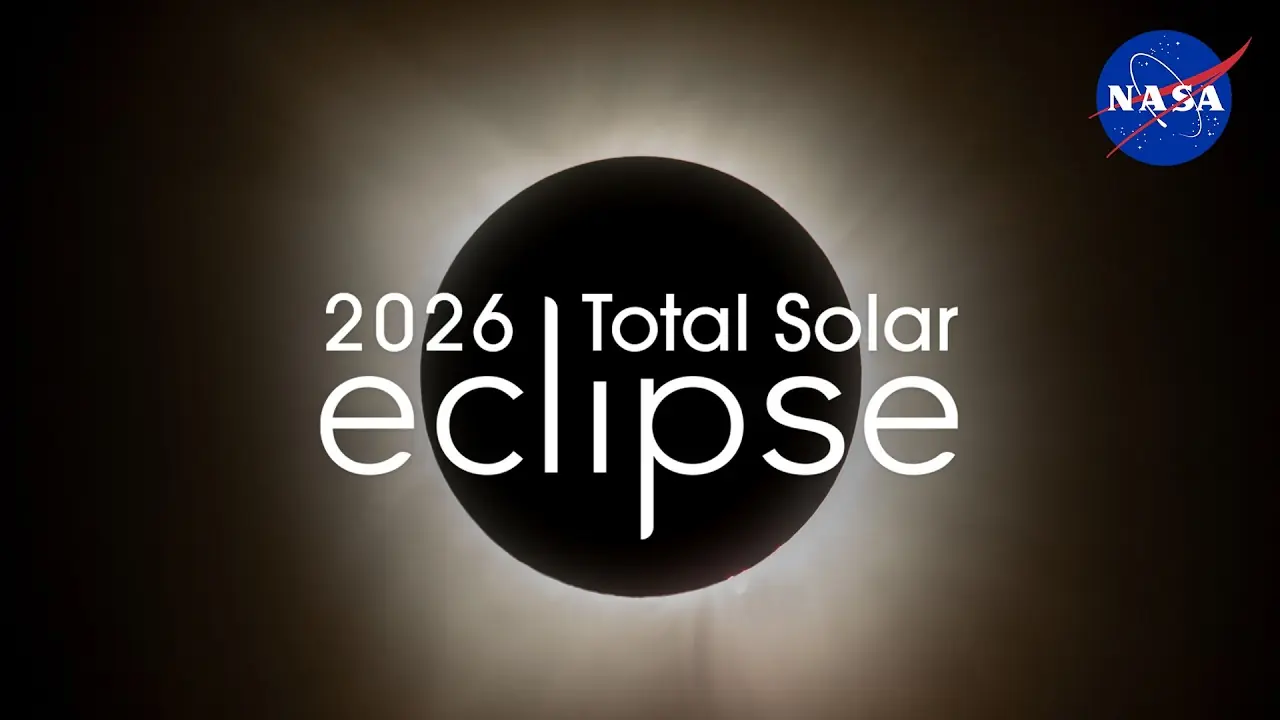
NASA’s live broadcast of the August 12, 2026 total solar eclipse begins in just a few hours, while a very small part of the event will be visible for only a few minutes in western and northwestern Greece.
NASA’s official live coverage begins tonight at 8:15 p.m. Greek time, with views from Iceland and Spain as the Moon’s shadow crosses the path of totality over Greenland, Iceland, the North Atlantic, Spain and a small part of Portugal.
For Greece, the situation is different: there will be no totality and most of the country will not see the eclipse at all, but the western and northwestern edge of the country will have a very brief window for viewing a partial eclipse just before sunset.
What will be visible from Greece
Across Greece as a whole, the partial eclipse begins to become visible at around 8:30 p.m. and the final visible phase ends at around 8:40 p.m. Totality is not visible from anywhere in Greece.
Corfu offers the best opportunity among major Greek locations. There, the partial eclipse begins at around 8:33 p.m., reaches its maximum at 8:37 p.m. and ends at 8:40 p.m., for a total duration of approximately seven minutes. Even there, however, the Moon will cover only a small portion of the solar disk.
In Igoumenitsa, the eclipse begins at around 8:33 p.m., peaks at 8:36 p.m. and ends at 8:38 p.m., lasting approximately five minutes. In Ioannina, the available window is even shorter, from around 8:33 p.m. until 8:36 p.m., with maximum eclipse at approximately 8:35 p.m.
In Preveza, conditions are marginal, with the partial eclipse calculated to be visible for only about one minute, around 8:34 p.m. to 8:35 p.m.
In Athens, by contrast, the eclipse is not visible because by the time the Moon’s shadow reaches far enough east, the Sun is already below the horizon. The same sunset limitation sharply reduces visibility toward central and eastern Greece.
In practical terms, observers in Corfu and parts of Epirus will need a completely unobstructed view toward the western horizon because the Sun will be extremely low. With proper eye protection, they may see a small portion of the solar disk covered by the Moon shortly before the Sun disappears below the horizon.
NASA’s livestream begins tonight at 8:15 p.m.
NASA has scheduled its live broadcast to begin at 1:15 p.m. EDT, corresponding to 8:15 p.m. Greek time. Coverage will include views from locations along the path of totality and scientific commentary explaining the event as it develops.
The total eclipse does not cover all of Europe. The narrow path where the Moon completely blocks the Sun crosses Greenland, Iceland, the North Atlantic, northern Spain and a small part of Portugal, while much of the rest of Europe experiences only a partial eclipse.
What makes today’s eclipse unusual
In several parts of mainland Europe, the eclipse takes place very close to sunset. NASA notes that in many locations the Sun will set while it is still partially eclipsed, creating an unusual view close to the western horizon.
Within the path of totality, complete coverage of the Sun lasts less than two minutes for most observers, while locations near the center of the path can experience slightly more than two minutes of totality, but still less than two and a half minutes.
The WB-57 will chase the Moon’s shadow
NASA’s work goes beyond the live broadcast. A WB-57 research aircraft will fly at approximately 50,000 feet, more than 15 kilometers above Earth, carrying four high-resolution cameras designed to capture the solar corona at several visible and infrared wavelengths.
The SAMI system will record at least 20 images per second, allowing scientists to examine structures and rapid changes in the corona, solar prominences and the relationship between coronal material and the solar wind.
The WB-57 will travel along the Moon’s shadow at approximately 460 miles per hour. By doing so, its cameras will be able to observe the corona for nearly three minutes, longer than the maximum duration available to observers on the ground.
Scientific balloons in Iceland and Spain
At the same time, the NASA-supported Nationwide Eclipse Ballooning Project is conducting scientific balloon flights to study how Earth’s atmosphere reacts to the sudden and temporary reduction in incoming sunlight.
In Iceland, two teams have planned a total of 80 launches beginning 18 hours before the eclipse and continuing until eight hours afterward to study the atmospheric boundary layer. In Spain, three teams will launch six balloons carrying 360-degree cameras and ozone-measuring instruments.
Why totality matters to scientists
When the Moon completely covers the Sun’s bright visible surface, the much fainter solar corona becomes visible. This creates opportunities for observations that are difficult to perform in the same way from the ground under normal conditions.
Scientists use these brief opportunities to investigate, among other things, how the corona is heated to temperatures approaching one million degrees and how it is connected to the solar wind.
Eye protection is essential even in Greece
The fact that only a very small part of the eclipse will be visible from Greece does not reduce the danger to the eyes. During any partial phase, it is not safe to look directly at the Sun without dedicated eclipse glasses or an appropriate solar filter. Ordinary sunglasses do not provide adequate protection.
Cameras, telescopes and binoculars require a dedicated solar filter mounted in front of their optics. Viewing without a filter is only permitted during the brief period of complete totality and therefore does not apply anywhere in Greece during today’s eclipse.
What we think
For the Greek audience, today’s eclipse has two very different sides. In Corfu and parts of Epirus, there is a small but genuine opportunity to see the event close to sunset, while for the rest of the country the livestream is effectively the only way to experience totality. NASA’s scientific coverage, involving the WB-57 and atmospheric experiments, makes the broadcast more than a simple transmission of a spectacular celestial event.
Frequently asked questions
Will the eclipse be visible from Greece?
Yes, but only as a very small partial eclipse for a few minutes in western and northwestern areas. Totality is not visible from Greece.
What will be visible from Corfu?
In Corfu, the partial eclipse begins at approximately 8:33 p.m., reaches its maximum at 8:37 p.m. and ends at 8:40 p.m. The Moon will cover only a small portion of the Sun.
Will the eclipse be visible from Athens?
No. The August 12, 2026 eclipse is not visible from Athens.
What time does NASA’s livestream begin?
NASA’s broadcast begins at 8:15 p.m. Greek time on August 12, 2026.
Are eclipse glasses required in Greece?
Yes. Because Greece will only experience a partial eclipse, proper solar eye protection is required at all times when directly observing the Sun.