

Summary
- NASA has revisited the visual-acuity experiments flown on Gemini V and Gemini VII in 1965
- Experiment S-8/D-13 compared astronaut vision before, during, and after spaceflight
- The ground-based Eye-Q targets used white rectangles roughly 46 to 183 meters long
- The tests found no statistically significant degradation in visual acuity during the Gemini V and VII missions
- Modern research shows that months-long spaceflights can cause SANS in a large proportion of astronauts
- From Cooper’s observations to a controlled experiment
- The binocular-like tester with 36 rectangles
- Eye-Q: an eye test up to 183 meters long
- What went wrong in orbit and what they managed to see
- What the results showed
- From human eyesight to Landsat
- What we know about eyes in space today
- What we think
- Frequently Asked Questions
NASA is bringing renewed attention to one of the Gemini program’s most unusual experiments, in which giant white rectangles on Earth were used to measure what astronauts could actually distinguish from orbit.
NASA’s History Office published a new retrospective on August 20, 2026, covering the visual-acuity experiments flown on Gemini V and Gemini VII, one day before the 61st anniversary of Gemini V’s August 21, 1965 launch. The story began with Gordon Cooper’s remarkable observations during Mercury-Atlas 9, which prompted NASA to turn a seemingly simple question — “how well can a person see from space?” — into a controlled scientific experiment.
The significance of the experiment went far beyond the eyesight of four astronauts. The results helped clarify what a human could recognize on Earth from orbit, how the atmosphere and spacecraft windows affected contrast, and why Earth observation from space could become a serious scientific tool. At the same time, today’s knowledge of Spaceflight Associated Neuro-ocular Syndrome shows why the Gemini conclusions should not be generalized to missions lasting many months.
From Cooper’s observations to a controlled experiment
In May 1963, L. Gordon Cooper Jr. completed 22 orbits of Earth aboard Faith 7 during the Mercury-Atlas 9 mission. He took 29 color photographs with a 70mm camera and reported that, from an altitude of around 100 miles, or 161 kilometers, he could distinguish vehicles moving along dirt roads, smoke-producing trains, and the tops of buildings. NASA notes that Cooper had exceptional visual acuity of roughly 20/12, but his descriptions were considered by many to be almost too good to be true.
The skepticism became so strong that, as NASA now recalls, a contemporary magazine report even described speculation by psychiatrists that weightlessness might be causing hallucinations. Instead of leaving the issue to anecdote, researchers developed Experiment S-8/D-13 to monitor the crews’ visual acuity and determine which features on the ground could be predictably recognized from orbit.
The binocular-like tester with 36 rectangles
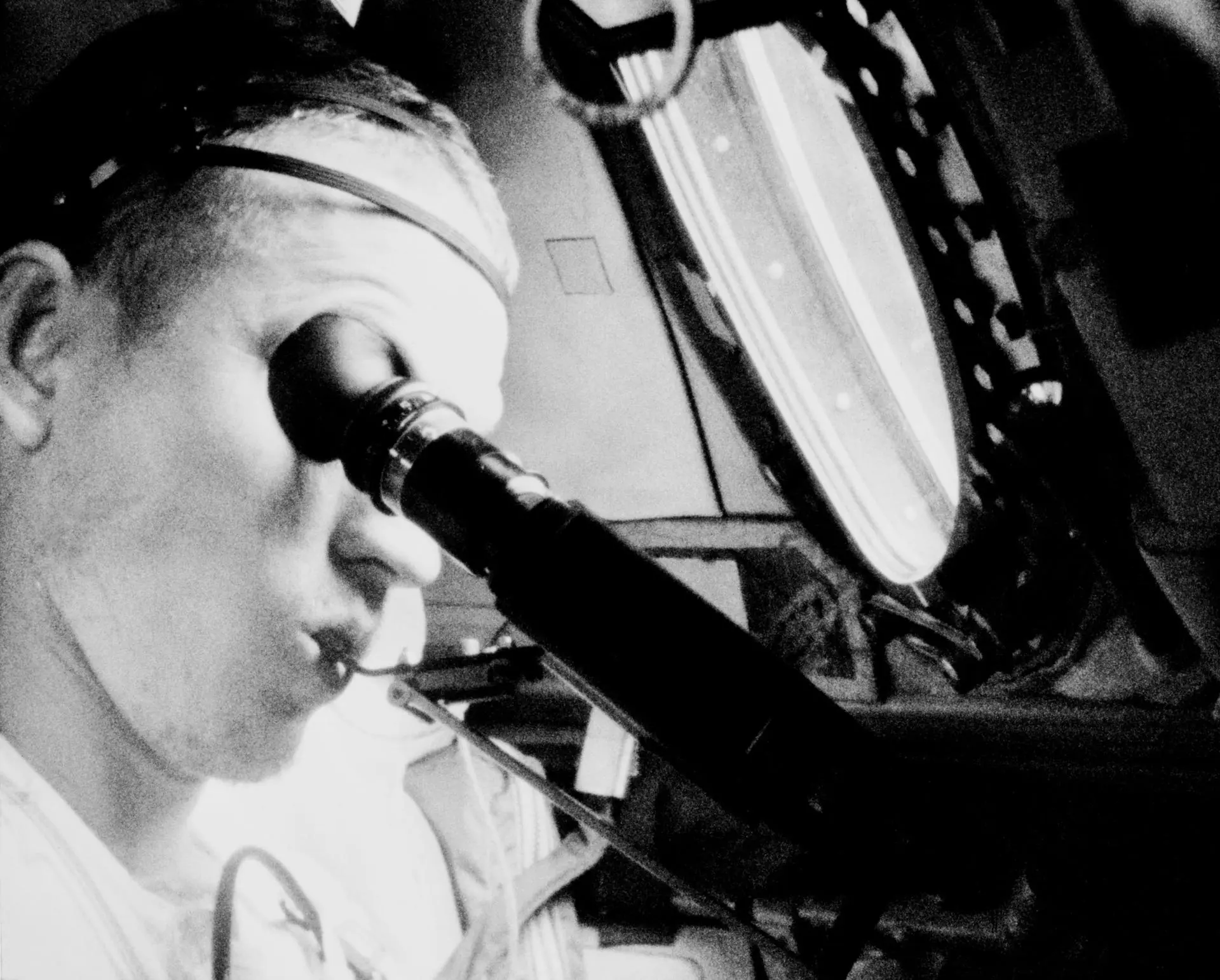
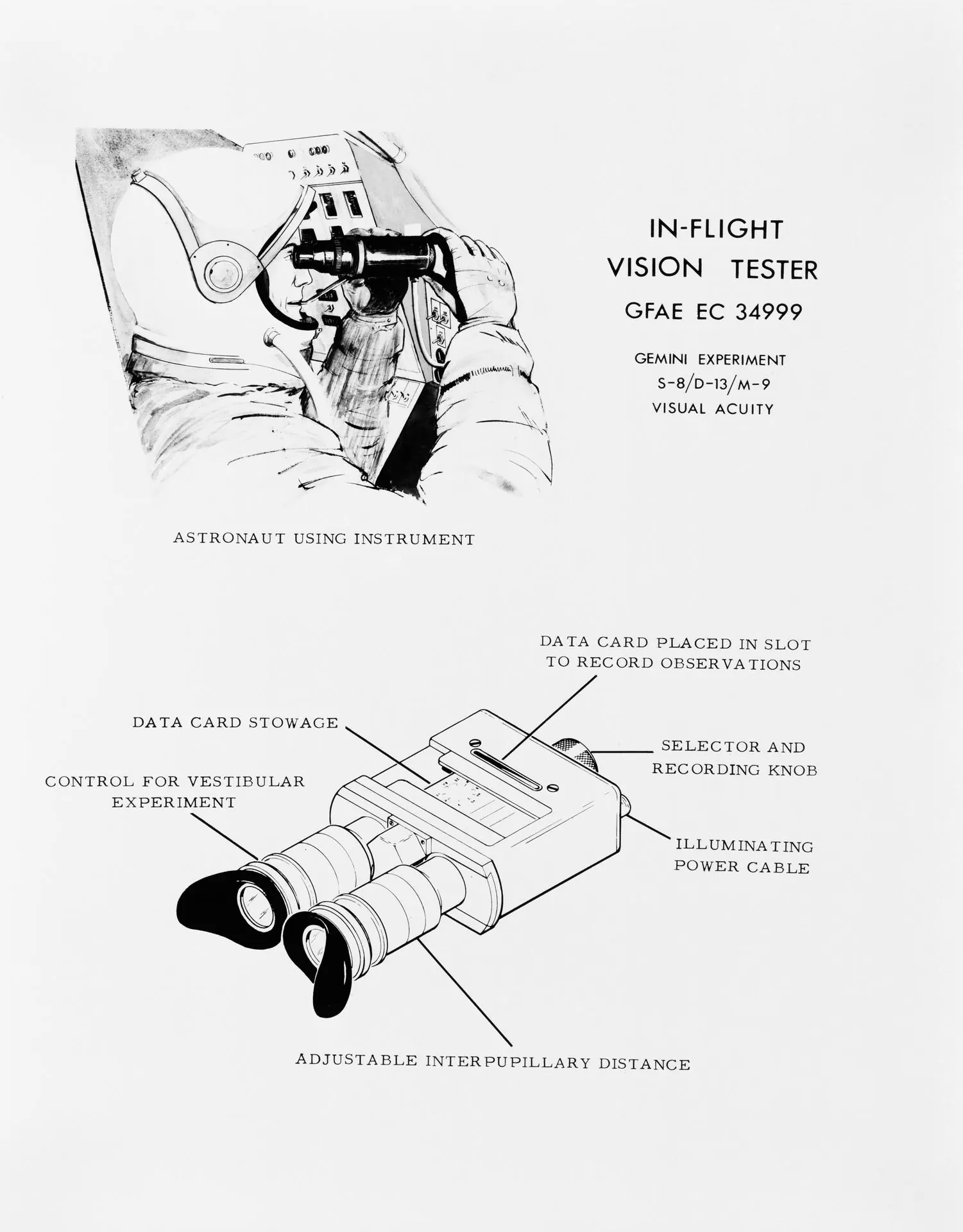
The first part of the experiment took place inside the spacecraft. Astronauts used a small binocular optical instrument containing 36 illuminated rectangles of different sizes and contrast levels. Half were vertical and half horizontal, while their size, contrast, and presentation sequence were randomized so that the test could not simply be memorized.
Each crew member had to report the orientation they saw and recorded the answer by punching holes in a special card. The instrument was so sensitive to alignment that it used a biteboard molded to each astronaut’s dental impression to keep the eyes in the intended position. The permissible offset between the eye and the optical axis of the eyepiece was less than 0.005 inch, or about 0.13 millimeter.
Testing took place before, during, and after the missions. This allowed researchers to compare each astronaut’s performance on Earth and in space rather than relying only on subjective descriptions.
Eye-Q: an eye test up to 183 meters long
The second part was far more spectacular. Huge ground targets were built from white rectangles laid over dark tilled soil near Laredo, Texas, and Carnarvon, Australia. The rectangles, produced with the involvement of the Dow Chemical Corporation, ranged from roughly 150 to 600 feet in length, or about 46 to 183 meters. The system acquired the nickname “Eye-Q.”
During orbital passes, the astronauts had to determine the orientation of the shapes. Instruments on the ground and aboard the spacecraft simultaneously monitored variables including brightness, contrast, atmospheric conditions, and the optical effect of the spacecraft window. NASA was therefore testing not simply whether “something could be seen,” but whether human performance could be predicted from measurable optical data.
What went wrong in orbit and what they managed to see
In practice, the experiment was considerably harder than an ordinary eye test. Clouds, unwanted scattering of sunlight in the spacecraft windows, and unfavorable spacecraft orientation disrupted several attempts. During Gemini V, fuel-cell difficulties and later problems with thruster control created additional limitations.
Gemini V’s most important quantitative observation came during revolution 48 over Laredo. Pete Conrad managed to discriminate some of the targets after the spacecraft was rotated to remove strong sunlight from his window. Subsequent analysis showed that his performance remained within the statistically expected range established by his preflight measurements.
The event also revealed something highly relevant to photography and observation from space: during that pass, the loss of contrast caused by light scattered through the spacecraft window was greater than the loss caused by the atmosphere itself. Human eyesight could be exceptional, but the quality of the optical system in front of it remained critical.
What the results showed
The final scientific report was clear: preflight, in-flight, and postflight measurements showed no statistically significant change in the visual capability of the four Gemini V and VII crew members. Observations made at the Laredo site were also consistent with limits predicted from the astronauts’ preflight measurements.
The results supported the idea that laboratory visual-acuity data, when combined with the actual optical characteristics of a target, the atmosphere, and the spacecraft window, could predict the limiting ability of an astronaut to discriminate small objects on Earth with the unaided eye. NASA’s new retrospective also notes that astronauts could distinguish features such as roads and ships with visible wakes from orbit.
This does not mean that the experiment proved every specific observation Cooper had reported, such as identifying a particular automobile. What it established was scientifically more useful: exceptionally detailed human observation from orbit was real under suitable conditions and could be measured quantitatively.
From human eyesight to Landsat
NASA now connects these early experiments with the much broader scientific interest that developed during the 1960s in systematic Earth observation from above. Geologists, geographers, oceanographers, and other researchers realized that orbital imagery could be useful for mapping, agriculture, natural-disaster monitoring, and the study of the oceans.
That scientific interest helped build momentum for the Earth Resources Technology Satellite, later renamed Landsat 1, which launched in 1972 and began one of the world’s most important long-running Earth-observation programs. The evolution of that technology and the way Landsat imagery now reveals information beyond visible light has also been covered in PTTL’s feature on Landsat satellite imagery.
What we know about eyes in space today
Gemini’s finding that no significant deterioration in visual acuity was measured during flights lasting eight and roughly 14 days remains valid for those specific experiments and mission durations. It does not mean, however, that long-term exposure to microgravity leaves the eyes unaffected.
NASA currently reports that about 70% of astronauts on long-duration International Space Station missions experience some degree of changes associated with Spaceflight Associated Neuro-ocular Syndrome, or SANS. These can include optic-nerve swelling, retinal folds, and changes in the shape of the eye, while the risk is considered greater as mission duration increases. The long-term consequences are still being investigated.
The distinction is important: Gemini primarily measured immediate functional visual performance during comparatively short missions, whereas modern space medicine also examines structural changes that become significant after months of exposure to microgravity.
What we think
The Gemini visual-acuity experiments are a strong example of how the early space age turned even the strangest astronaut reports into measurable science. The real significance is not whether Gordon Cooper had “superhuman” eyesight, but that NASA succeeded in separating genuine visual capability from the effects of atmosphere, illumination, contrast, and spacecraft windows. The same principle — measurement instead of impression — remains fundamental both to modern remote sensing and to research into astronaut health.
Frequently Asked Questions
What was Experiment S-8/D-13?
It was the astronaut visual-acuity and visibility experiment flown on Gemini V and Gemini VII. It included tests conducted inside the spacecraft and observations of controlled targets on the Earth’s surface.
How large were the Eye-Q targets?
The white rectangles at the ground observation sites were roughly 150 to 600 feet long, or about 46 to 183 meters.
Did NASA prove that Gordon Cooper could see cars from space?
Not in the sense of directly verifying every specific observation Cooper had reported. The controlled experiments did show, however, that astronauts under suitable conditions could distinguish much finer Earth features than many experts had initially considered possible, including roads, ships with wakes, and the specially constructed targets.
Did Gemini prove that eyesight is unaffected by spaceflight?
Only in the specific Gemini missions and tests was no statistically significant change in visual acuity detected. Modern research shows that months-long missions can produce SANS and other structural changes in the eyes.