

Summary
- The International Shark Attack File reports an increase in incidents involving people bitten while trying to photograph or film sharks
- Overall unprovoked shark bites remain extremely rare
- In 2025, 65 unprovoked and 29 provoked bites were confirmed worldwide
- ISAF classifies interactions initiated by people, including touching or harassing sharks, as provoked
- Research in French Polynesia suggests around 5% of one documented sample of bites may have been motivated by shark self-defense
- Studies have identified more pushy behavior from photographers and influencers during organized wildlife encounters
- Responsible underwater photography can instead contribute to shark research and conservation
- The increase is not in total shark bites
- Shark selfies have become a content category
- A recent nurse shark incident
- PTTL has already covered an extreme case
- It is not only about human safety
- Can sharks bite in self-defense?
- Unprovoked bites remain exceptionally rare
- When the image becomes the objective
- Cameras can also help protect sharks
- What should photographers do?
- What we think
- Frequently Asked Questions
Experts are warning about an increase in cases involving people being bitten by sharks while deliberately moving closer to capture photographs or videos, renewing the debate over wildlife imagery in the social-media era.
The International Shark Attack File, the Florida Museum of Natural History’s scientific shark-bite database, recently told the BBC that it has observed an increase over the past three years in incidents involving people bitten while attempting to record shark footage or photographs.
The issue is not that sharks have suddenly become dramatically more dangerous. Overall incidents remain exceptionally rare. The concern is that some photographers, influencers and tourists are deliberately reducing their distance from wild animals in pursuit of more dramatic content, potentially increasing risk for both people and sharks.
The increase is not in total shark bites
An important distinction is required.
The International Shark Attack File confirmed 65 unprovoked shark bites worldwide in 2025, alongside 29 provoked incidents, meaning cases in which a person initiated some form of interaction with a shark.
ISAF’s provoked category includes incidents involving divers who harass or attempt to touch sharks, feeding interactions, spearfishing and handling sharks caught in nets or on hooks.
A person deliberately moving extremely close for a photograph should therefore not automatically be framed as an innocent victim of an unprovoked “shark attack.”
Shark selfies have become a content category
Social platforms now contain vast quantities of footage showing people swimming beside sharks, touching them or, in extreme cases, attempting to ride them.
The logic is obvious: the smaller the distance between the creator and a wild animal, the more extraordinary the image appears.
But that logic can encourage increasingly close encounters.
A 2020 study examining wildlife photographers and influencers on commercial swim-with-wildlife tours repeatedly identified what researchers described as “pushy” behavior, with operators reporting that experienced photographers and influencers were among those most likely to disregard safety instructions in pursuit of the desired image.
A recent nurse shark incident
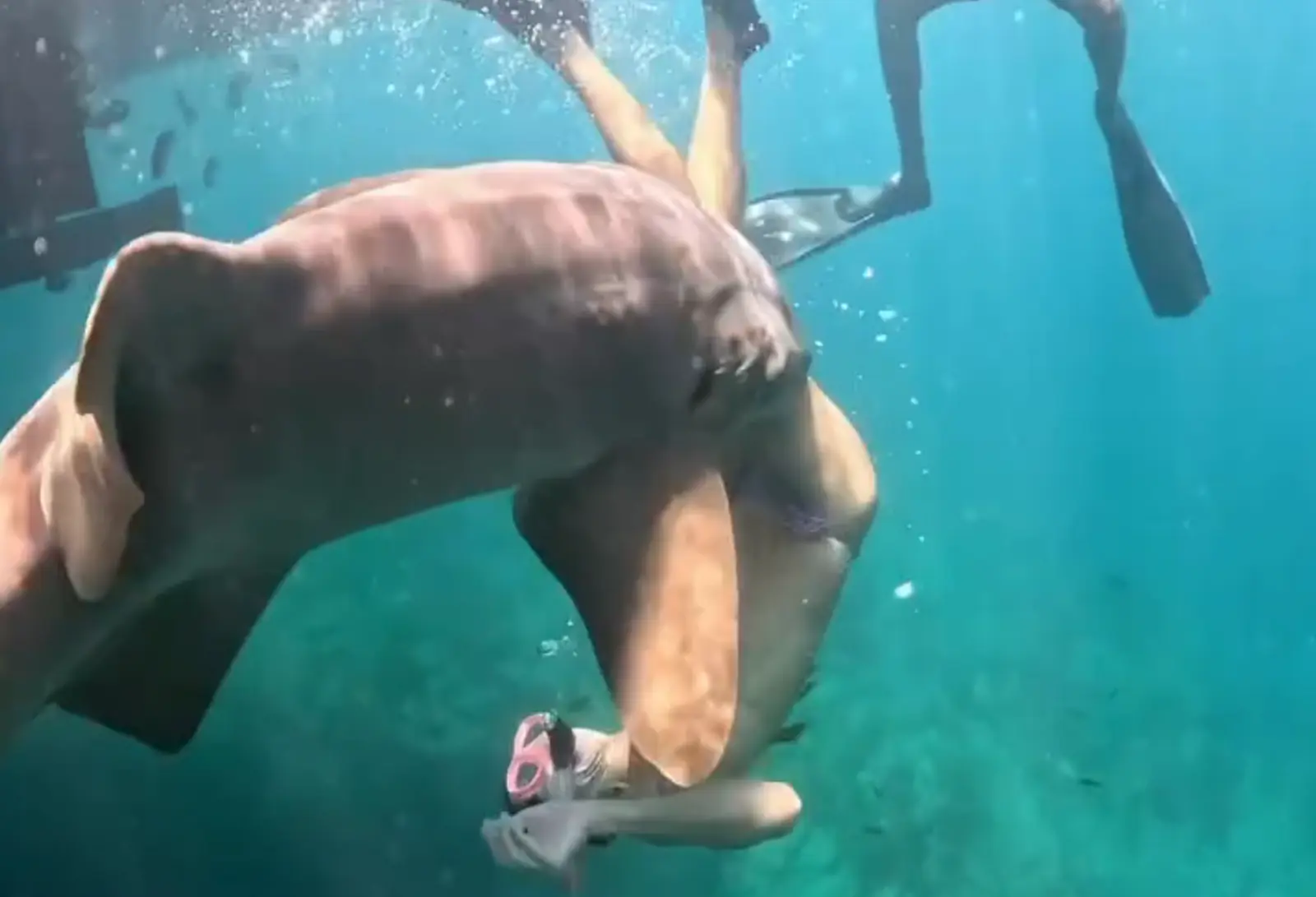
One recent case involved Brazilian social-media creator Tayane Cachoeira Dalazen.
Earlier in 2026, she was bitten on the leg by a nurse shark while swimming off Fernando de Noronha in the Atlantic. Footage of the incident and photographs of the wound circulated widely online.
Nurse sharks are generally considered less aggressive than some other species, but that does not make close contact risk-free.
They remain wild animals capable of defending themselves when pressured, restrained or threatened.
PTTL has already covered an extreme case
In 2025, PTTL reported on a tourist in Turks and Caicos who suffered catastrophic injuries and, according to reports at the time, had approached a shark to photograph it.
The woman ultimately lost both hands.
Read the previous PTTL report.
It is not only about human safety
The issue extends beyond the risk to photographers.
Very close human presence can alter wildlife behavior, cause stress and affect how animals use their environment.
Research into wildlife tourism has repeatedly shown that close human interactions can alter marine-animal activity and that contact needs careful management to minimize harassment.
Shark scientist Kristian Parton summarized the issue simply: people would not enter the Serengeti and place a hand on a lion’s face. The same logic should apply underwater.
Can sharks bite in self-defense?
Research published in 2025 in Frontiers in Conservation Science examined precisely this possibility.
Eric Clua, Thomas Vignaud and Aaron Wirsing studied shark-bite records in French Polynesia and identified incidents where a bite appeared to follow a human action perceived as threatening by the shark.
Among 74 documented bites between 2009 and 2023, four were classified as highly likely self-defense cases, representing roughly 5% of that dataset.
The study associates defensive bites with actions including handling, harming or otherwise threatening sharks.
This does not mean that every shark bite near a photographer is defensive. It does show why the person’s behavior must be considered when evaluating an incident.
Unprovoked bites remain exceptionally rare
Data do not support the popular image of sharks actively hunting people.
ISAF recorded 65 confirmed unprovoked bites worldwide in 2025, compared with a recent five-year average of approximately 61 per year.
The organization describes the overall risk of a shark bite as extremely low.
The current discussion is therefore primarily about a specific pattern of human behavior rather than a broad surge in shark aggression.
When the image becomes the objective
The shark-selfie debate forms part of a much wider issue in wildlife photography.
PTTL recently covered a viral incident in Torres del Paine involving photographers standing extremely close to a wild puma, reigniting arguments over whether people should move away even when the animal approaches first.
Read PTTL’s report on the puma photography debate.
The basic principle remains the same whether the subject is a lion, bear, puma or shark:
No image is more important than the safety and welfare of the animal.
Cameras can also help protect sharks
Underwater photography itself is not the problem.
Photography and filmmaking can provide enormous scientific and conservation value when they document animals without forcing interaction.
PTTL recently covered an initiative in which photographers, filmmakers and conservation organizations use Insta360 cameras and archived underwater footage to contribute to education and shark research.
Read how photographers are using cameras to help protect sharks.
The distinction is fundamental.
In one case, the camera records the animal.
In the other, the creator changes the animal’s behavior in pursuit of better content.
What should photographers do?
There is no single safe distance that applies to every shark species and every location.
Photographers should follow:
- local regulations
- instructions from qualified operators and guides
- protected-area rules
- species-specific advice from researchers
- distances that allow animals to continue their natural behavior
If an animal changes direction because of the photographer, shows defensive behavior or loses a clear escape route, the interaction has already gone too far.
What we think
Wildlife photography has its greatest value when it reveals behavior that would have happened even if the photographer had not been there.
Touching a shark or deliberately moving within centimeters of its mouth may produce content capable of generating millions of views.
That does not make it better wildlife photography.
Once a creator provokes a different behavior for the sake of the image, the photograph stops being a simple record of wild nature and becomes a record of the photographer’s intervention.
The difficult part is not getting closer.
The difficult part is making a powerful image while remaining distant enough for the animal to behave as though we do not exist.
Frequently Asked Questions
Are shark bites increasing globally?
There is no major increase in overall unprovoked incidents. ISAF recorded 65 unprovoked bites worldwide in 2025, close to the recent five-year average of 61.
What is a provoked shark bite?
ISAF classifies an incident as provoked when a person initiates interaction with a shark, including touching, harassing, feeding or handling the animal.
Can a shark bite in self-defense?
Yes. A 2025 study in French Polynesia identified cases where previous human behavior appeared to trigger a defensive response.
Is swimming with sharks safe?
Safety depends on species, location, conditions and how the interaction is managed. Participants should follow qualified guides and never touch or harass sharks.
Is all shark photography unethical?
No. Responsible underwater photography can support education, research and conservation. The problem begins when creators disturb or manipulate wildlife in pursuit of a more dramatic image.