

Summary
- Some parents in Britain are using AI to remove watermarks from low-resolution school photo previews and upscale the images.
- School photographers report that the practice is beginning to affect sales.
- The trend directly challenges the sector’s business model while also raising copyright and child-image privacy concerns.
- The accessibility of new AI tools makes watermark removal far easier for non-specialist users.
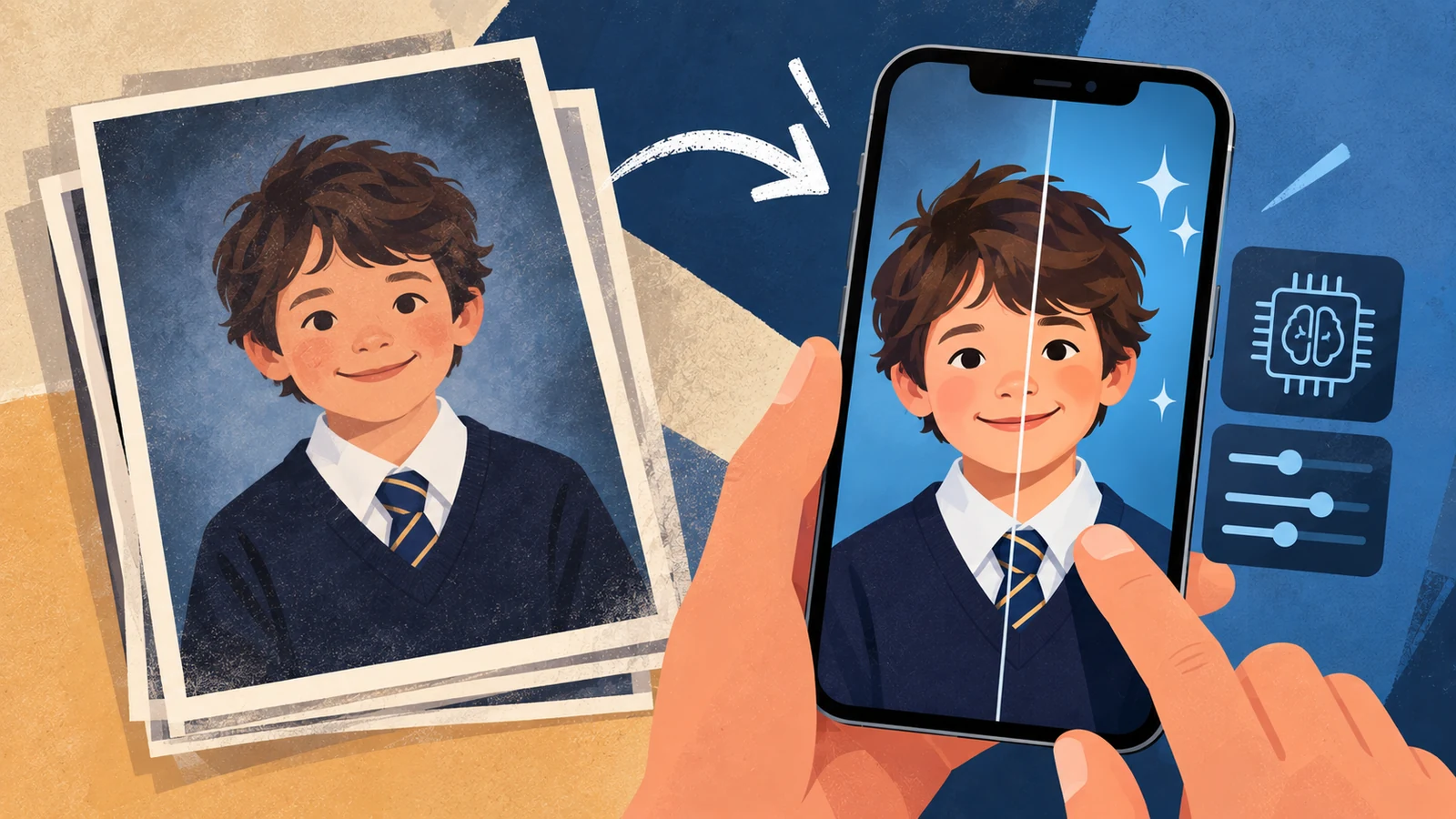
A new practice in Britain is worrying professional school photographers: parents are taking low-resolution previews, using AI tools to remove watermarks and then upscaling the images instead of purchasing the official photographs.
The traditional school portrait has been part of British school life for generations. But the ease with which modern AI tools can process a small preview is creating a very specific problem for a business model that depends on parents placing orders.
From a low-resolution preview to an image without a watermark
The process is straightforward: a parent accesses the low-resolution preview shown in the photographer’s online gallery, uses AI tools to remove the watermark or logo, and applies upscaling techniques to increase the resolution and make the file more usable.
The key change is accessibility. Tasks that once required image-editing skills are now available to far more people. Lee Brooker, a veteran school photographer in Colchester, has reported a slight decrease in sales from parents attempting to save around £12 by using AI tools to remove his company logo from photographs.
Why this directly affects the school photography business model
The preview is not the final product; it is how families decide whether to purchase the photograph. If a protected preview can easily be converted into a cleaner, larger file, one of the practical barriers to unauthorised use becomes weaker.
Photographers organise the shoot, bring cameras and lighting, photograph large numbers of pupils, process the files and make them available through an online system before knowing how many families will ultimately buy. Photo sales are therefore the point at which that investment in labour and production is recovered.
In Britain, a single school portrait can cost around £20, while larger orders with additional products can rise considerably higher. Gross revenue is not the same as profit, however: printing, shipping, equipment, lighting, labour and, in some cases, a commission to the school all have to be covered.
The issue goes beyond one lost sale
There is also a copyright issue. The technical ability to remove a watermark does not transfer the rights to the user or automatically turn a preview into a legitimately acquired final file.
School photography adds another sensitive dimension because the subjects are children. Brooker has expressed greater concern about parents uploading children’s photographs to AI tools or even public social-media groups and asking strangers to remove the watermarks. The image then leaves the photographer’s protected gallery environment and is handed to external services or unknown users.
AI is already putting wider pressure on professional photographers
The school-photo issue sits within a broader challenge for the profession. Data from the UK Association of Photographers indicates that 58% of professional photographers who responded to its survey said they had lost commissioned work to generative AI. That figure relates to the wider AOP sample, not specifically to school photographers.
Watermark removal existed before the current generation of AI. What has changed is accessibility: tasks that could require time, software and technical experience can now be performed much more easily by a non-specialist user.
What we think
For school photographers, this is a warning that a watermark alone is no longer as strong a technical barrier as it once was. If removing it and upscaling a preview can be done in a few steps, the sector may need to reconsider both how proofs are presented and how the value and rights attached to the final product are communicated to parents.
The most worrying aspect is not that AI can generate a school portrait from scratch. It is that AI can be applied to the completed work of a real photographer to bypass the exact stage at which that photographer gets paid.