

Summary
- UCL participants missed 58.8% of hidden devices when using a detector
- SweepLED combines a phone case with LEDs and AI reflection analysis
- About 94% accuracy in a test involving 30 objects
- Research prototype with no announced commercial release
Commercial detectors offer limited help in finding hidden surveillance devices, according to a UCL study, as KAIST presents SweepLED, a research system that detects cameras using LEDs and artificial intelligence.
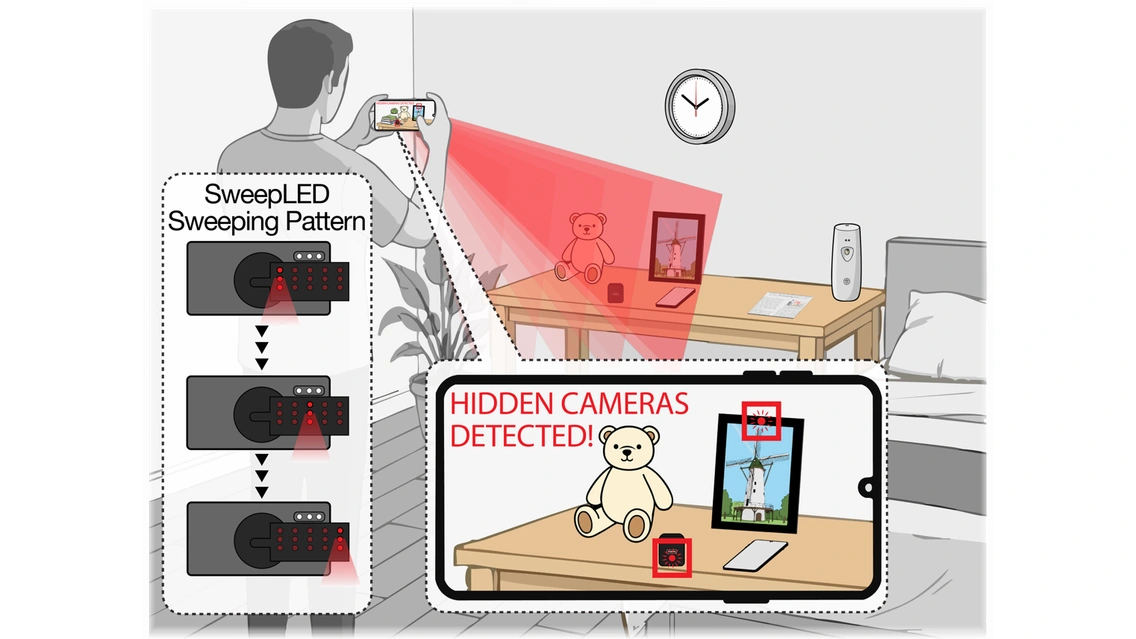
The first study examines how people use tools already on sale. The second proposes a different optical method: an attachable phone case illuminates a suspicious object from successive directions while the camera records how its reflections change.
The shared difficulty is interpreting the clues. A bright spot or radio-frequency signal may come from an innocent object, leaving users to decide whether a camera is present. That uncertainty limits a detector’s practical value.
What the commercial detector study found
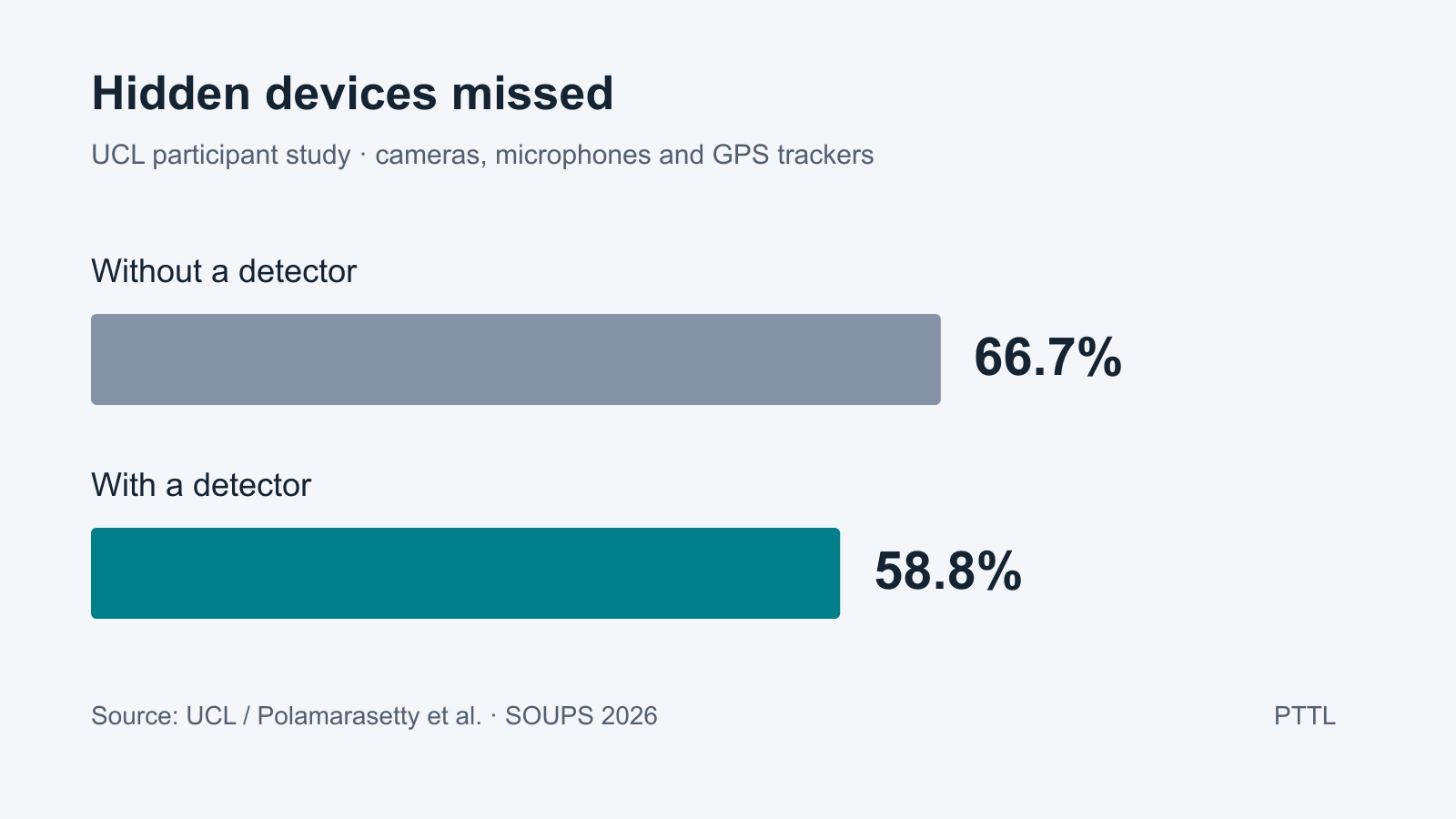
The UCL team evaluated 19 commercial devices and conducted tests with 34 participants in staged domestic environments. Hidden devices included cameras, microphones and GPS trackers.
Participants using a detector missed 58.8% of the hidden devices, compared with 66.7% without one. The improvement therefore amounted to 7.9 percentage points, while more than half the devices remained undiscovered.
In a separate part of the study, Bluetooth tracker detection apps missed 27.6% of devices, without producing false alarms in that test. Radio-frequency tools proved particularly difficult to use because their readings did not always explain which device had triggered a signal.
The work by Akhil Polamarasetty, Leonie Maria Tanczer, Enrico Costanza and Kevin Chetty was presented at SOUPS 2026 and focuses on surveillance by intimate partners or former partners. The researchers link difficult interfaces to anxiety, self-blame and false reassurance. They recommend clearer device identification and specific next steps instead of readings that require technical interpretation.
How SweepLED works
SweepLED was developed by a team led by Professor Jun Han at KAIST’s School of Computing, in collaboration with the National University of Singapore and Singapore Management University. Its case contains an LED array that lights up sequentially while the user holds the phone still.
This changes the illumination direction without simultaneously changing the viewing position. On an ordinary glossy surface, a reflection moves, fades or disappears. Inside a camera lens, optical elements, the aperture and the sensor produce different changes in reflected light.
The system records these changes as a short video and analyses them with an AI model. Processing compensates for small hand movements, reduces the effect of ambient light and identifies regions with lens-like characteristics. It then examines changes in reflection intensity, shape and position, with confirmation from three viewpoints.
What approximately 94% accuracy means
In the prototype paper published in ACM MobiSys Companion 2026, the researchers used 30 objects: twelve cameras and eighteen non-camera objects. To test recognition of unfamiliar objects, they left one object out of model training each time and used it for evaluation.
Accuracy reached 93.9% with the phone held in the hand and 95.1% in a static setup, with a sweep time under five seconds. These figures measure the system’s classification of objects. The UCL study measures how many hidden devices people found in a room, so the studies address different parts of the same challenge.
Availability and cost
KAIST says the case’s core components cost less than US$7. That threshold is equivalent to approximately €6.02 using the ECB reference rate for September 7, 2026, €1 = US$1.1622. The conversion concerns prototype component costs and is not an official Greek retail price.
SweepLED remains a research project, with no announced commercial release or on-sale date. Further details are available in KAIST’s official presentation and the research paper.
Our take
SweepLED’s most useful direction is transferring the interpretation of reflections from the person to the system. To become a practical tool, it will need to combine recognition with guidance that helps users inspect an entire room and understand exactly what has been detected. The UCL study demonstrates how much that part of the design matters.
Frequently asked questions
What is SweepLED, and how does it detect hidden cameras?
SweepLED is a research prototype with LEDs mounted on a phone case. The LEDs illuminate objects sequentially from different directions, while an AI system analyses changes in reflections to identify those produced by a camera lens.
What results did it achieve in testing?
Tests involving 30 objects, including 12 cameras, reported 93.9% accuracy in handheld use and 95.1% with the device in a fixed position. Scanning took less than five seconds.
Is SweepLED already available to buy?
No. It is a research prototype, and no commercial availability or release date has been announced.