

Summary
- A trail camera recorded Craig Berg on the Greenstone Ridge Trail on August 30
- The 70-year-old was reported missing after failing to return on September 5
- He was found on September 12 injured and hypothermic but alive
- A U.S.
- Coast Guard MH-60 Jayhawk evacuated him from Isle Royale
A trail camera on Michigan’s remote Isle Royale provided search teams with a crucial geographic clue for 70-year-old Craig Berg, who was found alive after being missing for a week.
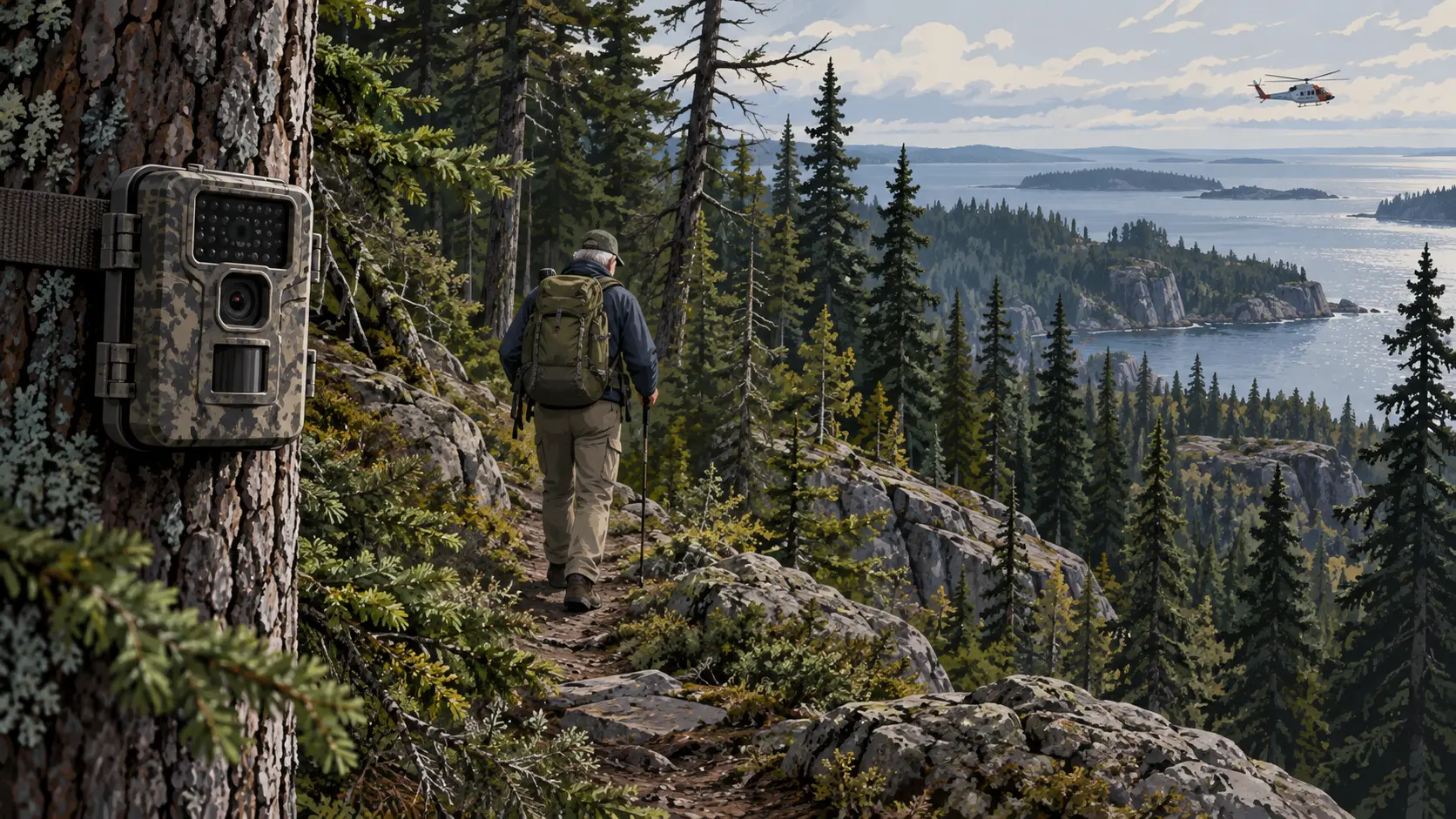
Berg had set out alone on a multi-day hike in Isle Royale National Park in Lake Superior and was due to leave by ferry on September 5, 2026. When he failed to return, his family reported him missing and search operations began the following day. Information released during the search showed that a trail camera had recorded him on August 30 near the Greenstone Ridge Trail, helping searchers expand their efforts into the island’s interior.
The case is especially relevant to imaging because it demonstrates a practical use for automated cameras far beyond wildlife photography: a dated image tied to a specific location can become operational evidence in a rescue search. Trail cameras, such as the Behold Cam-1 wildlife camera previously featured on pttl.gr, operate autonomously and trigger when motion is detected, creating a visual timeline in places without continuous human presence.
The August 30 clue changed the search area
Teams initially focused near Rock Harbor, where Berg had planned to finish his route. The trail-camera image showed that he had passed along the Greenstone Ridge Trail on August 30. It did not reveal the final location where he would be found, but it provided a confirmed trace of his route and helped broaden the search zone.
That distinction matters: the camera did not “find” the missing hiker by itself. Berg was located on September 12 with the help of backpackers and search personnel on the island, after which a U.S. Coast Guard MH-60 Jayhawk helicopter evacuated him.
Helicopter rescue after hypothermia
The U.S. Coast Guard said the 70-year-old was found injured and hypothermic, but alive and alert. An MH-60 Jayhawk crew from Coast Guard Air Station Traverse City hoisted him from Isle Royale and transported him to Marquette Regional Airport in Gwinn, where emergency medical personnel took him to a hospital.
The operation involved the Michigan State Police, National Park Service, Michigan Department of Natural Resources and U.S. Coast Guard, together with teams and resources from neighboring states. The Coast Guard described the rescue as the result of cooperation between first responders, partner agencies and members of the public.
Why Isle Royale makes any search difficult
Isle Royale is a remote Lake Superior archipelago accessible only by boat, seaplane or private watercraft. The National Park Service says there are no public roads or cars on the main island, while its trail network totals about 165 miles. Cellular service is unreliable, and the agency tells visitors not to depend on it.
Those conditions explain why a single verified frame can matter. In a roadless area with dense vegetation and long distances that are covered mainly on foot, knowing that a missing person passed a specific point on a specific date can significantly narrow possible routes.
What trail cameras can — and cannot — do
Trail cameras are primarily designed to record wildlife or activity automatically in remote locations. They are typically triggered by motion sensors and store photos or video with time data. In a search, they can act as additional “eyes” in the field when cameras are already installed and their data can be accessed by authorities.
They are not a substitute for emergency communications, a satellite messenger, a personal locator beacon or proper route planning. Their value in this case came from recording a real passage at a critical place and time, not from continuously tracking the hiker.
What we think
The incident is a strong example of how a simple automated image can become far more valuable than its original purpose. The key is not “smart” technology by itself, but the combination of place, time and a reliable visual record. The rescue also shows that technology remains complementary: people on the ground, verification of information and a coordinated response were still required to turn that clue into a safe recovery.
Frequently asked questions
Did the trail camera find Craig Berg?
Not exactly. It recorded him on August 30 on the Greenstone Ridge Trail and gave search teams a confirmed clue to his route. He was later located on September 12 with the help of backpackers and search personnel.
What condition was he in?
The U.S. Coast Guard said he was injured and hypothermic but alive and alert. He was evacuated by helicopter and then taken to a hospital.
Why is searching Isle Royale so difficult?
The island is accessible only by boat or aircraft, has no public road network and contains a large trail system in a remote wilderness setting. Cellular service is unreliable.
Can a trail camera replace an emergency device?
No. A trail camera may provide incidental or targeted evidence that someone passed a location, but it does not offer continuous communication or guaranteed tracking. Remote trips require separate safety planning and appropriate emergency communications.