

Summary
- NASA’s James Webb Space Telescope observed Messier 82, also known as the Cigar Galaxy
- The new image combines Webb observations with archival Hubble data
- Webb’s infrared vision reveals about 16.5 million stars through dust and gas
- M82 is undergoing an intense period of star formation
- Powerful outflows may disrupt future star birth in the galaxy
NASA’s James Webb Space Telescope observed Messier 82, revealing millions of stars and dramatic gas outflows in remarkable detail.
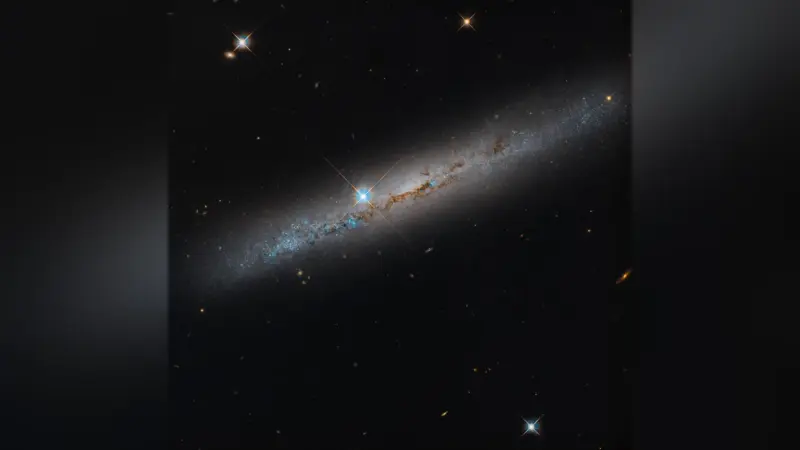
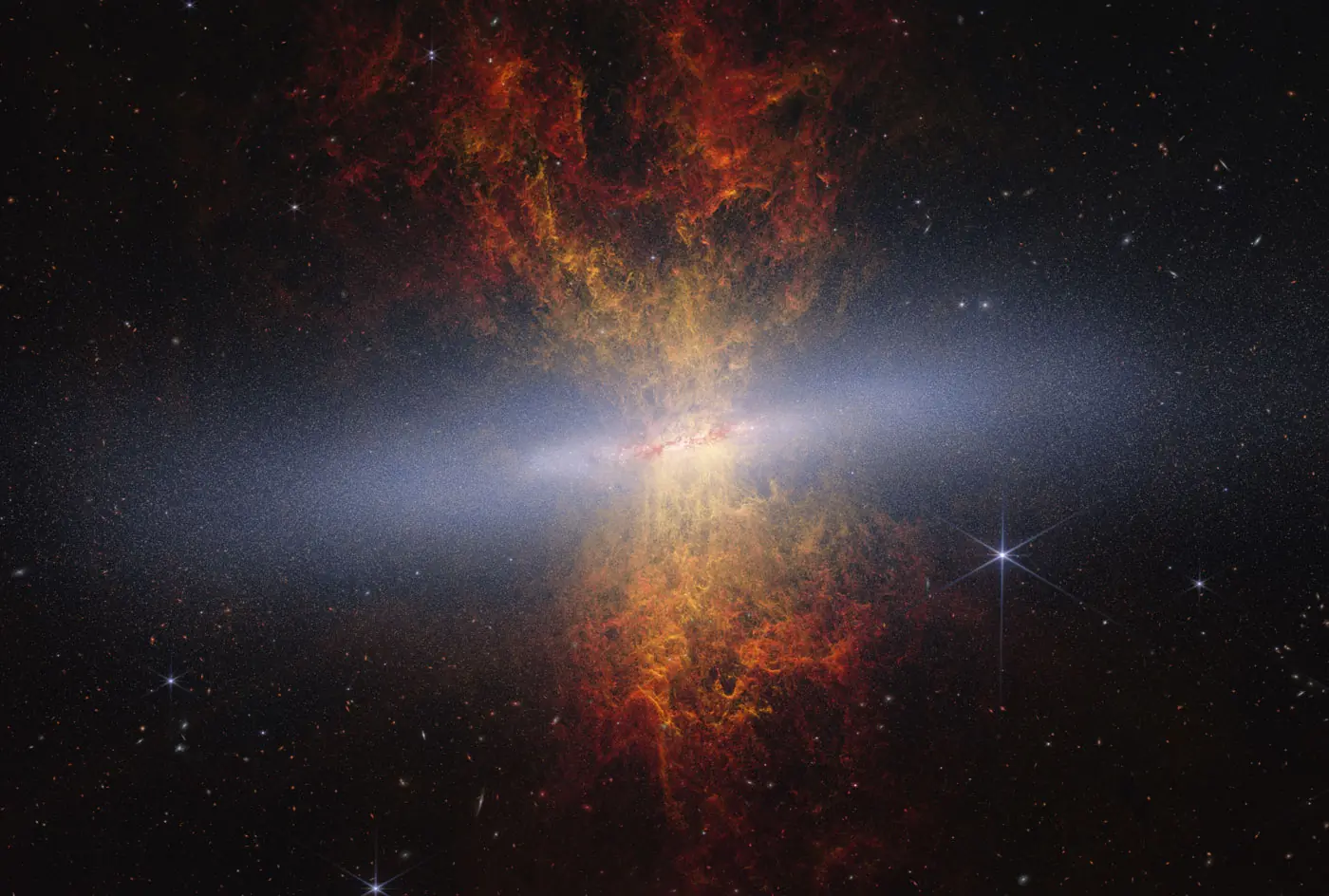
NASA presented a new image of Messier 82, also known as the Cigar Galaxy, based on recent observations by the James Webb Space Telescope and combined with archival data from the Hubble Space Telescope. The new view provides a more complete look at the galaxy, which is seen nearly edge-on from Earth and is known for its intense star-forming activity.
The observation is important because Webb, with its ability to see infrared light, can peer through clouds of dust and gas that hide much of the galaxy’s structure. This allows scientists to study the shape of M82 more clearly, as well as approximately 16.5 million of its stars.
A galaxy with extreme star formation
Messier 82 is a starburst galaxy, meaning it is forming new stars at a very high rate. This intense activity is thought to be linked to a past merger or gravitational interaction with another galaxy.
The image shows a bright disk, with spectacular gas plumes extending above and below it. These outflows have an hourglass-like shape, appearing more yellow near the galaxy’s bright center and becoming redder farther away.
What Webb sees beyond visible light
The major advantage of the James Webb Space Telescope is its ability to observe infrared light. In galaxies like M82, where dust and gas obscure much of the internal structure, this capability allows scientists to look deeper into the system.
Combined with Hubble data, the new observation helps scientists better separate stellar populations, active star-forming regions, and the enormous flows of material being ejected from the galactic disk.
Star formation may threaten M82’s future
Although M82 is currently forming stars at an impressive rate, this phase is expected to be relatively brief in the galaxy’s history. Extreme star formation drives powerful outflows that remove gas from the galaxy.
This has consequences for M82’s future, because gas is the basic material from which new stars form. In other words, the same process that makes the galaxy so active today may limit its ability to create new stars in the future.
What we think
The new image of M82 shows why the combination of Webb and Hubble is so important for modern astronomy. Webb reveals what dust hides, while Hubble data adds valuable context. The Cigar Galaxy remains one of the most impressive laboratories for studying the birth and evolution of stars.
Frequently asked questions
What is Messier 82?
Messier 82, also known as the Cigar Galaxy, is a galaxy with intense new star formation.
Why is Webb’s new image important?
Because Webb observes in infrared light and can peer through dust and gas, revealing details that are difficult to see in visible light.
How many stars are visible in the new observation?
The new view allows scientists to identify approximately 16.5 million stars in M82.
What do the outflows above and below the galaxy show?
They show material being ejected from the galactic disk as a result of intense activity and rapid star formation.