

Summary
- Creative work is not a standardised consumer commodity.
- The fee reflects individual vision, experience and production requirements.
- Black Friday shifts the focus of the message from artistic vision to the lowest price.
- Flexible pricing for a commission differs from a seasonal discount.
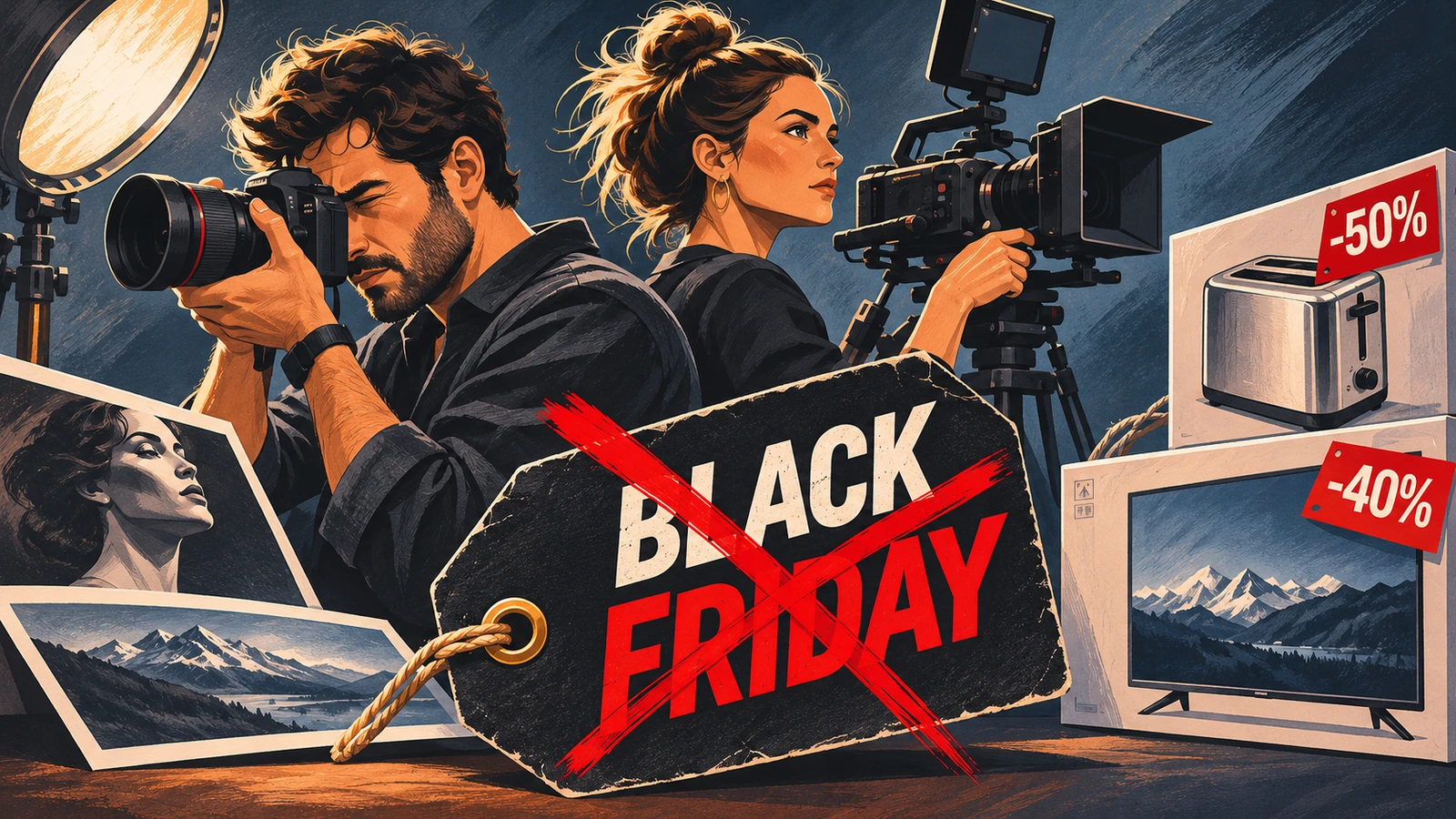
Every year, as Black Friday approaches, advertisements for discounted photo and video packages appear alongside deals on televisions, appliances and camera equipment. In our view, this practice sends the wrong message about the profession itself.
Photographers and videographers are professionals, but above all they are creators and artists. Their work is not a toaster or a television sitting on a store shelf. It is a work shaped by their own vision, their choices and their relationship with the subject they take on.
Creative work is not a commodity on a shelf
A store can sell two identical televisions at different prices without changing the product. A commissioned photo shoot or film production, on the other hand, does not exist ready-made on a shelf. It has to be planned and carried out for a particular person, business or story.
Two photographers can use exactly the same camera, lens and lighting and create entirely different images. The same applies to two videographers asked to tell the same story. Aesthetics, composition, rhythm, sensitivity and the ability to observe and interpret the subject are what make the results different.
At a wedding, for example, clients entrust someone with moments that cannot be repeated. In a corporate video, they entrust someone with the way their business will be presented. In both cases, the choice of creator matters far beyond the number of files delivered.
What the client is actually paying for
The fee is not just for the hours we spend behind the camera. Depending on the project, it covers communication, research, preparation, shooting, selecting material, image processing, editing, sound, colour grading and delivery. It also encompasses operating expenses, equipment maintenance and replacement, and responsibility for a reliable result.
In its guide to commissioned photography, the American Society of Media Photographers (ASMP) distinguishes creative fees from licensing fees and production expenses. The creative fee reflects experience, creativity, individual vision and the complexity of the assignment.
This has practical implications for video as well: delivering a short clip for an organic social media post is different from designing a production for widespread advertising use. Pricing needs to reflect the actual scope, requirements and agreed usage terms of the work.
The message we send to clients
When consumers think of Black Friday, they are typically looking to get the product they want at the lowest possible price. For a particular television, that comparison makes sense: the same model remains the same regardless of the retailer selling it. When creators adopt this approach, however, they transfer that same selection criterion to their own work. That is where the communications mistake lies.
If a photographer’s main message is “book today for 40% off”, prospective clients have another reason to compare percentages instead of studying portfolios, discussing their needs and finding someone whose work speaks to them. They may also wonder why they should pay the regular price when the same service is periodically offered for less.
In doing so, we devalue our own creative work through the way we communicate it: instead of asking clients to choose our vision, we ask them to choose our discount. And if the reason they choose us is that we are cheaper, what will stop them from turning to someone even cheaper tomorrow?
A discount may bring immediate bookings. The question is whether it builds the professional identity we want over the long term. When a lower price becomes the main selling point, we allow our creative work to compete in an arena where someone cheaper can always appear.
Negotiating is not the same as Black Friday
Professionals have every reason to adapt proposals to their clients’ needs and budgets. They can shorten the shoot, choose a smaller production crew, agree on fewer deliverables or organise a special session with a clearly defined scope and sustainable costs. They can also choose to donate their work to a social or artistic cause they believe in.
These are deliberate professional and creative decisions. They differ from an across-the-board discount driven by the retail calendar. Even selling a finished photobook or a series of prints has a different economic logic from taking on a new bespoke commission.
If we want to use this period to communicate with our audience, we can showcase a finished project, explain the process behind an image, talk about our aesthetic or highlight the experience we offer clients. We do not need to imitate the advertising vocabulary of department stores to become visible.
What we think
Black Friday can be a useful opportunity for us as buyers. A lens, computer or light that we need might be available at a better price. The Black Friday shopping guide addresses precisely this side of the profession. But buying the tools is one thing; the value of the work we create with them is another.
We are creators, not appliance companies. Black Friday belongs to the logic of retail, not to the way we believe we should communicate our artistic work. We want clients to choose us because they recognise something distinctive in our work, not because they found the biggest discount. Professional sustainability and artistic identity are not competing objectives. Sound pricing is one way we protect the time and freedom that creative work requires.
Let us buy our equipment on Black Friday without treating our creative work as clearance stock. If we do not communicate the value of our work ourselves, we will struggle to persuade clients to recognise it.