

Summary
- Christoforos Anagnostopoulos explains why London never really “ends” photographically.
- The three-day workshop is limited to five participants for personal guidance in the field.
- Creative Control and Less is More sit at the core of his approach.
- The program combines street, travel and architectural photography from sunset into the night.
- He advocates carrying less gear, observing more, and investing in experiences.
- The goal is for each participant to leave with a clearer personal vision, not simply more photographs.
- London, a small group and creative control
- From tourist photography to visual storytelling
- Light, geometry and night photography
- Gear, self-limitation and growth in the field
- Experience, technology and personal photographic style
- Why London
- Christoforos Anagnostopoulos
- What we think
- Frequently asked questions
Christoforos Anagnostopoulos talks to PTTL about London as a field for photographic learning, where observation, composition and personal vision matter more than the gear itself.
For the photographer and filmmaker, London is a city that never really “ends” photographically: its light, atmosphere, contrasts and very different neighborhoods make it possible to move from street and travel photography to architecture, landscape and night photography.
In the interview that follows, he explains why he chose a group of only five people for the three-day workshop, what “Creative Control” and “Less is More” mean in practice, how photographic storytelling changes as the light changes, and why he believes training the eye is more important than constantly upgrading equipment.
London, a small group and creative control
Christoforos, what keeps bringing you back to London for a photography workshop, and what do you think this particular city offers a photographer?
London is one of those cities that photographically never “ends.” No matter how many times you visit, it always has something new to offer, because the light, the atmosphere and the rhythm of its streets are constantly changing. Autumn in London is, for me, the best time to visit, ideal for working with shadows, contrast and color.
What makes London unique for a photographer is its endless variety. Within a relatively short distance, you can move from the strict Brutalist lines of the Barbican to the modern glass skyscrapers of Canary Wharf. You can work on street photography and then, when you visit one of the city’s many parks, try nature or landscape photography.
The workshop is limited to just five participants. Why did you choose such a small group, and how much does that change the way you work with each photographer?
My goal in every workshop is to have meaningful, personal contact with each participant individually. I want to be beside them at the moment of capture, to share my knowledge and techniques in practice, and to answer any question that comes up on the spot.
A small group of five people is the ideal number for creating a genuinely enjoyable photographic group. For three days we will spend a lot of time together, photographing, talking and exchanging views about photography.
For me, the overall experience is just as important as photography itself. I want everyone to enjoy the trip, feel comfortable, and leave not only with better images but also with beautiful memories.
You often talk about “Creative Control.” What does it mean in practice for a photographer to gain real creative control over an image?
For me, “Creative Control” means moving from the stage where you simply record what is in front of you to the stage where you consciously decide how you want to present it.
In practice, it means you do not let the camera or its automatic settings make the decisions for you. You fully understand how light, exposure, depth of field, the choice of focal length, or the use of a filter can completely change the mood of an image.
Once you gain that control, you stop relying on luck and begin creating images with intention, consistency and personal character.
One of the core elements of the workshop is the “Less is More” philosophy. How does that approach work in a city as dense and visually chaotic as London?
London is indeed a city full of visual “noise”: people, buildings, signs, movement. It is very easy for a photographer to feel overwhelmed and try to fit everything into one frame.
The “Less is More” philosophy applies exactly there: we learn to subtract instead of add.
In practice, this means looking for clean lines, strong contrasts of light and shadow, or isolated elements that stand out from the environment. Instead of photographing the entire building or the whole street, we focus on a geometric detail, a reflection, or a figure moving within a natural frame.
By isolating what is essential and leaving outside the frame anything that distracts attention, we turn urban chaos into a strong, balanced and atmospheric image.
From tourist photography to visual storytelling
How can a photographer move beyond classic tourist photography and create images in London with a personal identity?
Tourist photography usually focuses on what we see, meaning the simple recording of a familiar landmark. Meaningful photography, however, focuses on how we see it and on what it makes us feel.
To move beyond the classic snapshot, the first step is to change our point of view. Instead of standing where everyone stands, we look for unusual perspectives: a very low angle, reflections in glass surfaces or puddles, or the use of light and shadow to create strong contrasts.
Human presence and atmosphere also play a decisive role. A familiar landmark takes on a completely different character when it becomes the background for a spontaneous street moment, or when it is captured through a more abstract, Fine Art approach.
This is exactly what we work on in the workshop: not staying on the surface of the subject, but using the elements of the city as “materials” to compose an image that expresses our own aesthetic and visual identity.
The program combines street, travel and architectural photography. What do these three genres have in common for you, and how can they work together in a photographic narrative?
For me, these three genres are not isolated compartments, but different sides of the same story.
Their common ground is context and atmosphere. Architecture provides the structure, the geometry and the “stage” on which city life unfolds. Street photography brings pulse, human presence, emotion and the unpredictable moment. Travel photography is the connecting link that embraces everything, giving the sense of place and journey.
When you combine these elements, the photographic narrative gains depth. You are not simply showing a beautiful building or a random street portrait. You show how people interact with their urban environment. A geometric line on a skyscraper comes alive when a figure passes beneath it at the right moment.
In the workshop we learn to see the city as a single whole, composing images that complement one another and tell a complete story.
From Notting Hill and Soho to the City and Canary Wharf, you have chosen very different photographic environments. What criteria did you use to design this route?
The route was designed to offer the greatest possible visual and aesthetic variety, allowing participants to see and photograph all the different sides of the city over three days.
Each area reveals a completely different personality of London and serves a specific educational purpose. For example, Notting Hill expresses the more classic, picturesque and lively side of the city, while the City and Canary Wharf represent London’s modern, futuristic and imposing face.
I want participants to experience this alternation, challenge themselves in different conditions and environments, and see how the same photographic philosophy can be applied to every different corner of the city.
Light, geometry and night photography
Light, shadows, geometry and reflections play an important role in the workshop. What should a photographer learn to observe first before even raising the camera?
The first and most important thing a photographer should learn to observe is how the light falls in the space and what shadows it creates. Before even touching the camera, you need to understand the direction, quality and intensity of the light. Light reveals textures, but shadows are what give volume, depth and mystery to an image.
Geometry comes immediately after that. The photographer needs to “scan” the space with their eyes, looking for clean lines, leading lines, shapes, and surfaces that can create reflections, such as glass, metal or even a puddle in the street.
In reality, most of the photographic process happens before you raise the camera. Once you learn to read the light and the structure of the environment with the naked eye, the camera becomes the medium, the tool that records what you have already composed in your mind.
The program includes shooting at sunset, during blue hour and also night street photography. How does your approach to composition and storytelling change as the light changes?
As the light changes through the day, the “language” with which we approach the city changes completely as well.
At sunset, with low, warm light, we make use of long, dramatic shadows and silhouettes, giving the narrative a warmer and more nostalgic character.
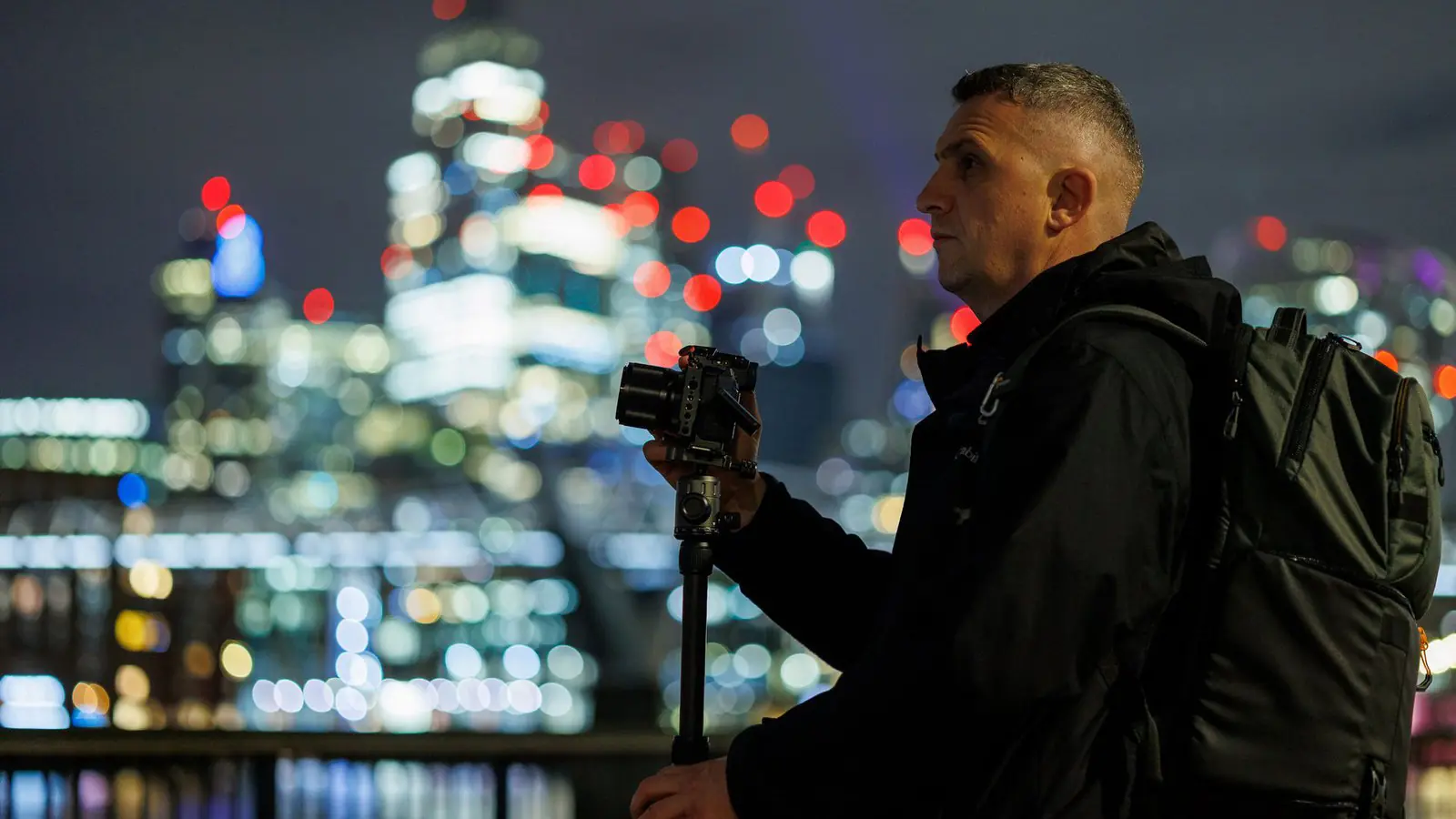
During Blue Hour, the atmosphere is transformed, as the balance between the deep blue sky and warm artificial lights creates a unique color contrast. The storytelling becomes more atmospheric and cinematic, with an emphasis on geometry and reflections.
When we move into night street photography, the light becomes local and the approach changes radically. We do not photograph the entire environment; instead, we focus on “islands of light”: a shop window, a neon sign or a street lamp. Darkness removes visual noise, composition becomes simpler, and the image gains mystery, bringing out the human figures moving through the city.
Gear, self-limitation and growth in the field
Is there any particular photographic equipment you consider ideal for this workshop, or do you want participants to learn to make better use of what they already have?
The best equipment is always what you already have. Regardless of the camera each person owns, everyone can participate normally, even with a basic camera and a simple kit lens. The main goal of the workshop is not to enter a process of buying new gear, but to help each participant use one hundred percent of the capabilities of the tools they already have.
For the needs of this particular London workshop, all you need is a versatile lens that covers wide-angle shots through more normal focal lengths, so it can handle architecture, street and travel photography.
At the same time, because of my collaboration with Tokina and Hoya, we will have specialized filters with us, such as polarizers, ND filters and night-photography filters, which participants will be able to try in practice. This way, they will see how the right optical filter can elevate composition and creative control directly in the field.
How important is it for a photographer to limit the gear they carry, and can having too many lenses and cameras ultimately work against creativity?
It is extremely important. Having too many choices of lenses and bodies not only does not help, but very often works directly against creativity.
A photographer carrying too much heavy gear faces two main issues. First, when you have many lenses in the bag, you constantly spend time thinking about which one to choose for your subject. That makes you miss the moment and the energy of the street, and in the end it tires you mentally and creatively. Second, when you walk all day in a city like London, the physical fatigue from the extra weight is unavoidable and takes away your desire to observe the environment.
This is exactly where the “Less is More” philosophy finds its fullest application. For me, one or two lenses, ideally primes, are the best choice. That self-limitation does not hold you back; it frees you. It forces you to move through the space yourself, adapt to the environment, work harder on your composition and ultimately achieve the shot you really want, while staying focused on the essence of the image.
Having already run previous workshops in London, what are the most common mistakes you see participants make at the beginning, and what change do you usually notice by the end?
The most common mistake I see at the beginning is haste and the excessive pressure participants put on themselves. Many arrive with very high expectations built from the idealized images they see every day on social media, wanting to make the “best photograph ever taken.” That expectation creates anxiety, and when a shot does not immediately turn out as they imagined, they become disappointed and lose their flow. At the same time, they raise the camera immediately without first reading the light, the background or the composition.
I also notice an initial hesitation to get closer to the subject or to wait patiently. Many take one quick photo and leave, instead of staying in place and working the frame.
The change that happens by the third day, however, is impressive. You see people letting go of performance anxiety, disconnecting from social-media images and slowing their pace. They stop chasing quantity or the “perfect” image and focus on substance. They learn to wait for the light, trust the process and compose cleaner, more mature images that express their own genuine vision.
What level should someone have to take part? Is this workshop mainly for advanced photographers, or can someone still in the early stages benefit meaningfully as well?
The workshop is designed to offer meaningful benefits to every photographer, regardless of their level. The only thing someone needs to know beforehand is the basic operation of their camera: the fundamental settings of aperture, shutter speed and ISO.
From there, the structure of the workshop focuses on developing the photographic eye, composition, reading light and storytelling, concepts that matter equally to a beginner and a more advanced photographer. That is exactly why the workshop takes place entirely in the streets of the city and not in a room with PowerPoint presentations. Everything we analyze and discuss happens directly in practice, in the field.
For a photographer at the beginning of the journey, it is a unique opportunity to build strong foundations quickly, let go of fears and learn to think photographically. For a more advanced photographer, it is an ideal opportunity to break away from old habits, try new techniques and develop a personal visual identity. Because the group is very small, up to five people, the guidance is fully adapted to the needs and level of each participant individually.
Experience, technology and personal photographic style
When these three days in London are over, what is the most important thing you would like each participant to take away — beyond the photographs they will have created?
Beyond the photographs themselves, what I want above all is for them to take away a complete, unforgettable experience. I want each participant to leave full of images, not only on the camera’s memory card but, first of all, in their mind and heart.
My goal is for them to feel that they lived three creative days in which they truly enjoyed photography, without stress or pressure, among people who share the same passion. To return home inspired, with a new and clearer way of seeing the world around them, having made new friends and reconnected with the joy of creating. If that happens, then the workshop has achieved its ultimate purpose.
As a photographer and educator, do you think we give too much importance today to technology and gear and too little to how we actually learn to see?
Without a doubt, yes. We live in a time when technology is evolving at a breakneck pace, and it is very easy to get trapped in the logic of specs, megapixels and the newest equipment. Many people mistakenly believe that buying a better camera will automatically turn them into better photographers.
In reality, all cameras of recent years offer excellent performance that more than covers our needs. Instead of constantly investing money in the new model that has just been released, I would encourage every photographer to invest that money in photographic trips, experiences and photo books. Those are the things that will broaden their horizons, train their aesthetic sense and truly inspire them.
Technology is an excellent tool that makes things easier for us, but it remains simply a means, not the goal. A camera has no aesthetic sense, does not understand emotion and cannot compose a story. The most essential part of photography is training your eye: learning to observe light, look for geometry and feel the rhythm of the environment. When you spend more time “seeing” than dealing with gear, your photography gains a real identity.
Do you believe personal photographic style can be taught, or is it something every creator ultimately has to discover alone?
I believe photographic style cannot be “taught” in the strict sense, as if it were a rule to memorize. Personal style is the imprint of each creator’s personality, aesthetic influences and character. It is something everyone ultimately has to discover for themselves, through their experiences, life and emotions.
What can and should be taught, however — and this is exactly where the role of an educator lies — is how to unlock that process. You can teach someone how to observe consciously, how to understand the structure of an image, how to remove visual noise and how to analyze what it is that attracts them to a subject.
In the workshop, our goal is not for everyone to make the same photographs as mine or as the other participants. It is to provide the right stimuli and tools so that each person can trust their own way of seeing. Technique can be learned, but personal style reveals itself when you stop copying others and begin photographing what you truly feel.
For someone thinking about coming to London in October but still hesitating, what would you tell them they will experience during these three days?
I would tell them to put every hesitation aside, because what they are about to experience is not a typical photography lesson but a genuine photographic adventure in one of the most vibrant cities in the world.
During these three days in London, we will walk for kilometers, explore completely different neighborhoods — from picturesque Notting Hill and busy Soho to the imposing architecture of the City of London and the futuristic skyscrapers of Canary Wharf — and learn to see the city in a completely new way.
We will not lock ourselves in any classroom. We will be out in the field from morning until night, trying techniques, playing with light, shadows and reflections, and testing specialized equipment in real conditions.
Most importantly, they will be part of a small, close-knit group of people with the same passion. We will exchange ideas, laugh, become creatively tired, and in the end they will leave not only with excellent photographs and new knowledge, but with memories and friendships that last over time. If you love photography and travel, it is an experience truly worth giving yourself.
Why London
Why did I specifically choose London for this experiential workshop?
Many people consider London a city that has been photographed endlessly, where everything has already been captured. My challenge, and what I want to pass on to participants, is exactly the opposite: to prove that even in the busiest and most photographed environment, if you train your eye, you can discover completely new, unseen perspectives and tell your own unique story.
London offers a rare photographic concentration. Within a few kilometers you change century, light, architecture and human energy. This wealth of stimuli is the best “battlefield” on which a photographer can train.
Thank you very much for the wonderful conversation and the meaningful questions that gave me the opportunity to share the philosophy behind this project!
Christoforos Anagnostopoulos
Christoforos Anagnostopoulos is a professional photographer, filmmaker and Tokina & Hoya Global Ambassador. His journey in photography and filmmaking began at a young age, driven by his admiration for classic landscapes and experimental storytelling techniques.
After a 15-year career in finance, he decided to devote himself fully to his creative side. His work focuses on documentary, travel and urban photography, landscape photography and astrophotography, while his films and projects have received distinctions at international festivals around the world.
Photography education also holds a central place in his work. Through international workshops, mentoring and presentations, his goal is to share his experience in practice and help every photographer develop their own personal vision and visual identity.
Public links: Website, Instagram, Facebook, LinkedIn, TikTok, YouTube.
What we think
The interview with Christoforos Anagnostopoulos shifts the emphasis away from buying gear and toward conscious observation. His focus on light, geometry, self-limitation and personal intent describes a form of photographic education that goes beyond camera settings.
His view that personal style cannot be taught as a formula, but can be cultivated through tools of observation, experience and continuous practice, is particularly interesting. In a city as visually dense as London, that approach makes the environment itself part of the exercise.
Frequently asked questions
How many participants can join the workshop?
The group is limited to up to five people so that there can be personal guidance and meaningful contact with each participant in the field.
What level of photographic knowledge is required?
Participants only need to know the basic operation of their camera, including aperture, shutter speed and ISO. The workshop focuses on vision, composition, light and storytelling.
Is special or expensive equipment required?
No. Christoforos Anagnostopoulos argues that the best equipment is what a photographer already owns. For this workshop, he considers a versatile lens covering wide-angle through more normal focal lengths useful.
What does “Creative Control” mean in photography?
It means consciously deciding how to present a subject, while understanding how light, exposure, depth of field, focal length and filters influence the final image.
What is the main goal of the three days?
Beyond the photographs, the goal is for each participant to leave more inspired, with a clearer personal vision, new experiences and a stronger connection to the joy of creating.