

Summary
- DOOM now runs natively on the 2010 Canon EOS 550D through Magic Lantern
- Camera buttons provide gameplay controls while sound, music and savegames are supported
- A special fullscreen mode renders gameplay at 360 × 240 on the camera’s 720 × 480 display surface
- The project supports multiple Doom-compatible IWADs but does not distribute the commercial game data
- The existing binary works only on the EOS 550D with Canon firmware 1.0.9 and must not be installed on other cameras
- The 2010 Canon EOS 550D becomes a console
- The DSLR buttons become a controller
- It even plays music through the camera speaker
- DOOM uses the full 720 × 480 display surface
- There are saves and support for multiple DOOM games
- It must not be installed on another Canon
- What Magic Lantern is and why it matters
- Why DOOM ends up running everywhere
- What we think
- Frequently asked questions
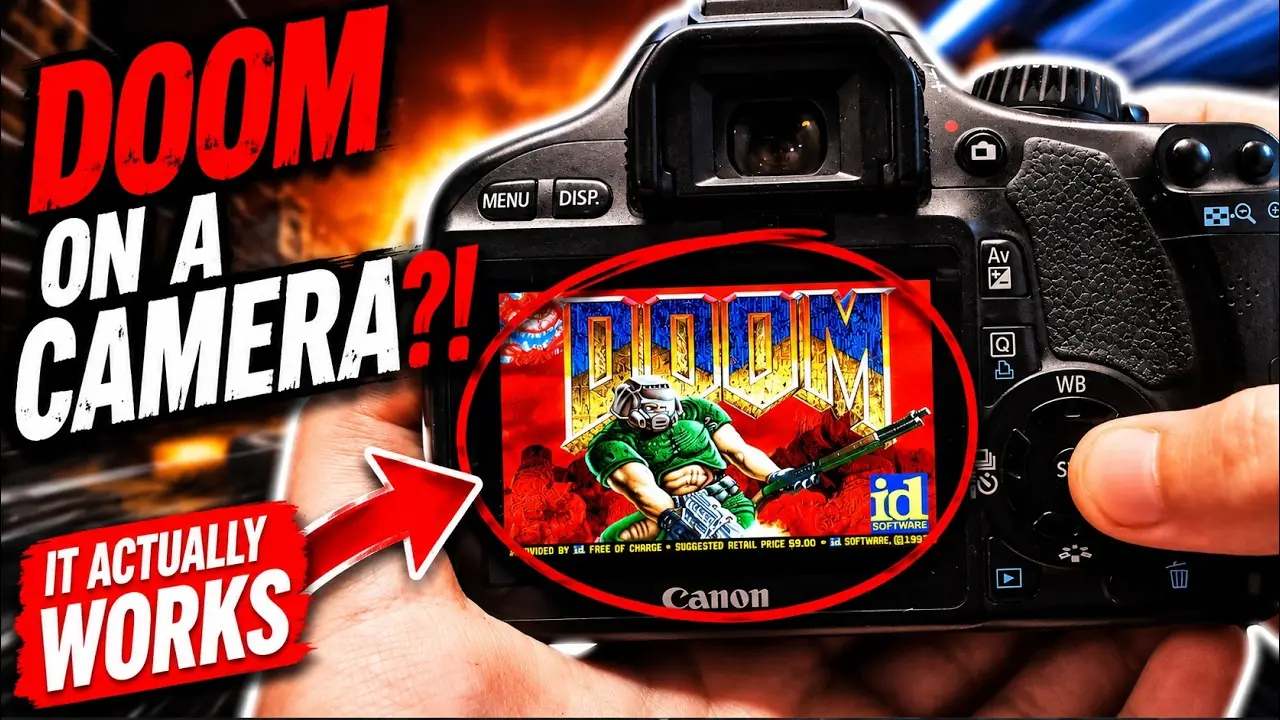
Canon’s 2010 EOS 550D can now properly run the classic DOOM, thanks to an experimental Magic Lantern module supporting DSLR button controls, sound, music and game saving.
Developer Bas Lichtjaar, known as lauris-nl on GitHub, has created a playable DOOM port for the Canon EOS 550D, known as the Rebel T2i in the Americas and Kiss X4 in Japan, effectively turning a 16-year-old DSLR into a small handheld gaming machine. The project runs as a Magic Lantern module, and its current release is described by its creator as experimental.
What makes this interesting is not simply that DOOM has “opened” on yet another unusual device. The port genuinely uses the camera’s hardware: its rear display, physical buttons and audio system, while providing features including saves, selectable IWADs and music. At the same time, it demonstrates how deeply the Magic Lantern community can interact with the hardware of older Canon DSLRs.
The 2010 Canon EOS 550D becomes a console
The EOS 550D was introduced in February 2010 and is built around an 18-megapixel APS-C CMOS sensor and a DIGIC 4 image processor. Canon positioned it in the more affordable part of its DSLR lineup, while it offered features including Full HD video recording and a nine-point autofocus system.
Sixteen years later, the same body can load DOOM as a module through Magic Lantern. According to the project repository, Doom550D supports the EOS 550D / Rebel T2i / Kiss X4 and specifically Canon firmware version 1.0.9.
The result is not a video simply playing on the camera’s screen. It is an actual port of the game running on the DSLR hardware and accepting input from its physical controls.
The DSLR buttons become a controller
The creator has adapted the 550D’s physical controls to cover nearly all of DOOM’s core gameplay functions.
The directional buttons handle movement and turning, SET fires and confirms menu selections, PLAY opens doors and activates switches, and the rear wheel changes weapons. Holding zoom-in makes the character run, while zoom-out combined with the left or right buttons provides strafing.
MENU opens DOOM’s normal menu and DISP. displays the automap. There is even a secret cheat menu, activated by pressing Delete/Trash three times quickly, providing access to classic cheats, music selection and level changes.
It even plays music through the camera speaker
One of the most interesting technical aspects of the project is audio.
The module reads the game’s MUS music data and uses a lightweight 24-voice synthesizer designed to avoid placing excessive load on the DSLR’s processor. The synthesizer generates audio at 24 kHz, which is linearly interpolated into Canon’s 48 kHz output and mixed with DOOM’s original 8-bit sound effects.
The developer makes clear that this is not cycle-accurate OPL2 emulation. The approach was chosen to provide a retro character while remaining lightweight enough not to noticeably compromise gameplay.
DOOM uses the full 720 × 480 display surface
Doom550D also includes a special fullscreen mode for the camera display.
Gameplay can be rendered at 360 × 240 pixels, with every game pixel presented as an exact 2 × 2 block on the 720 × 480 surface used by the module. This avoids interpolation during scaling. Menus, the automap and intermediate screens retain DOOM’s characteristic 320 × 200 layout.
There are saves and support for multiple DOOM games
The project goes considerably beyond a simple proof of concept.
Game saving is supported, with separate saves for each WAD, while menu, music and sound-effect settings remain stored on the card. The module can also list up to 32 compatible IWAD files.
Recognized files include Doom Shareware, Doom / The Ultimate Doom, Doom II, Final Doom: TNT Evilution and Plutonia Experiment, along with Freedoom Phase 1 and Phase 2.
There is, however, an important detail: the repository does not include DOOM’s commercial game data or other WAD files. Users need to provide legally obtained game files themselves.
It must not be installed on another Canon
This is also where the most important warning comes in.
The existing binary has been built specifically for the Canon EOS 550D running firmware 1.0.9. The developer explicitly states that it should not be loaded on another camera model or another firmware version.
Porting it to another Magic Lantern-compatible Canon is not a trivial process. The display and palette handling, button codes, audio backend, storage access and correct hardware restoration when exiting the game all have to be checked and potentially adapted.
The creator estimates that porting to a closely related camera could require 3 to 7 working days of engineering, while a different DIGIC generation or undocumented audio hardware could increase the workload to 4 to 8 weeks or more. These are the developer’s estimates rather than guaranteed schedules.
What Magic Lantern is and why it matters
Magic Lantern is unofficial open-source software for selected Canon DSLRs, designed to add capabilities beyond Canon’s official firmware.
On the 550D, Magic Lantern is loaded from the memory card and does not replace Canon’s original firmware. The project’s page for the camera warns that Magic Lantern is neither approved nor endorsed by Canon and that its use is at the owner’s risk.
Magic Lantern’s history is closely tied to the development of Canon DSLRs as tools for video and experimentation. PTTL recently looked at that legacy through its retrospective on the Canon EOS 5D Mark II and its connection to Magic Lantern.
Why DOOM ends up running everywhere
Since its release in 1993, DOOM has become an unofficial test for developers looking to demonstrate that a device can execute general-purpose code even when it was never designed for gaming.
The EOS 550D example is particularly interesting for the photography world: a body designed 16 years ago for still photography and Full HD video has enough processing capability, a display, storage, buttons and an audio subsystem to become an entirely different type of device with enough low-level engineering.
What we think
DOOM on the Canon EOS 550D does not add any practical photographic feature, but it is an impressive example of how interesting older hardware can remain when an active developer community surrounds it. More compelling than the game itself is the technical work required to adapt display output, buttons, audio and saves to a DSLR from 2010. The creator’s explicit warning that compatibility is limited to the 550D running firmware 1.0.9, however, means this should be treated as an experimental project rather than a module to be tried indiscriminately on any Canon camera.
Frequently asked questions
Which Canon camera can run this DOOM port?
The current Doom550D release is intended exclusively for the Canon EOS 550D, also known as the Rebel T2i and Kiss X4, running firmware 1.0.9.
Does it require Magic Lantern?
Yes. DOOM runs as a Magic Lantern module and requires a compatible installation for the EOS 550D with firmware 1.0.9.
Is DOOM itself included with the project?
No. The repository does not distribute DOOM’s commercial WAD data. Users must legally own a compatible IWAD or use compatible freely distributable content such as Freedoom.
Are sound and game saving supported?
Yes. The port supports music and sound effects through the camera’s audio output, along with separate save files for each WAD.
Can the same module be installed on another Canon DSLR?
No. The developer explicitly warns against using the existing binary on any other model or firmware version. Supporting another camera requires a dedicated port.