

Summary
- Sigma and Tamron occupy eight of BCN’s ten leading lens positions in Japan.
- Sigma sweeps the first four places, led by the 18-50mm F2.8 for Sony E.
- No Canon-branded lens appears in the Top 10, but the RF-mount Sigma ranks second.
- The data covers July 2026 sales from participating Japanese retailers.
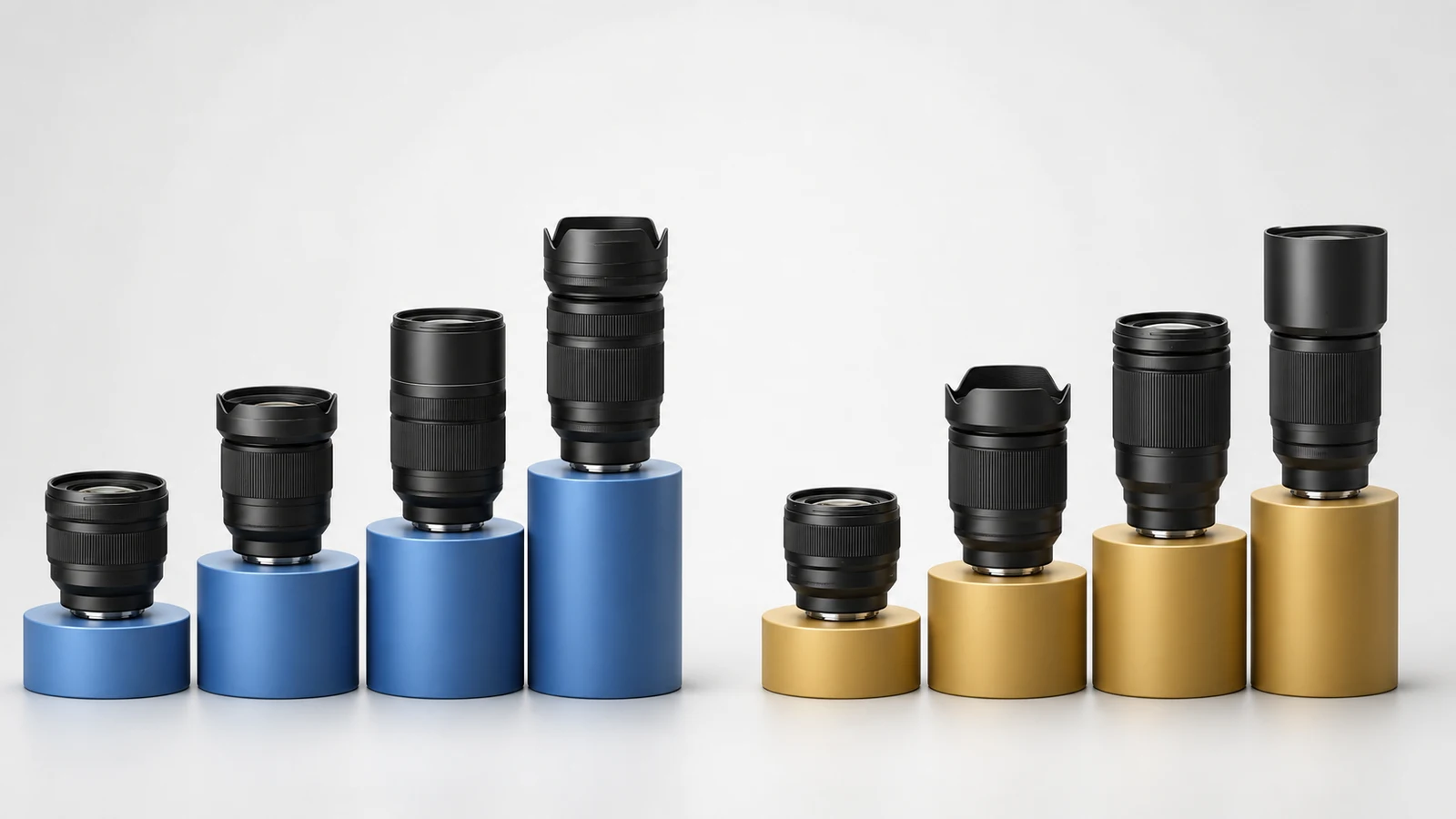
Sigma and Tamron occupy eight of the ten leading positions in BCN’s interchangeable-lens sales ranking for July 2026 in Japan, leaving every Canon-branded lens outside the Top 10.
Sigma achieved something even more striking: it swept the first four places, led by the 18-50mm F2.8 DC DN Contemporary for Sony E-mount. The same lens ranks second for Canon RF and fourth for Fujifilm X, while the full-frame 28-70mm F2.8 DG DN Contemporary for Sony E-mount takes third place.
The figures show the strength of independent manufacturers in a market where users increasingly choose a lens brand different from their camera body. They are not global market share and do not prove that Canon sells no lenses: this is a monthly model ranking from participating Japanese retailers.
BCN’s complete July Top 10
| Position | Lens | Mount |
|---|---|---|
| 1 | Sigma 18-50mm F2.8 DC DN Contemporary | Sony E |
| 2 | Sigma 18-50mm F2.8 DC DN Contemporary | Canon RF |
| 3 | Sigma 28-70mm F2.8 DG DN Contemporary | Sony E |
| 4 | Sigma 18-50mm F2.8 DC DN Contemporary | Fujifilm X |
| 5 | Tamron 17-70mm F2.8 Di III-A VC RXD | Sony E |
| 6 | Tamron 25-200mm F2.8-5.6 Di III VXD G2 | Sony E |
| 7 | Nikkor Z 24-120mm F4 S | Nikon Z |
| 8 | Tamron 70-180mm F2.8 Di III VC VXD G2 | Sony E |
| 9 | Sony E 70-350mm F4.5-6.3 G OSS | Sony E |
| 10 | Tamron 50-400mm F4.5-6.3 Di III VC VXD | Sony E |
Sigma and Tamron each hold four positions. The two first-party lenses are the Nikkor Z 24-120mm F4 S and Sony E 70-350mm F4.5-6.3 G OSS.
The Sigma 18-50mm F2.8 achievement
The same optical design appearing in first, second and fourth place may be the ranking’s most revealing detail. On APS-C, the 18-50mm F2.8 covers a practical everyday range, keeps a constant f/2.8 maximum aperture and remains small enough for compact mirrorless bodies.
Its success in Sony E, Canon RF and Fujifilm X shows that demand is not limited to one system. Sigma has used a common core design to address three major APS-C audiences with a faster alternative to typical kit zooms.
Tamron covers four different needs
Tamron’s four entries are not repetitions of one model. The 17-70mm F2.8 targets APS-C users seeking a fast standard zoom with additional reach. The 25-200mm G2 is a travel zoom, the 70-180mm F2.8 covers portraits and events, and the 50-400mm provides an extended telephoto range in one lens.
All four ranked versions use Sony E-mount. This underlines how mature Sony’s third-party ecosystem has become and how strongly lens choice contributes to a camera system’s appeal.
What Canon’s absence really means
No Canon-branded lens appears in this month’s Top 10. That does not mean the RF system is absent: the Sigma 18-50mm for RF ranks second and is used on bodies including the EOS R7, R10, R50 and R100.
The distinction between lens brand and mount is important. The list may be read as pressure on Canon to offer more affordable or faster options, but it also proves that opening RF to selected independent manufacturers can increase the value of the ecosystem itself.
Why zoom lenses dominate
All ten products are zooms. Buyers appear to prefer lenses that can remain on the camera across multiple uses, from travel and everyday photography to sports and wildlife.
Fast f/2.8 standard and telephoto zooms take several places, but they coexist with broader variable-aperture models. There is no single formula for success: weight, range, price, stabilisation and compatibility can carry different importance for different users.
How to read BCN data
BCN Ranking is based on actual retail sales data from participating physical and online stores in Japan. It is useful for identifying model trends, but it does not cover every retailer and does not automatically represent Europe, Greece or the global market.
A monthly list may also be affected by promotions, stock availability and recent releases. Firmer conclusions require comparison across several months and sales channels. Similar caution is needed when examining broader Japanese camera-market data.
What we think
The July ranking does not prove a permanent reversal, but clearly reveals what the market rewards: useful zoom ranges, constant f/2.8 where it matters, compact size and prices that compete with first-party lenses. The Sigma 18-50mm’s three-mount success sends a stronger message than one brand’s absence because it shows that a well-positioned design can succeed simultaneously across several systems.
Frequently asked questions
Which lens ranked first?
The Sigma 18-50mm F2.8 DC DN Contemporary for Sony E-mount.
How many positions do Sigma and Tamron hold?
They each hold four positions, for eight of the ten places combined.
Is Canon RF completely absent?
No. There is no Canon-branded lens, but the Sigma 18-50mm for Canon RF ranks second.
Do the figures represent the global market?
No. They cover sales by participating BCN retailers in Japan during July 2026.