Summary
- Tamron has announced the APS-C 16-50mm F2.8 A for four mounts.
- Weight starts at 305g and autofocus uses a VXD motor.
- The lens does not include VC stabilization.
- Launches begin on October 29, 2026.
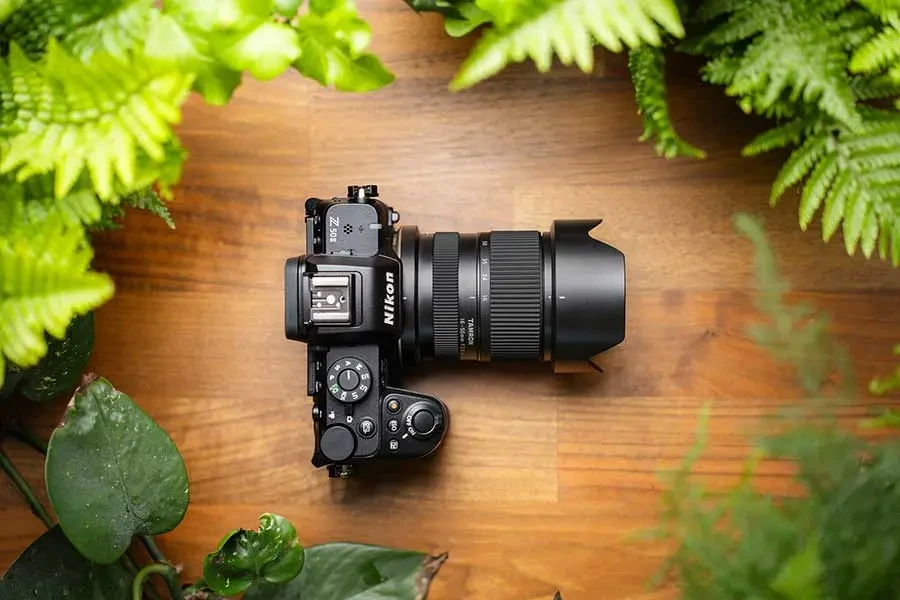
The new Tamron 16-50mm F2.8 A (Model B091) brings a constant F2.8 aperture and compact dimensions to four APS-C mirrorless mounts.
Announced on October 14, 2026, the lens is coming to Sony E, Nikon Z, Canon RF and Fujifilm X. Its appeal is straightforward: a brighter standard zoom with a wider starting point than many kit lenses, without adding much weight to an everyday setup.
An everyday zoom starting at 16mm
On Sony, Nikon and Fujifilm APS-C cameras the range is equivalent to 24-75mm on full frame; on Canon RF it is 25.6-80mm. The wide end is useful for interiors, architecture and travel, while 50mm works for portraits and tighter framing.
The maximum F2.8 aperture stays constant throughout the zoom range. That allows faster shutter speeds in lower light and greater control over depth of field than a typical variable-aperture kit zoom.
Tamron already offers the 17-70mm F2.8 Di III-A VC RXD, with a longer reach and VC optical stabilization. The new 16-50mm prioritizes compactness, sacrificing both the additional telephoto range and built-in VC.
Compact dimensions vary by mount
The Sony E version measures 79.6mm long and 64.4mm in diameter, weighing 305g. The Nikon Z version is 81.6mm long and weighs 315g, while Canon RF and Fujifilm X versions weigh 305g. All share a 55mm filter thread, moisture-resistant construction and a fluorine coating on the front element.
The Toned Profile Next design includes a practical touch: holes in the front cap let owners tether it with a cord. Tamron warns that the tethered cap must not be used to lift or carry the lens.
Autofocus, video and close-up shooting
Autofocus uses Tamron’s VXD linear motor, which the company says delivers fast, accurate and quiet performance for stills and video. These remain manufacturer claims rather than independent test results. Without VC, in-body stabilization, where available, becomes more important for handheld work.
Sony E and Nikon Z versions work with TAMRON Lens Utility for configuration and firmware updates. Canon RF currently supports firmware updates only, and Fujifilm X is not compatible with the utility. Feature customisation therefore differs by mount.
Minimum focusing distance is 15cm at 16mm, with 1:4.5 maximum magnification, and 29cm at 50mm, with 1:4.8 magnification. That opens up creative close-up compositions without making this a true macro lens. Optical construction comprises 14 elements in 10 groups, including LD and aspherical elements, with seven aperture blades and a minimum F16 aperture.
Pricing and availability
Launch dates differ by mount:
| Μοντούρα / Mount | Κυκλοφορία / Launch |
|---|---|
| Sony E, Canon RF | 29/10/2026 |
| Nikon Z | 19/11/2026 |
| Fujifilm X | 17/12/2026 |
European distributor Transcontinenta lists indicative Netherlands prices of €469.99 for Sony E and Fujifilm X, and €499.99 for Canon RF and Nikon Z. These are not confirmed final Greek retail prices. A lens hood and front and rear caps are included.
More details here.
What we think
The 16-50mm makes sense on a compact APS-C body. Its constant F2.8 aperture is a meaningful step up from a typical kit zoom, and the 16mm wide end matters when shooting indoors or trying to fit more of a landscape into the frame.
It will not be the best fit for everyone. Someone with a stabilized camera who values a light kit may find this lens appealing. A photographer who needs more telephoto reach, or shoots handheld on a camera without IBIS, has a strong reason to consider the VC-equipped 17-70mm instead.
The next useful evidence will come from independent samples showing edge performance, real-world focus noise and autofocus transitions in video. Those results will help establish whether Tamron has kept optical compromises in check while reducing size.
Frequently asked questions
Is this a full-frame lens?
It is designed for APS-C sensors. A compatible full-frame camera may need to use crop mode, reducing the active sensor area.
Does it include optical stabilization?
No. The 16-50mm F2.8 A does not include Tamron VC.
Does Lens Utility work on every mount?
No. Sony E and Nikon Z support configuration features; Canon RF supports firmware updates only, while Fujifilm X is not compatible.