Summary
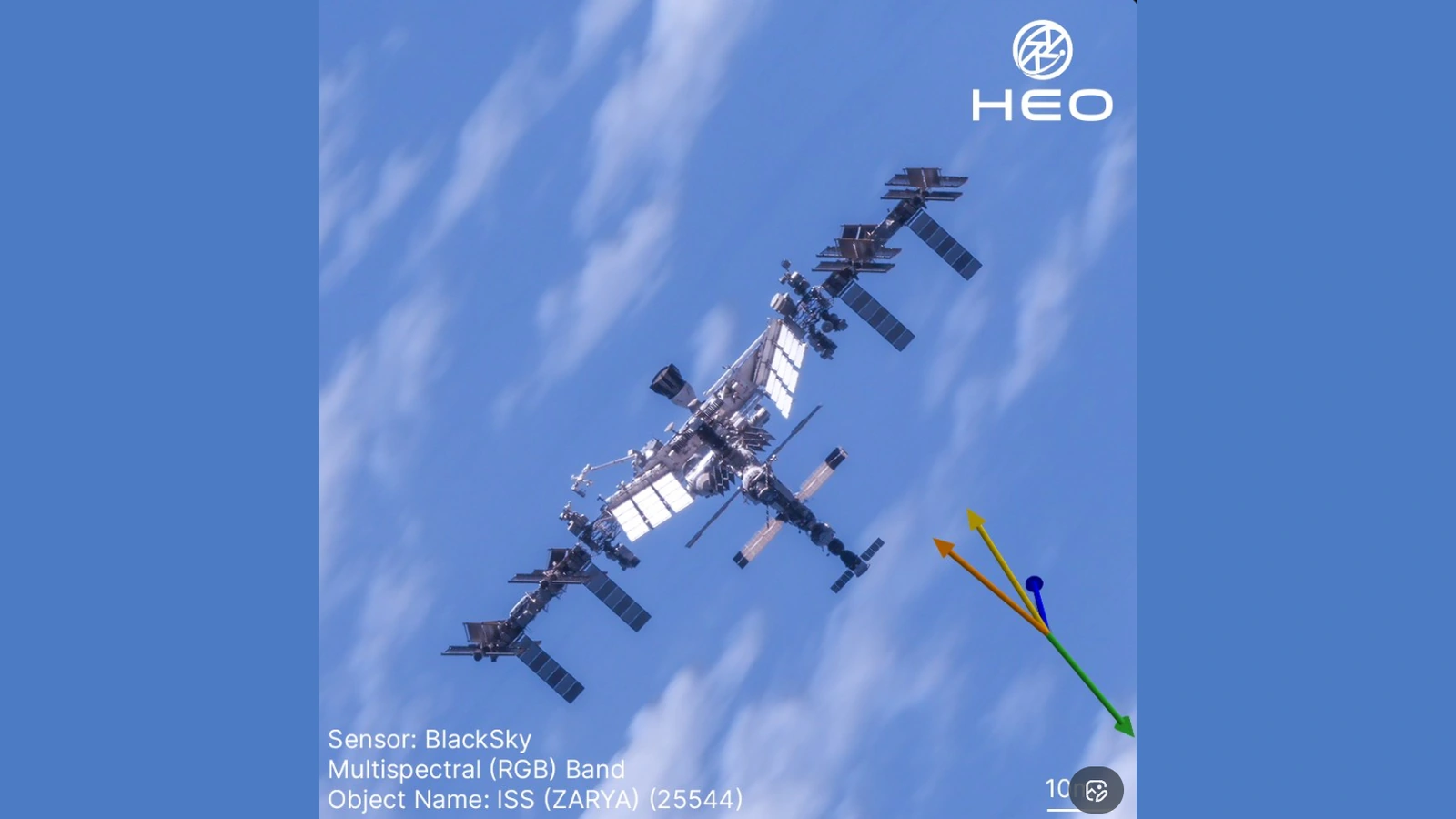
- HEO shared an overhead image of the ISS on November 9, 2026.
- A BlackSky satellite captured it above French Guiana.
- The station stands out clearly against Earth and its clouds.
- Non-Earth imaging can also support spacecraft inspection.
A remarkable image shows the International Space Station (ISS) from above, with Earth’s blue waters and clouds behind it, after another satellite photographed the orbiting laboratory in motion.
Australian company HEO shared the image on November 9, 2026, saying the ISS was orbiting above the coast of French Guiana in South America. The picture was captured using a satellite operated by US company BlackSky.
An unusual perspective on the ISS
Nearly the entire structure of the station is visible, from its outstretched solar arrays to its central modules. The ISS remains sharply defined while the blue Earth and clouds look softer, separating the subject from the background.
We usually see the ISS as a bright point from the ground, or through astronauts’ photographs looking back toward Earth. In a different approach, astronaut Anil Menon photographed a massive typhoon from the Cupola using an iPhone. This time the space station itself is the subject, and the camera is aboard another spacecraft.
How do you photograph a target moving at 28,000 km/h?
The ISS travels in low Earth orbit at roughly 28,000 kilometers per hour. The imaging satellite is moving at orbital speed too, so making the picture depends on carefully calculating the geometry, relative motion and the precise moment when the subject comes into view.
HEO specializes in non-Earth imaging (NEI): pointing satellite cameras at objects in space instead of Earth’s surface. Rather than building a satellite for each imaging task, it uses software and partner sensors, including BlackSky’s, to observe spacecraft already in orbit.
The image also illustrates a practical capability. The same approach can be used to inspect the condition of satellites and other orbital infrastructure, where resolving components and changes in spacecraft configuration can be valuable.
What we think
What makes this image special is the perspective. We are used to looking up at the ISS from Earth, or seeing photographs astronauts take from inside it. Here, one of humanity’s largest constructions in space becomes the subject of a photograph taken in space itself.
For photographers, the technical side is just as compelling: timing and subject tracking matter enormously. Speed alone does not tell the whole story. The relative motion of the two spacecraft, the available imaging window and the planning behind the observation all contribute to the final image.
It is also satisfying to see a tool developed for spacecraft inspection produce an image that works visually as well as technically. It gives us a rare view of something familiar, from a direction we almost never get to see.