


Summary
- 8K/60p and 4K/240p for the first commercial devices.
- Triple 20-bit AI ISP, Elite Color Engine with 3D LUT and APV.
- 10-bit Log, AI video segmentation and real-time skin/sky tone processing.
- Final implementation depends on each smartphone manufacturer.
Qualcomm has introduced the Snapdragon 8 Elite Extreme Gen 6, a new flagship mobile platform designed to enable the first commercial devices to record 8K at 60 frames per second and 4K at 240 fps.
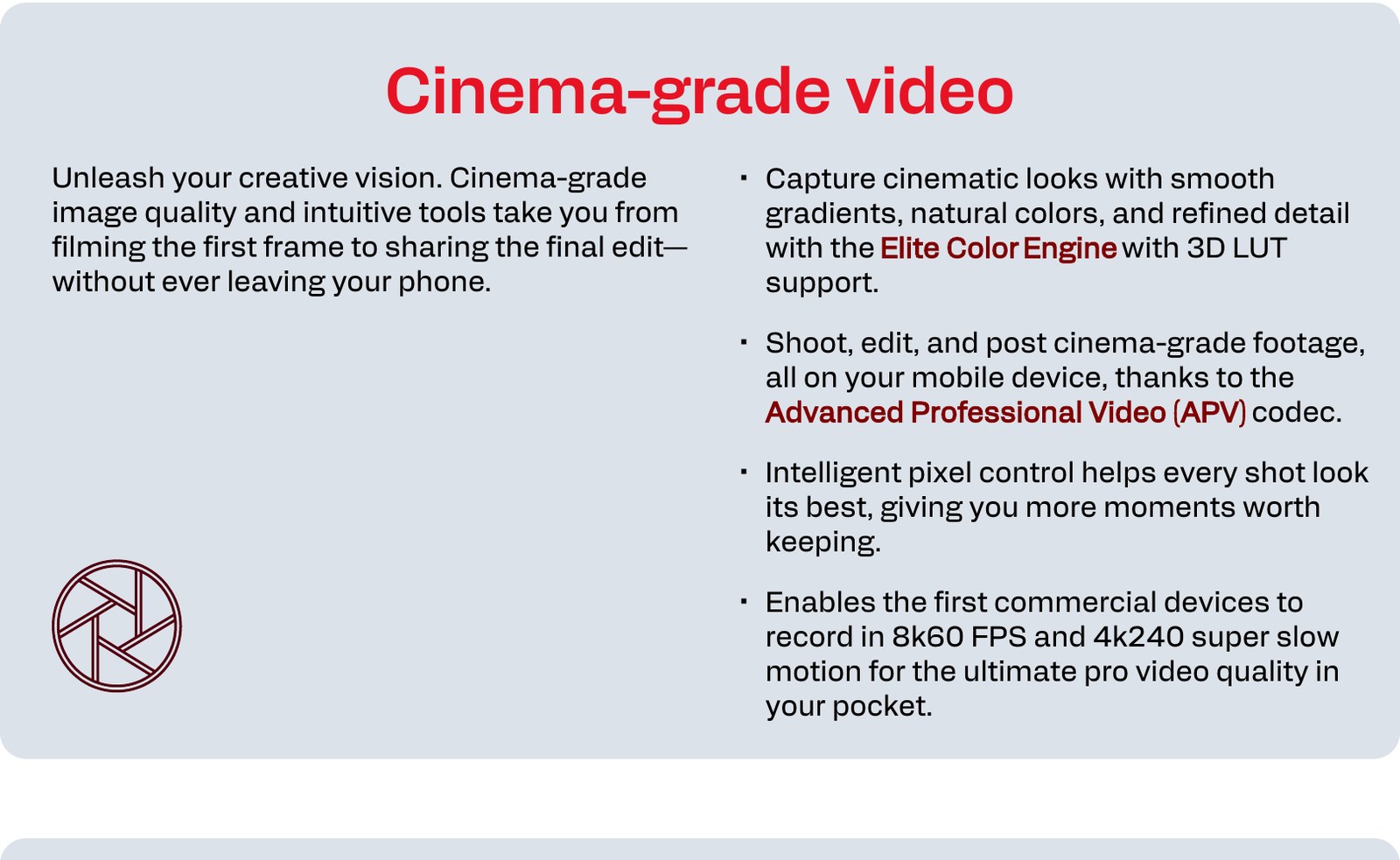
For photographers, filmmakers and content creators, the bigger change is not resolution alone. The platform combines triple 20-bit AI ISPs, an Elite Color Engine with real-time 3D LUTs, Advanced Professional Video (APV), 10-bit Log video and Intelligent Pixel Control, targeting a workflow that can run from capture through editing, grading, mastering and sharing on the device.
Qualcomm also introduced the Snapdragon 8 Elite Gen 6, but the most demanding video capabilities — 8K/60p, 4K/240p and the full APV-oriented production workflow — are central to the Extreme version.
Elite Color Engine, APV and 10-bit Log
The official Product Brief describes the Elite Color Engine with 3D LUT support as a way to produce smoother gradients, more natural colors and refined detail. Qualcomm also says APV enables users to shoot, edit and post cinema-grade footage entirely on the phone. Its official Snapdragon AI page adds support for 10-bit Log video for greater post-production flexibility.
8K/60p, 4K/240p and slow motion up to 960 fps
According to the official specifications, the platform supports 8K video at 60 fps, 4K slow motion at 240 fps and 1080p slow motion at 960 fps. It also includes Pro Sight video capture, video super resolution and ultra-low-light video at 4K/60p with Bayer Noise Reduction, while AI noise reduction is supported at 4K/30p.
Qualcomm lists 16-bit AI data per pixel, enhanced AI video segmentation at 4K/60p and real-time AI skin- and sky-tone adjustments at the same resolution and frame rate. These are platform capabilities; the final result will depend on each manufacturer’s sensors, optics, thermal design and camera software.
Up to three 64MP cameras with zero shutter lag
The Qualcomm Spectra ISP supports up to three 64MP cameras with zero shutter lag, a single camera up to 108MP with zero shutter lag and still capture up to 320MP. It also supports 10-bit HEIF photography and APV video capture.
The technical platform also includes a 2nm process, UFS 5.0 storage and memory support up to 24GB. For mobile video, those elements matter because high data rates, multi-frame processing and on-device post-production require substantial bandwidth and compute resources.
Which smartphones will use it
Qualcomm says devices powered by Snapdragon 8 Elite Extreme Gen 6 and Snapdragon 8 Elite Gen 6 will come from HONOR, iQOO, Motorola, OnePlus, OPPO, REDMI, RedMagic, vivo and Xiaomi. Motorola has already previewed the motorola signature 27, one of the first smartphones using Snapdragon 8 Elite Extreme Gen 6 with a clear focus on mobile imaging.
Using the chip does not automatically mean every device will enable all of these features. 8K/60p, 4K/240p and the rest of the imaging capabilities depend on each manufacturer’s camera module, thermal design, storage bandwidth, firmware and product decisions.
What we think
8K/60p is the attention-grabbing headline, but the more important shift for creators is Qualcomm’s attempt to connect capture, color pipeline, codec and post-production into a single mobile workflow. The real value of Snapdragon 8 Elite Extreme Gen 6 will become clearer when the first devices show how they handle thermals, bitrate, dynamic range and image processing in real-world shooting.
Frequently asked questions
Does it really support 8K at 60 fps?
Yes. The official Product Brief lists 8K video capture at 60 fps and says the first commercial devices can use this capability.
What slow-motion modes does it support?
Qualcomm officially lists 4K/240p and 1080p/960 fps slow-motion capture.
What is APV?
Advanced Professional Video is a codec designed for more demanding video workflows, aiming to preserve quality and flexibility from capture through post-production.
Will every phone with this chip record 8K/60p?
Not necessarily. The platform supports it, but final implementation depends on each smartphone manufacturer.