Summary
- Federico Veronesi won Wildlife Photographer of the Year 2026 with a monochrome image of an elephant in Namibia.
- Greece’s Agorastos Papatsanis won Plants and Fungi with a photograph made near Mount Olympus.
- All 34 images covering the 19 awards are presented, including three complete award-winning series.
- The London exhibition opens on 16 October.
- The two grand title winners
- The Greek winner on Mount Olympus
- The young photographers
- Portraits, behaviour and ocean life
- Cities, wetlands and human impact
- Photojournalist Story: Six views of San Francisco coyotes
- Rising Star: Alexis Tinker-Tsavalas and the invisible world
- Portfolio: Kutub Uddin’s miniature worlds
- What we think
An elephant carrying a dead calf in Namibia earned Federico Veronesi the top Wildlife Photographer of the Year 2026 title, in a year that also brought a Greek category victory on Mount Olympus.
The Natural History Museum announced the results on 13 October. The 62nd competition drew 65,403 entries from 121 countries and territories. This article brings together all 34 photographs representing 19 awards, including every image in the three winning series.
The first preview of the 2026 competition images introduced some of the Highly Commended photographs. The full winners are now known, ahead of the London exhibition opening on 16 October.
The two grand title winners
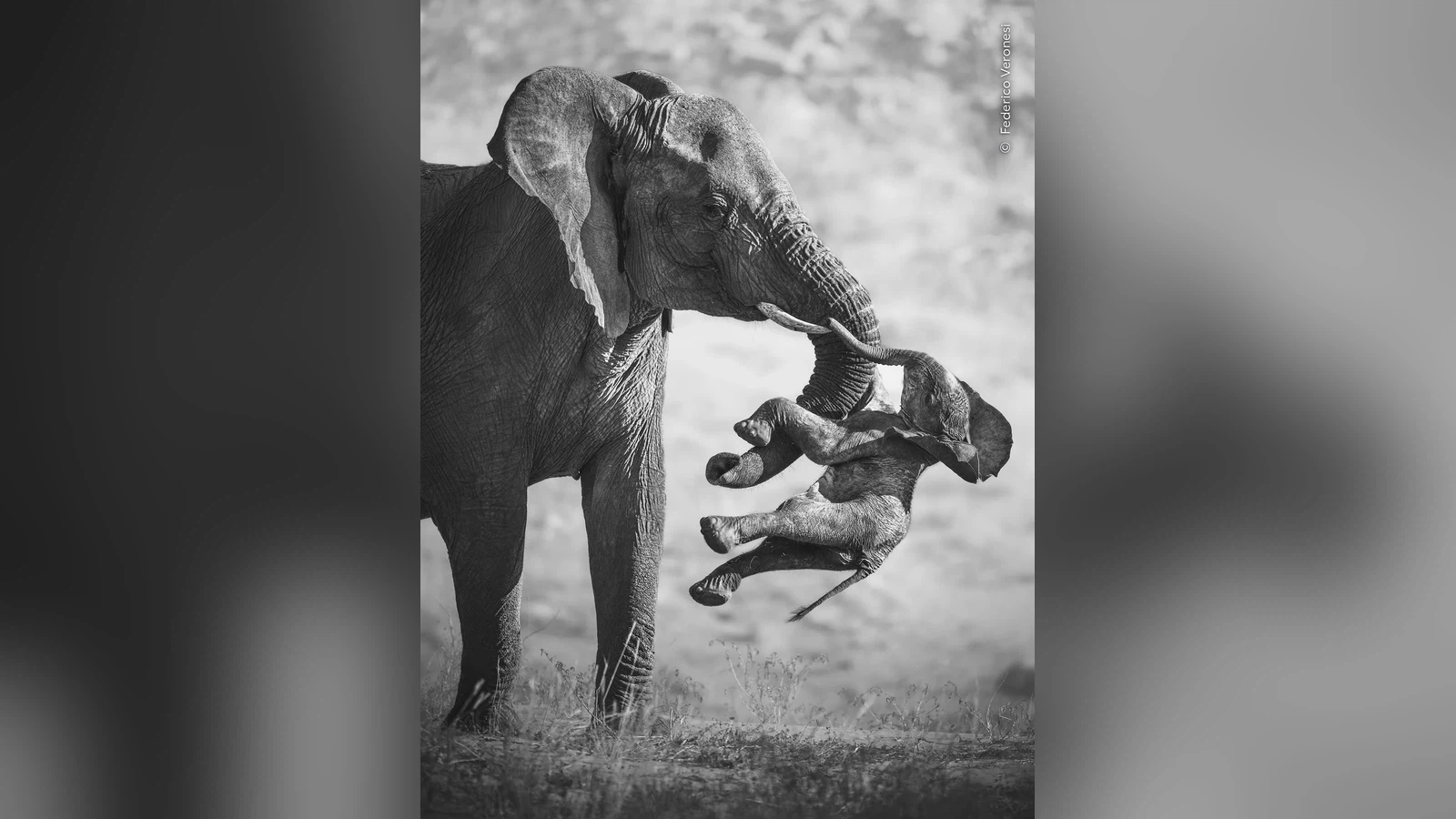
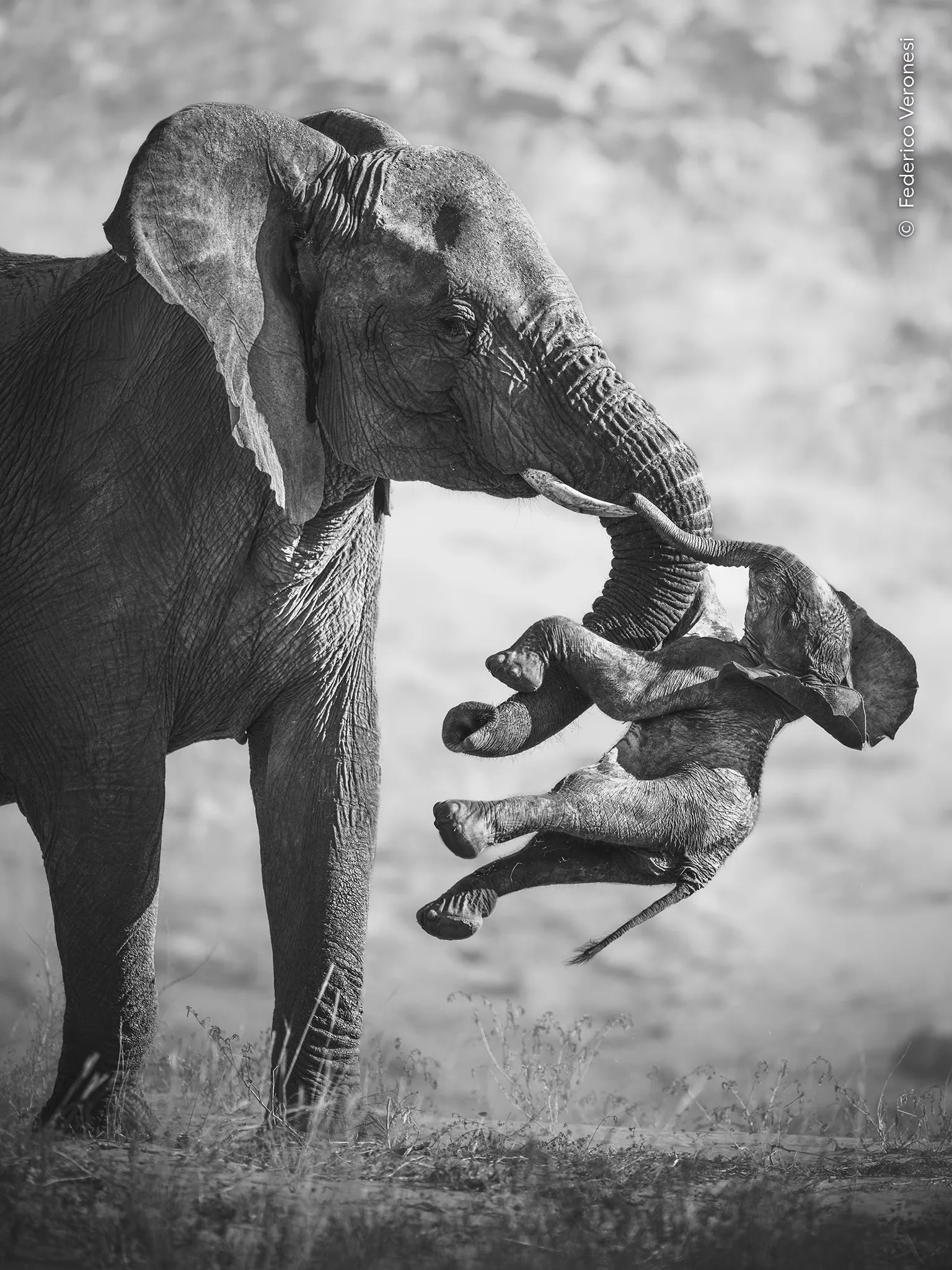
The Aftermath — Federico Veronesi (Behaviour: Mammals). A female elephant carries a dead calf in Namibia’s Huab Valley. Veronesi followed unusual drag marks in the sand until he reached the herd; the calf’s leg was held between tusk and trunk. Location: Huab River Valley, Damaraland, Namibia. Equipment: Nikon Z8 · 400mm f2.8 lens · 1/1000 at f2.8 • ISO 72.
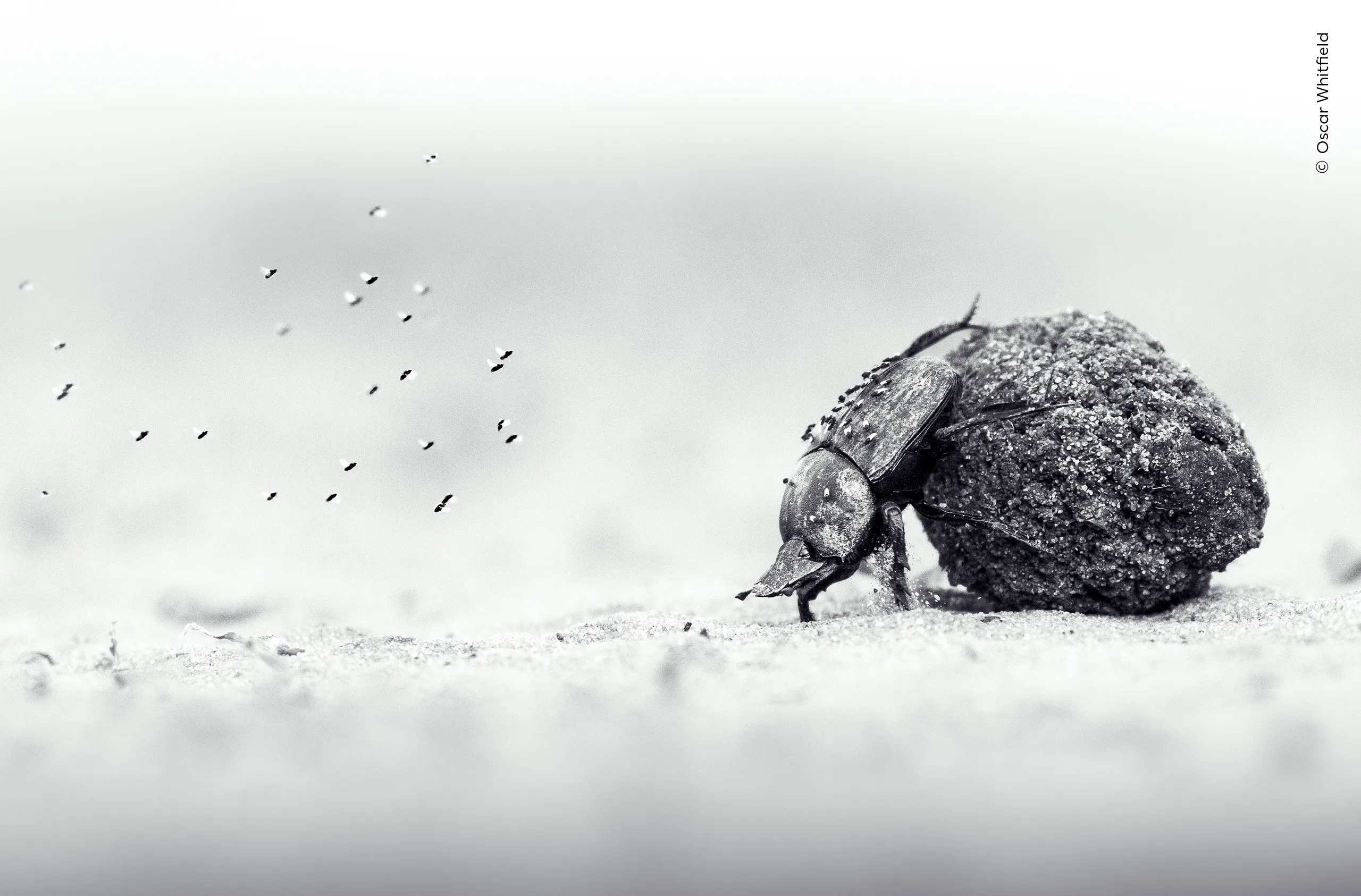
Labour of Love — Oscar Whitfield (11–14 Years). A dung beetle pushes its ball across dusty ground in Zimbabwe. Whitfield lay on the ground to bring the viewer to the insect’s eye level. Location: Zambezi National Park, Hwange District, Zimbabwe. Equipment: Canon EOS R6 Mark II · Sigma 150–600mm · f5–6.3 lens • 1/1250 at f6.3 • ISO 3200.
The Greek winner on Mount Olympus
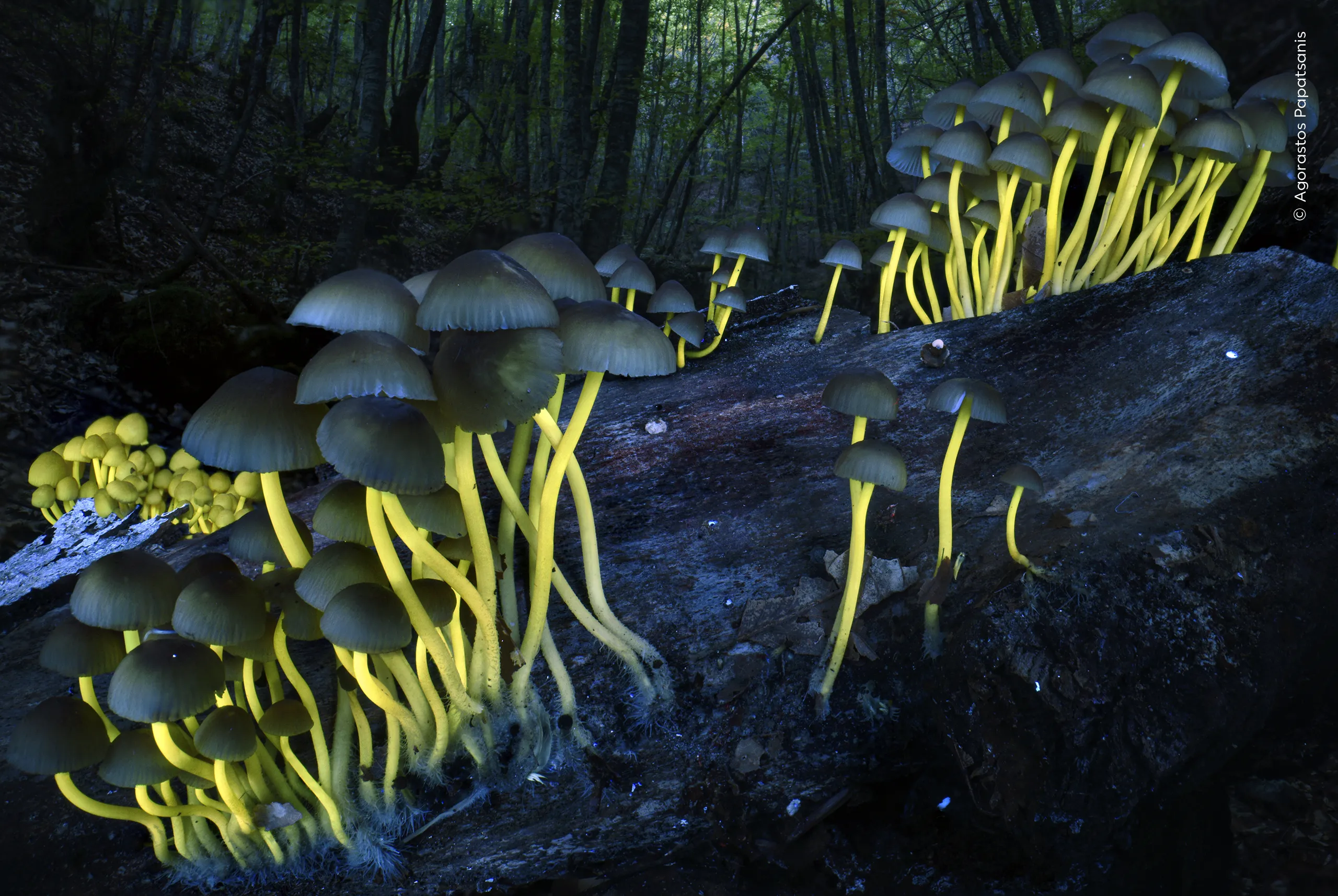
Shedding Light — Agorastos Papatsanis (Plants and Fungi). Fungi growing on dead wood near Mount Olympus fluoresce yellow under ultraviolet light. Papatsanis used a six-frame focus stack to reveal details across the scene. Location: Litochoro, Pieria, Greece. Equipment: Nikon D810 · Laowa 15mm f4 lens · 8.0 sec at f20 • ISO 400 • UV light • focus stack of 6 images.
The young photographers
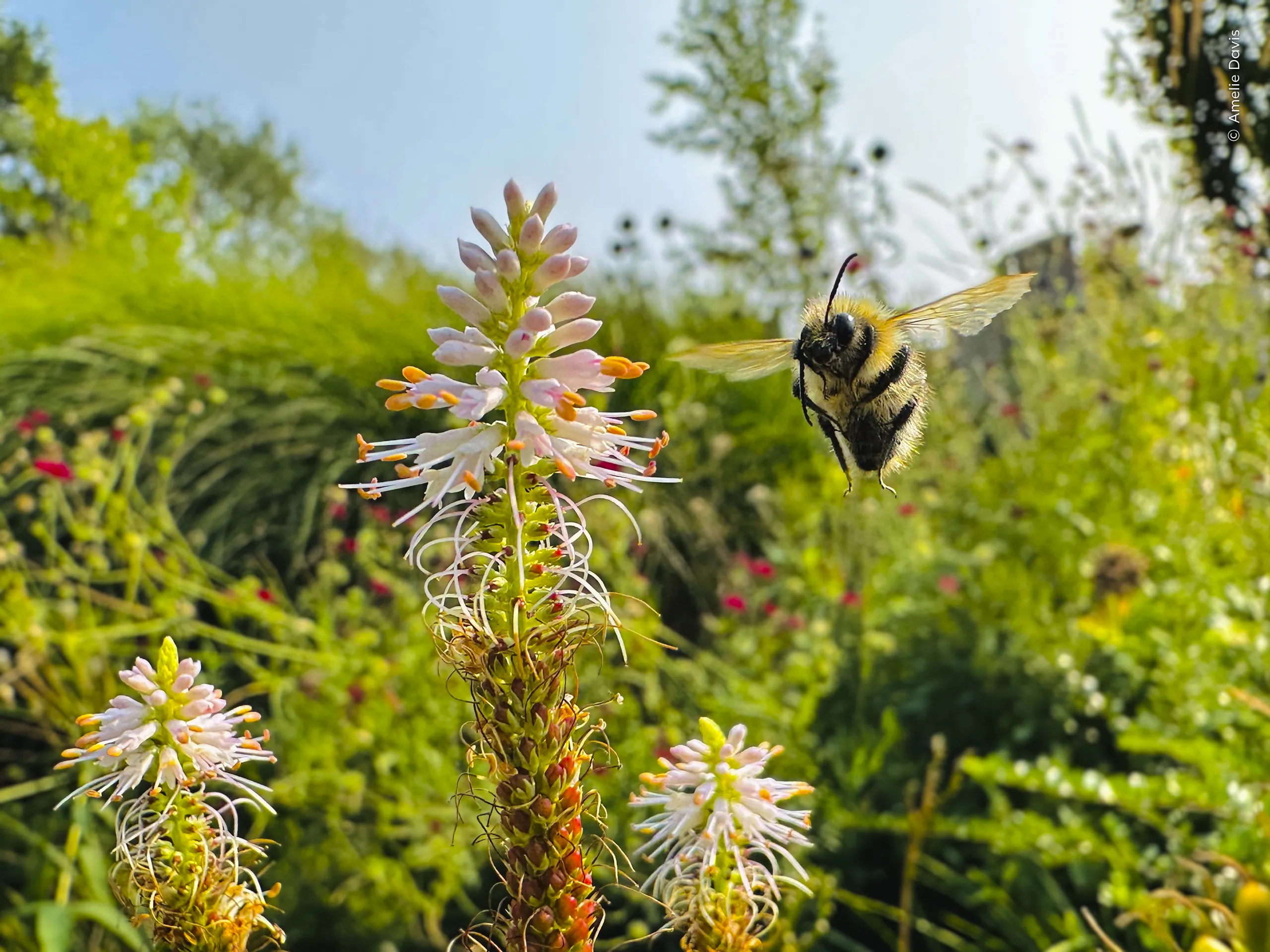
Flight of the Bumblebee — Amelie Davis (10 Years and Under). A bumblebee hangs in the air before landing on a flower. Davis had spent months working on photographs of bees. Location: Surrey, England, UK. Equipment: Apple iPhone 14 Pro Max · 13mm built-in ultrawide lens · 1/895 at f2.2 • ISO 40.
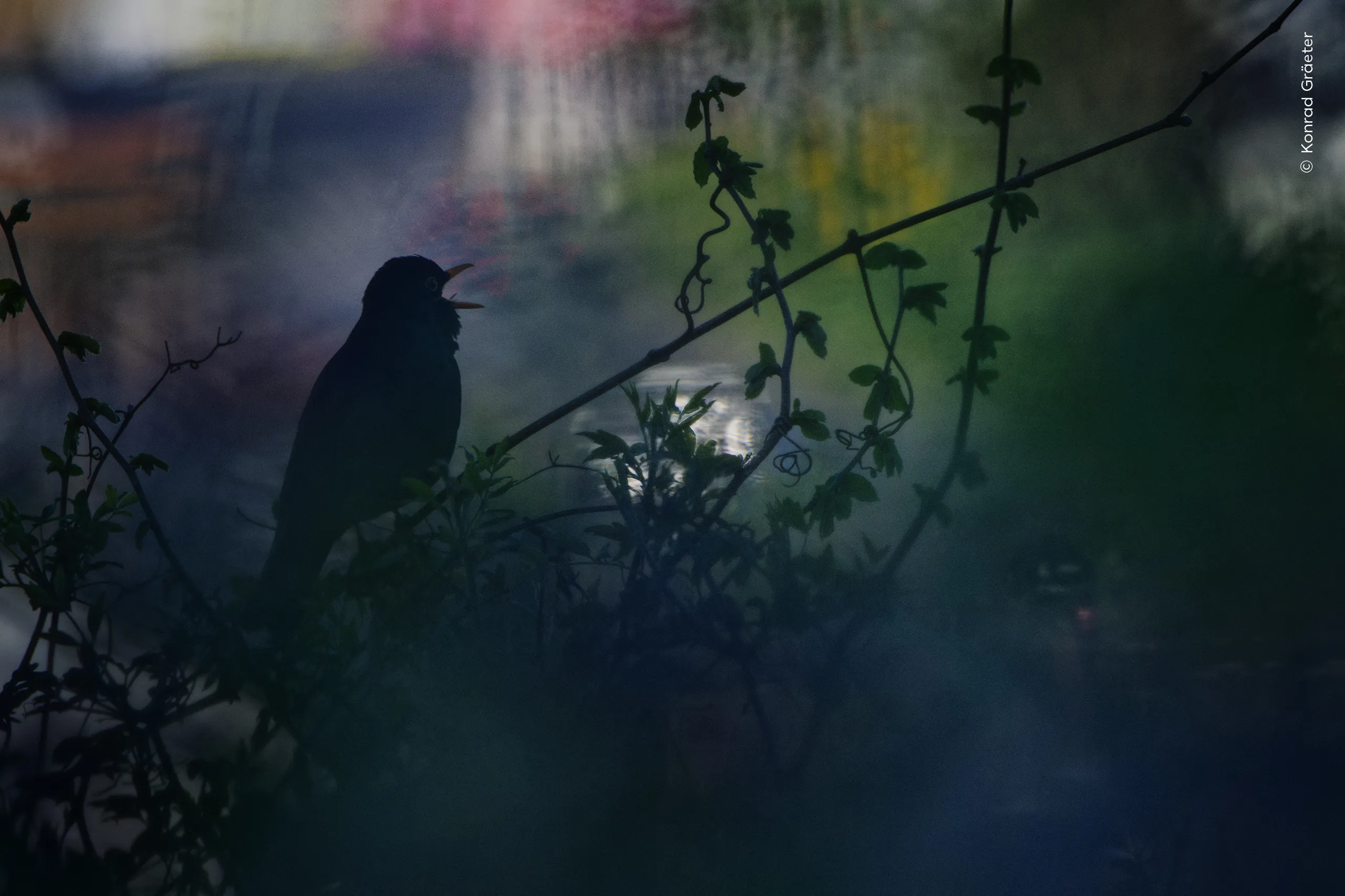
Birdsong Painted in Light — Konrad Gräeter (15–17 Years). A male blackbird sings from a vineyard in April. Gräeter worked low down on a steep slope and used light to emphasise the bird’s song. Location: Baden-Württemberg, Germany. Equipment: Fujifilm X-H2S · 150–600mm f5.6–8 lens · 1/800 at f8 • ISO 400.
Portraits, behaviour and ocean life
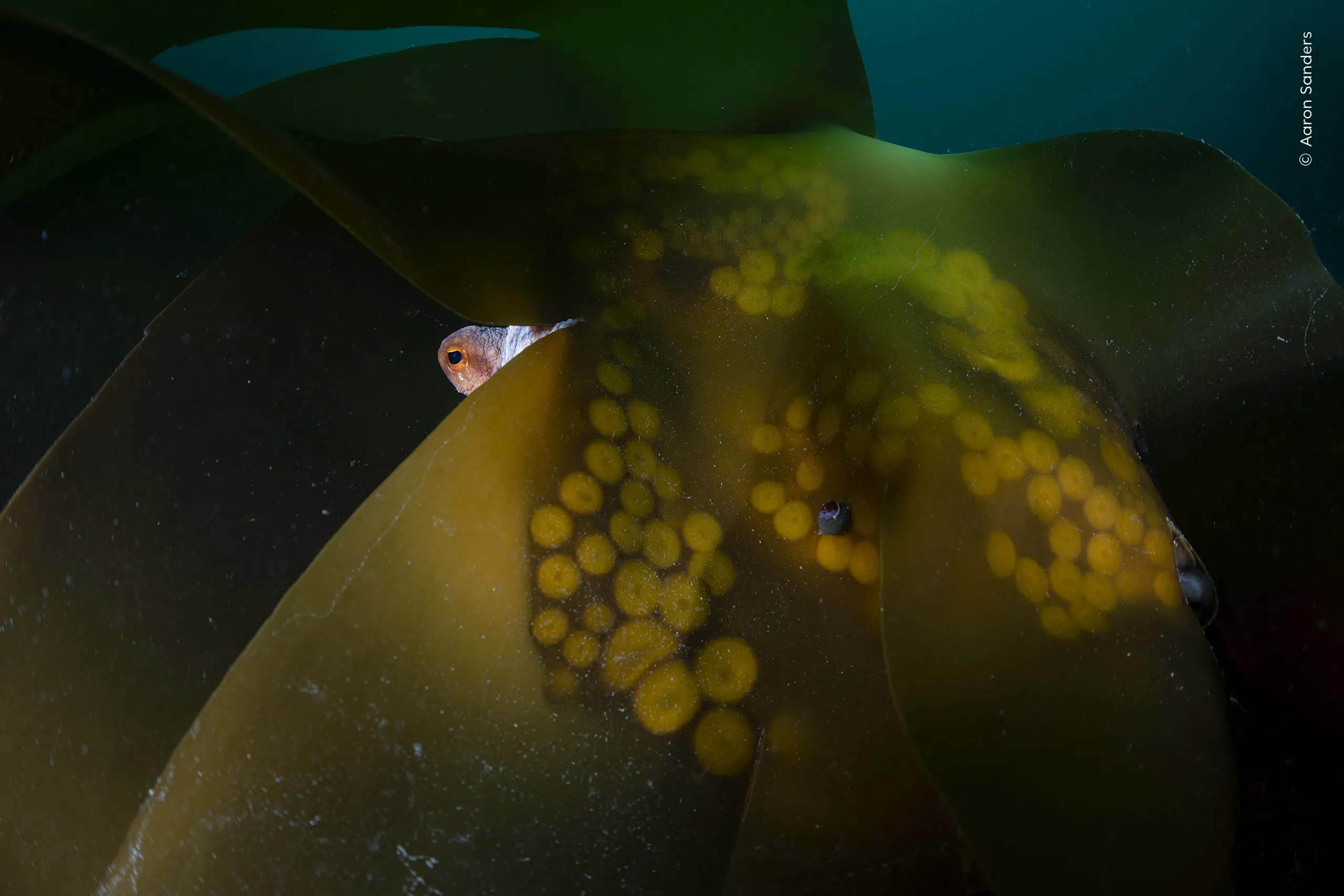
A Watchful Eye — Aaron Sanders (Animal Portraits). An octopus peers out from behind kelp in Cornwall. Sanders noticed the marks left by its suckers and waited quietly for the eye to appear. Location: Porthkerris Beach, Cornwall, England, UK. Equipment: Nikon Z8 · 24–50mm f4–6.3 lens · Nauticam WWL-C wet lens • 1/40 at f7.1 • ISO 125 • Inon Z-240 and Z-330 underwater strobes.
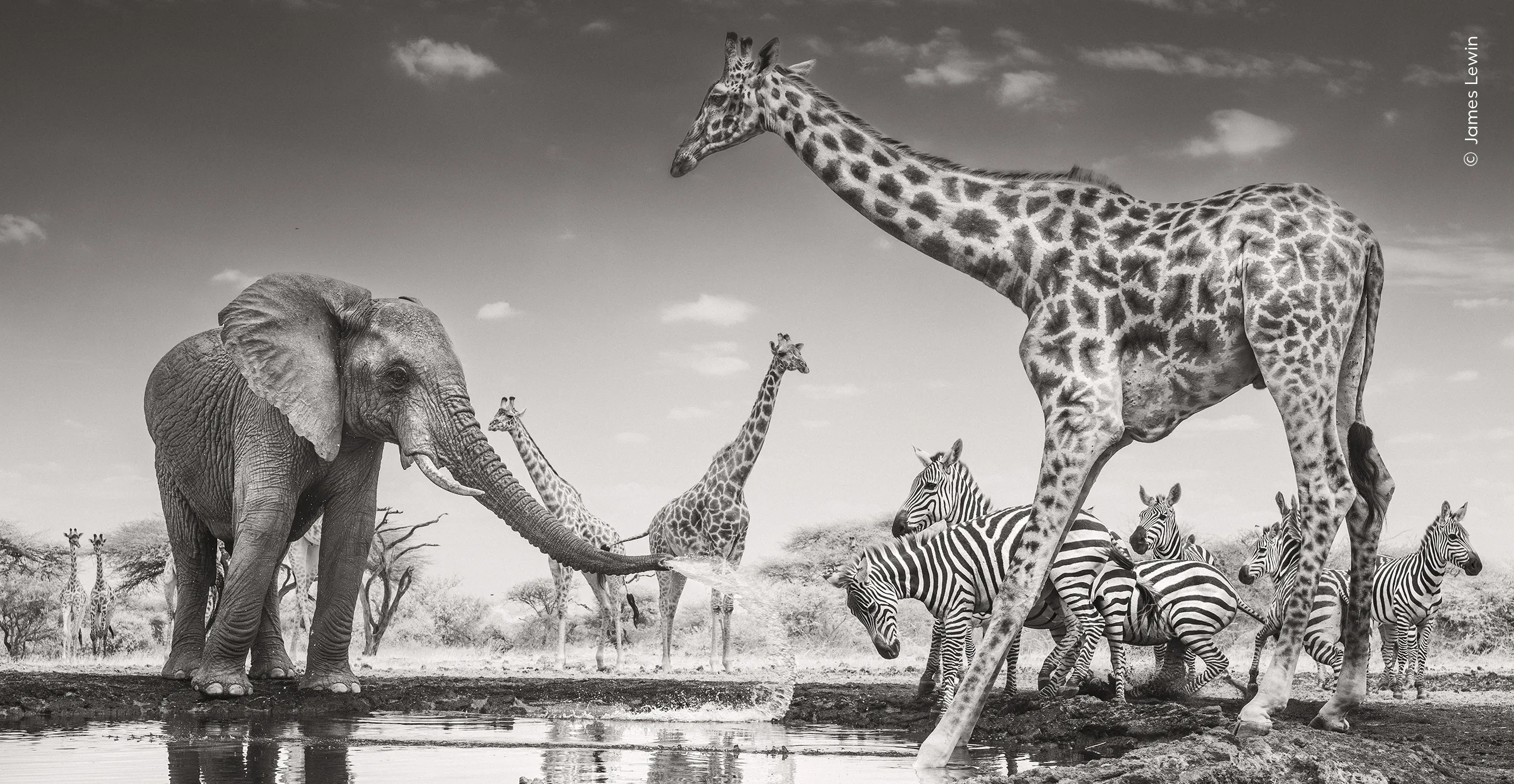
The Meeting Place — James Lewin (Animals in their Environment). A young bull elephant sprays water toward zebras at a Kenyan waterhole. Lewin used an infrared-converted camera to make the harsh light part of the image. Location: ol Donyo Lodge, Chyulu Hills National Park, Makueni County, Kenya. Equipment: Nikon Z 7II · 28–75mm f2.8 lens · 1/800 at f7.1 (+1 e/v) • ISO 800 • camera converted to infrared.
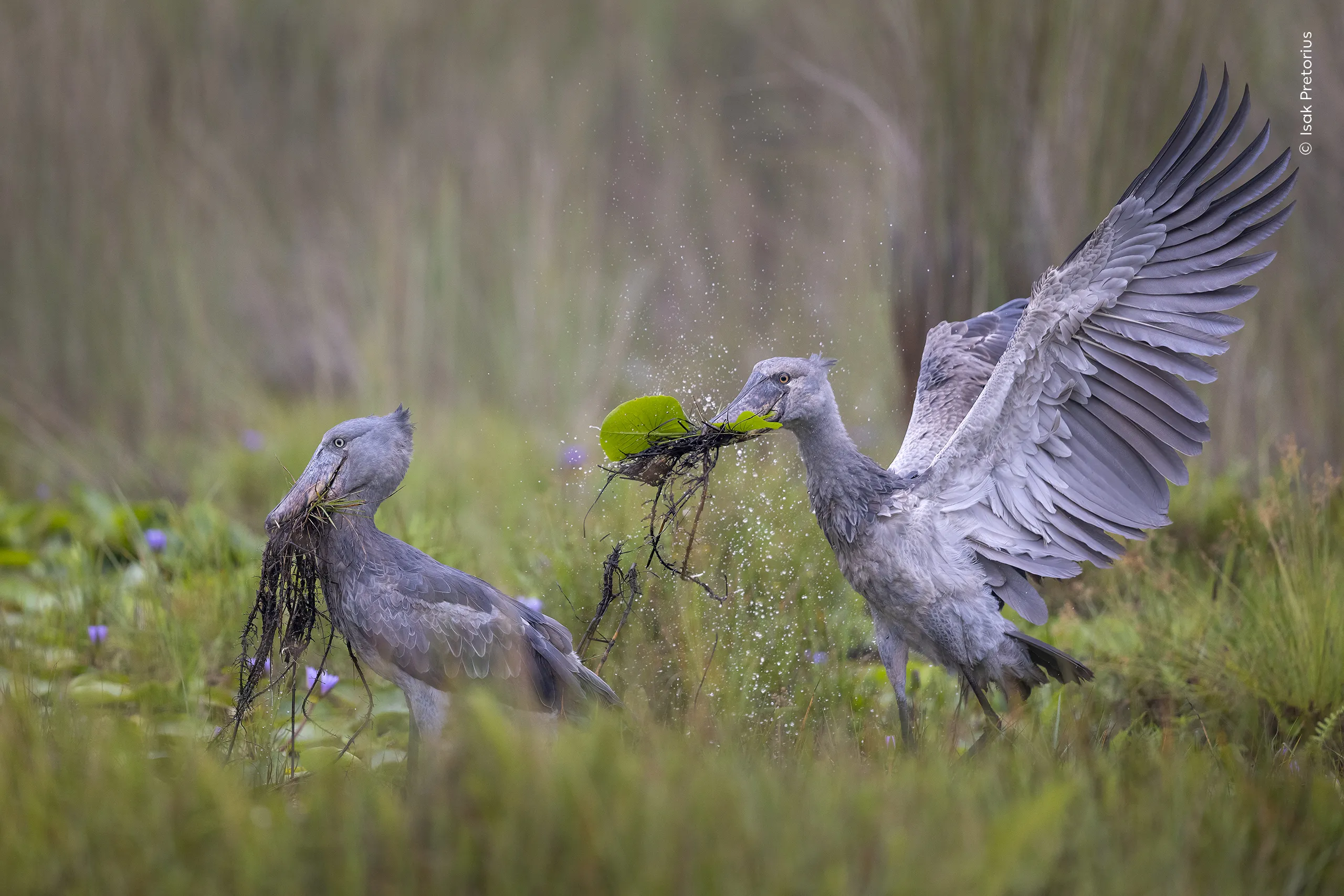
Scenes from the Swamp — Isak Pretorius (Behaviour: Birds). Two shoebills pull at vegetation in Uganda’s Mabamba Swamp, possibly collecting nesting material. Pretorius found them while navigating the wetlands in a narrow canoe. Location: Mabamba Swamp, Wakiso District, Uganda. Equipment: Canon EOS R5 · 500mm f4 lens · 1/2500 at f4 • ISO 1250.
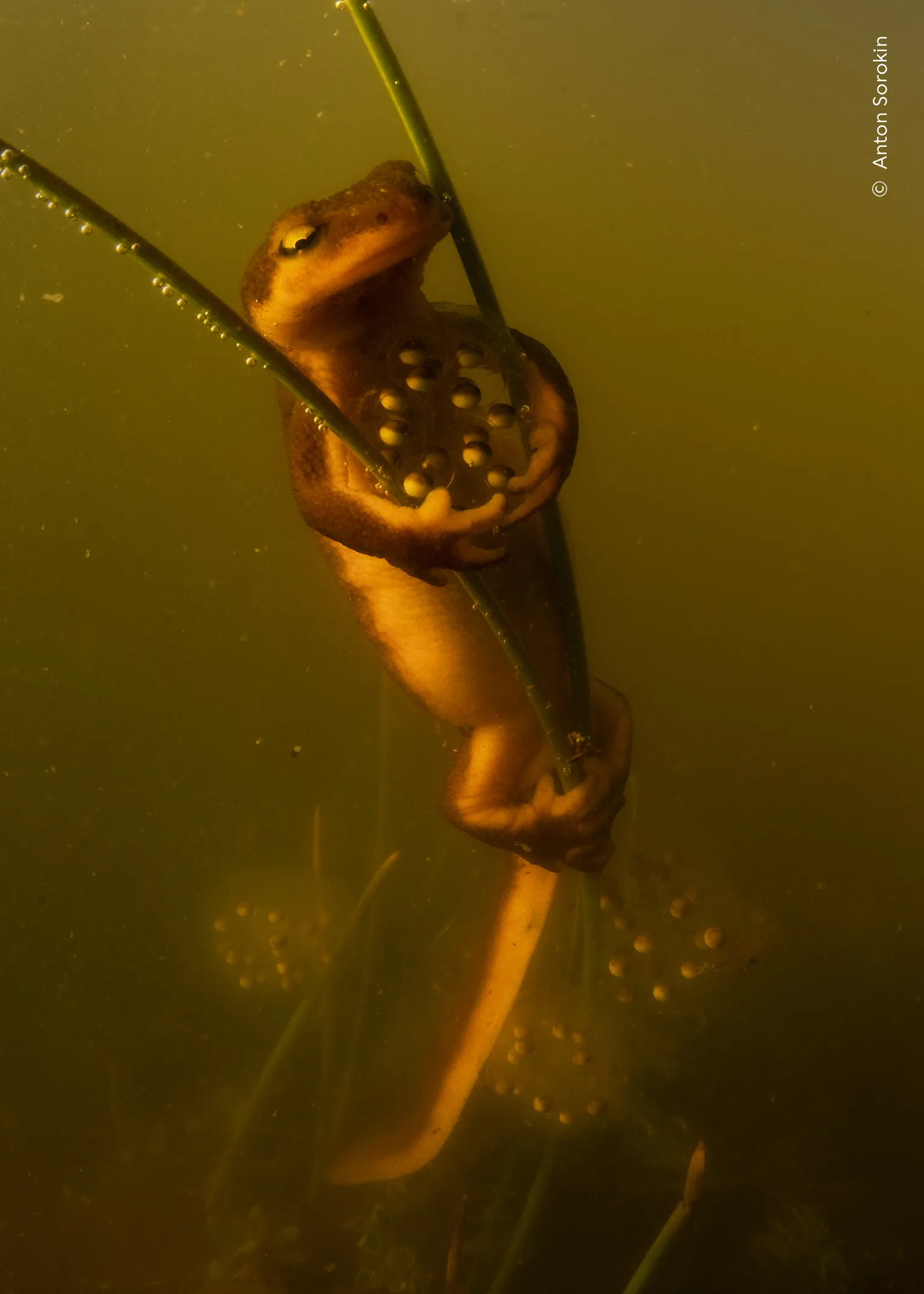
Protective Pose — Anton Sorokin (Behaviour: Amphibians and Reptiles). A California newt lays eggs while clinging to plants bearing an existing egg cluster. Sorokin carefully lowered his underwater camera into muddy shallows. Location: Contra Costa County, California, USA. Equipment: Nikon D850 · 8–15mm fisheye lens · 1/100 at f18 • ISO 400 • Nauticam housing • Seacam 60D strobes.
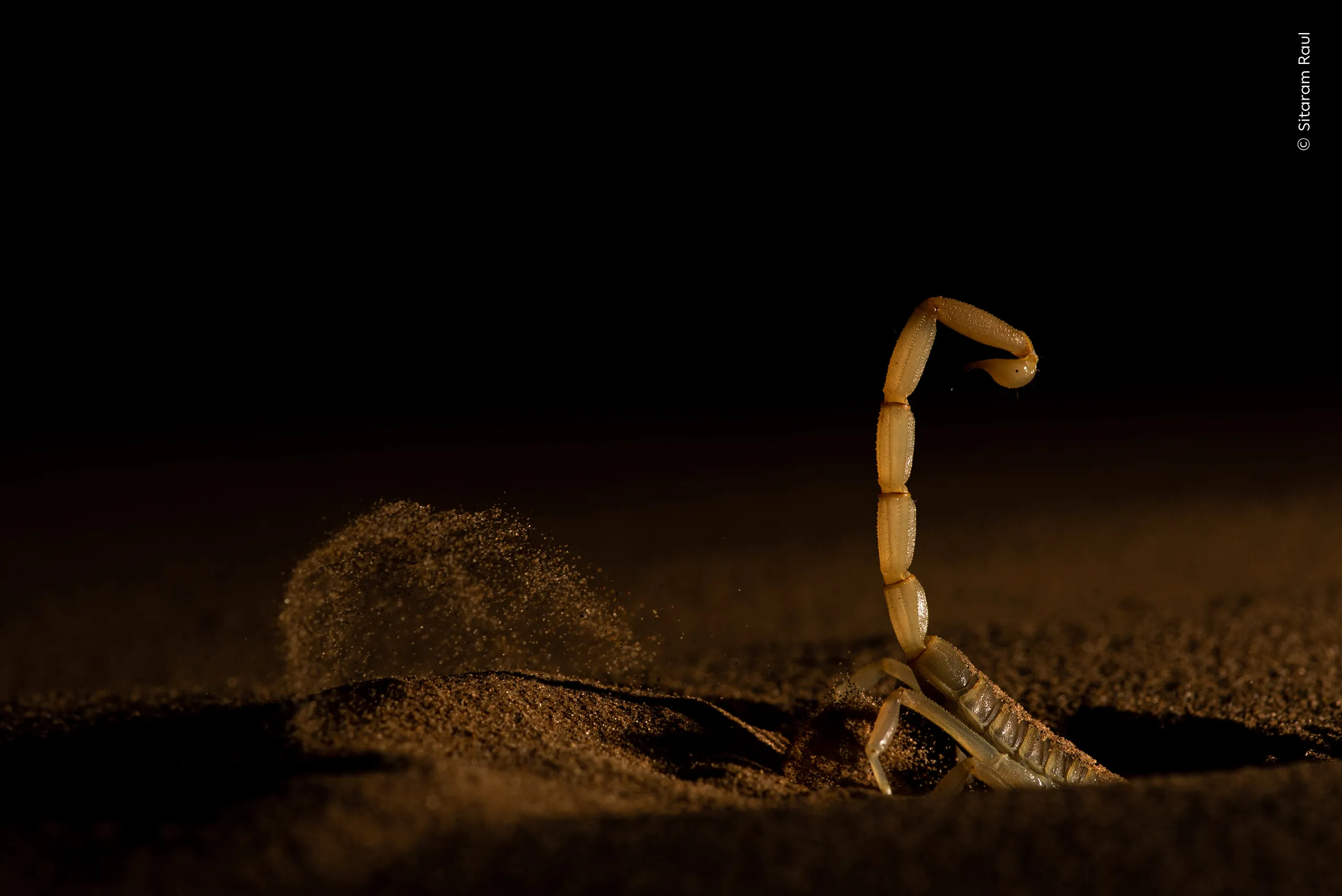
Shifting Sand — Sitaram Raul (Behaviour: Invertebrates). A scorpion throws sand as it excavates a refuge in the Thar Desert. Raul photographed it before sunrise to freeze the flying grains. Location: Thar Desert, Rajasthan, India. Equipment: Nikon D750 · 105mm macro lens · 1/250 at f14 • ISO 125 • Godox flash.
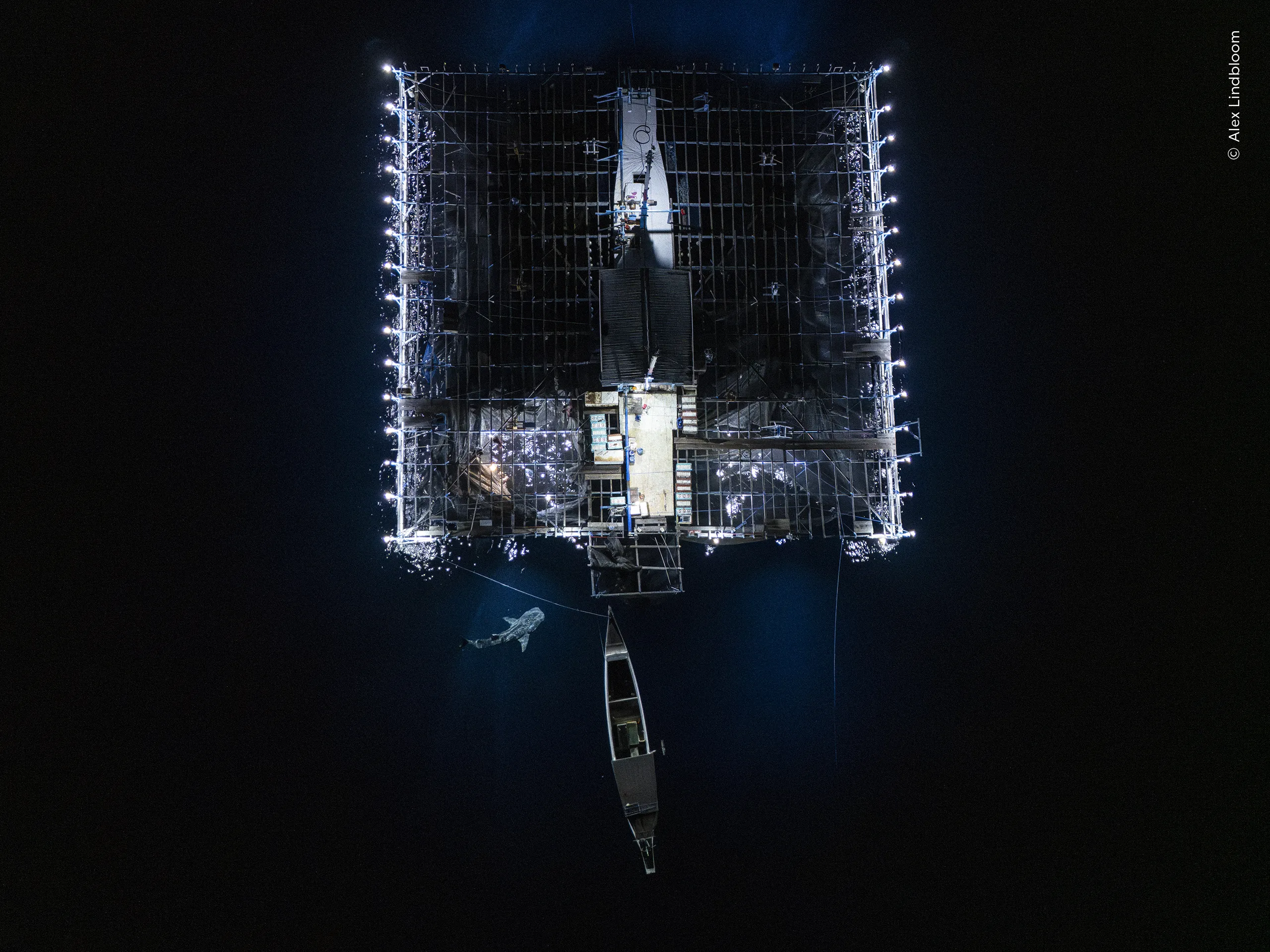
Night-Time Catch — Alex Lindbloom (Oceans – The Bigger Picture). A whale shark approaches a brightly lit Indonesian bagan fishing platform at night. Lindbloom used a drone to reveal the relationship between animal and fishing activity. Location: Off Cenderawasih Bay, Papua, Indonesia. Equipment: DJI Air 3 · 24mm f1.7 lens · 1/60 at f1.7 • ISO 3200.
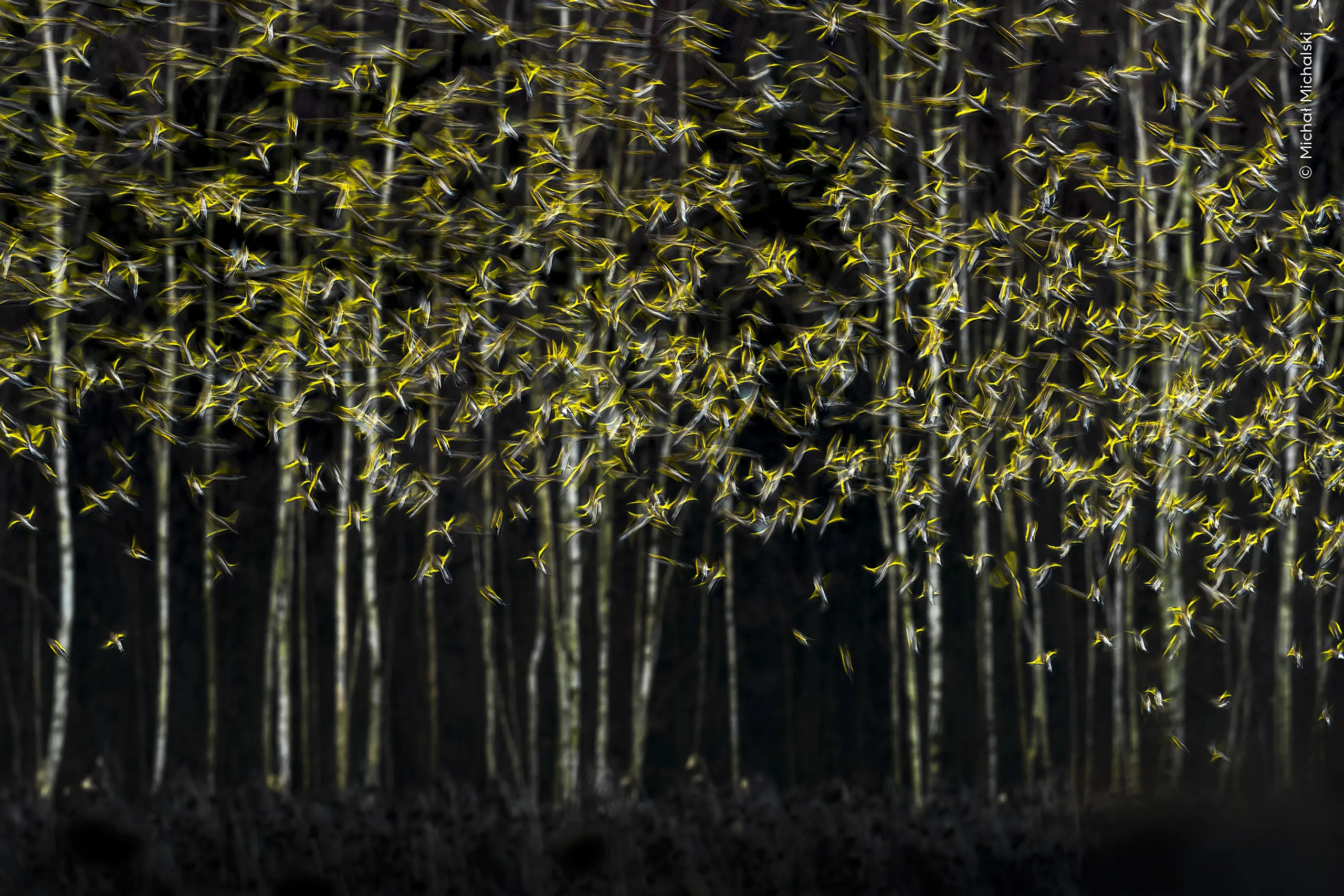
Escape Artistry — Michał Michalski (Natural Artistry). Birds taking off among bare birch trees resemble autumn leaves. Michalski turned flight, colour and repetition into a composition. Location: Miłochowice, Lower Silesian Township, Poland. Equipment: Nikon D500 · 500mm f5.6 lens · 1/30 at f8 • ISO 250.
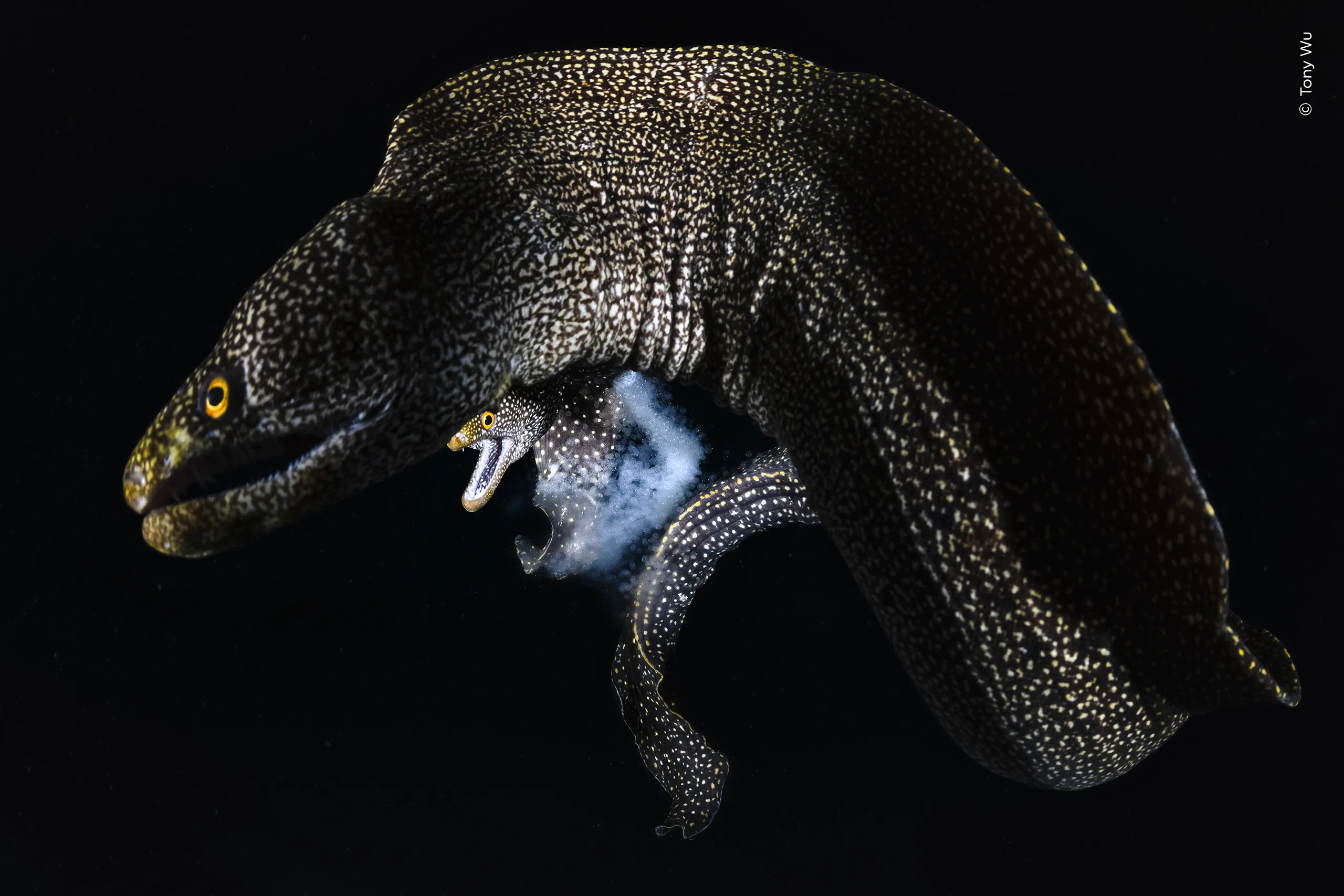
Making Morays — Tony Wu (Underwater). Abbott’s moray eels engage in reproductive behaviour underwater. Wu spent years observing the animals alongside marine biologists. Location: Kagoshima Prefecture, Kyūshū, Japan. Equipment: Sony α1 · customised Nikon fisheye 13mm f2.8 lens · 1/320 at f11 • ISO 500 • 2x Backscatter Hybrid HF-1 strobes.
Cities, wetlands and human impact
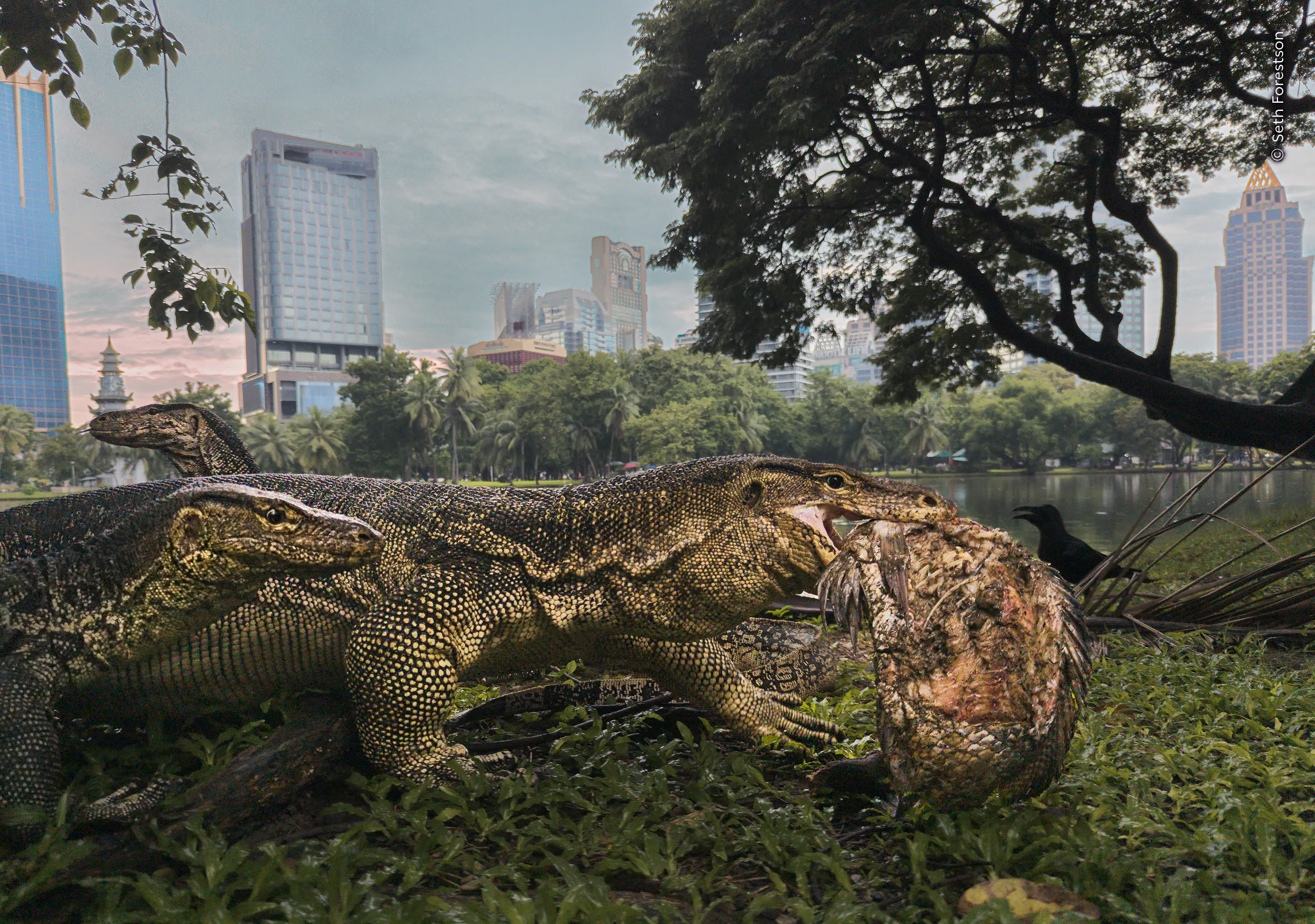
Urban Jungle — Seth Forestson (Urban Wildlife). A monitor lizard carries a fish in front of Bangkok skyscrapers. Forestson lowered himself into the mud to position the city behind the reptile. Location: Lumphini Park, Bangkok, Thailand. Equipment: Google Pixel 7 Pro smartphone · 1/291 at f1.9 · ISO 47.
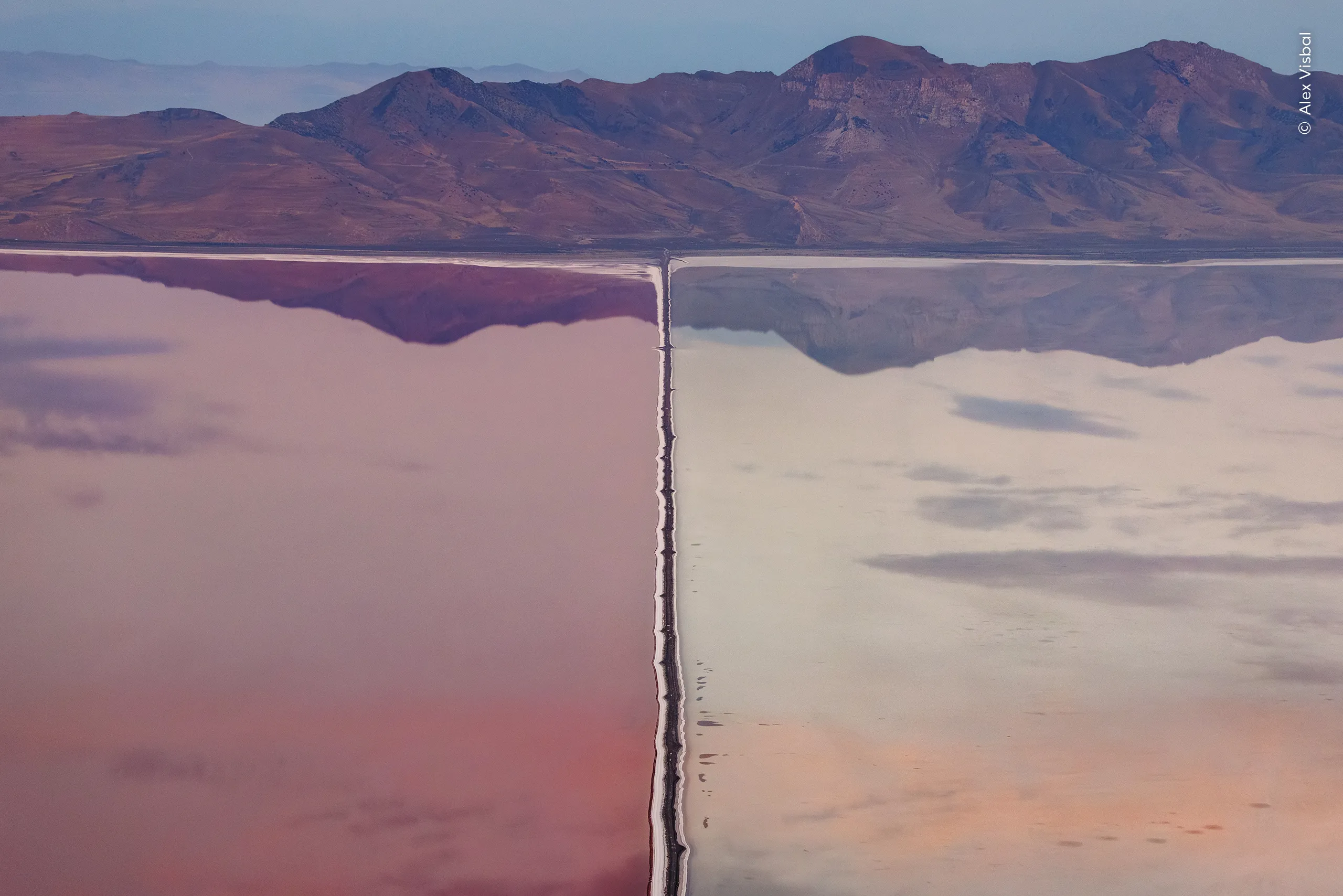
The Great Divide — Alex Visbal (Wetlands – The Bigger Picture). A human-built causeway cuts Utah’s Great Salt Lake into differently coloured expanses of water. Visbal’s aerial view makes the environmental division legible. Location: Stansbury Bay, Great Salt Lake, Utah, USA. Equipment: Canon EOS R5 Mark II · 70–200mm f2.8 lens · 1/640 at f3.2 (-0.67 e/v) • ISO 1250.
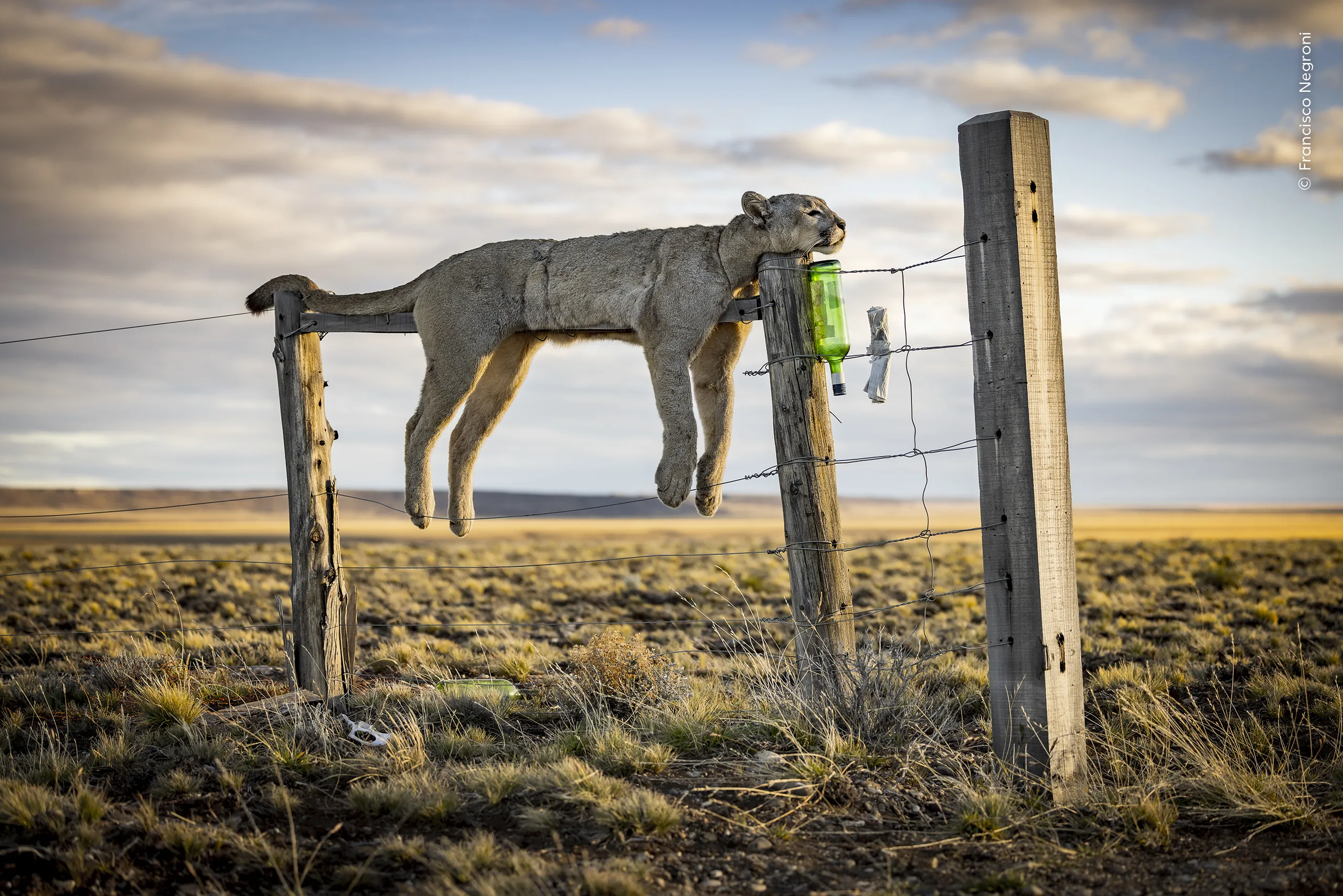
Warning Sign — Francisco Negroni (Photojournalism). A dead puma hangs on a fence in Patagonia as a hunting trophy. Negroni documents persecution of the species and the conflict surrounding its protection. Location: Route 40, Santa Cruz Province, Argentina. Equipment: Canon EOS R5 · 70–200mm f2.8 lens · 1/640 at f3.2 • ISO 100.
Photojournalist Story: Six views of San Francisco coyotes
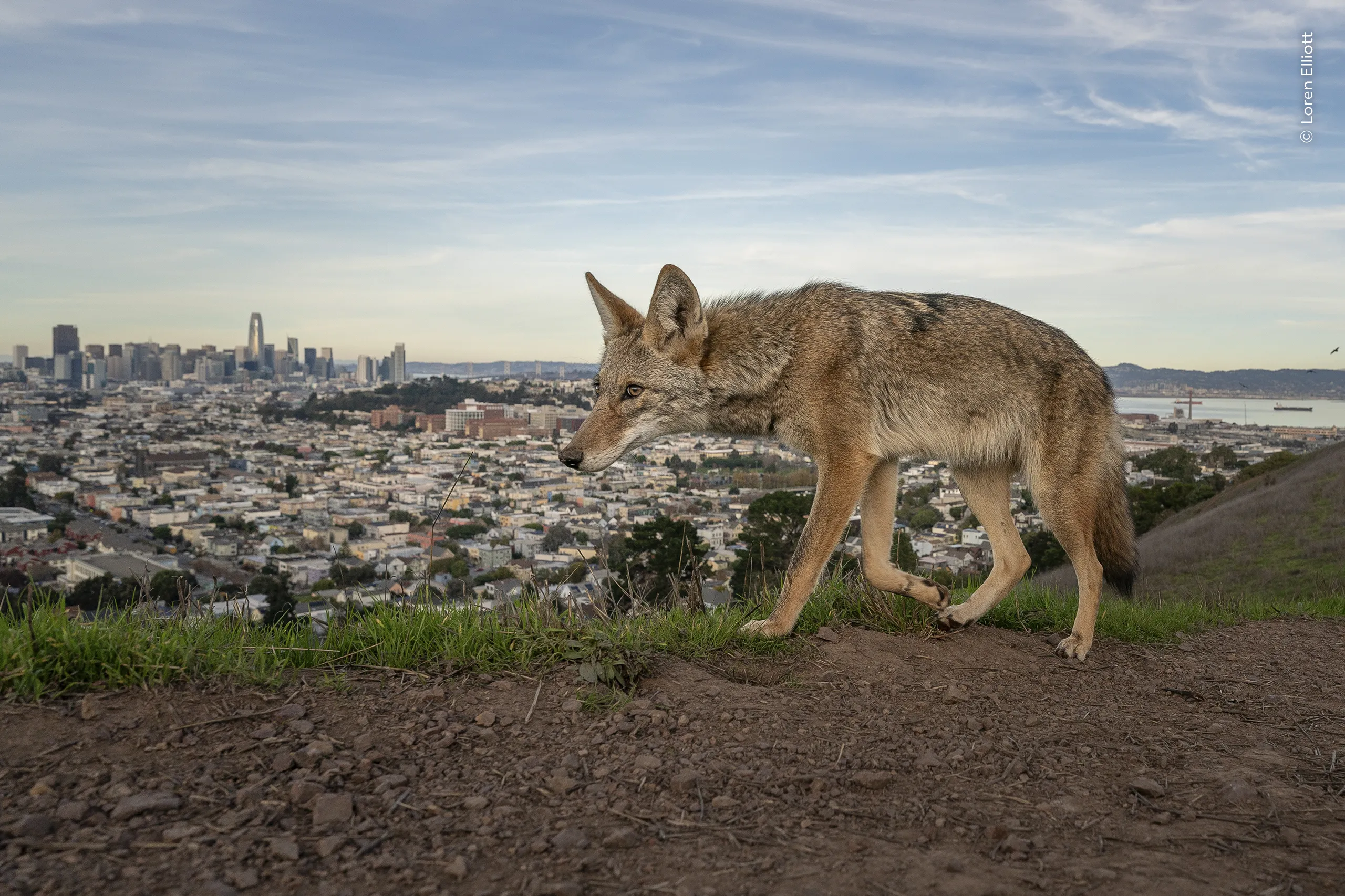
On the Outskirts — Loren Elliott (Photojournalist Story Award). A coyote follows a path in Bernal Heights Park with San Francisco beyond. Elliott documented how wild canids use the city’s green spaces. Location: San Francisco, California, USA. Equipment: Sony α9 II · 20mm f1.8 lens · 1/800 at f5.6 • ISO 250 • 2x Pocket Wizard Plus IIIe radio triggers.
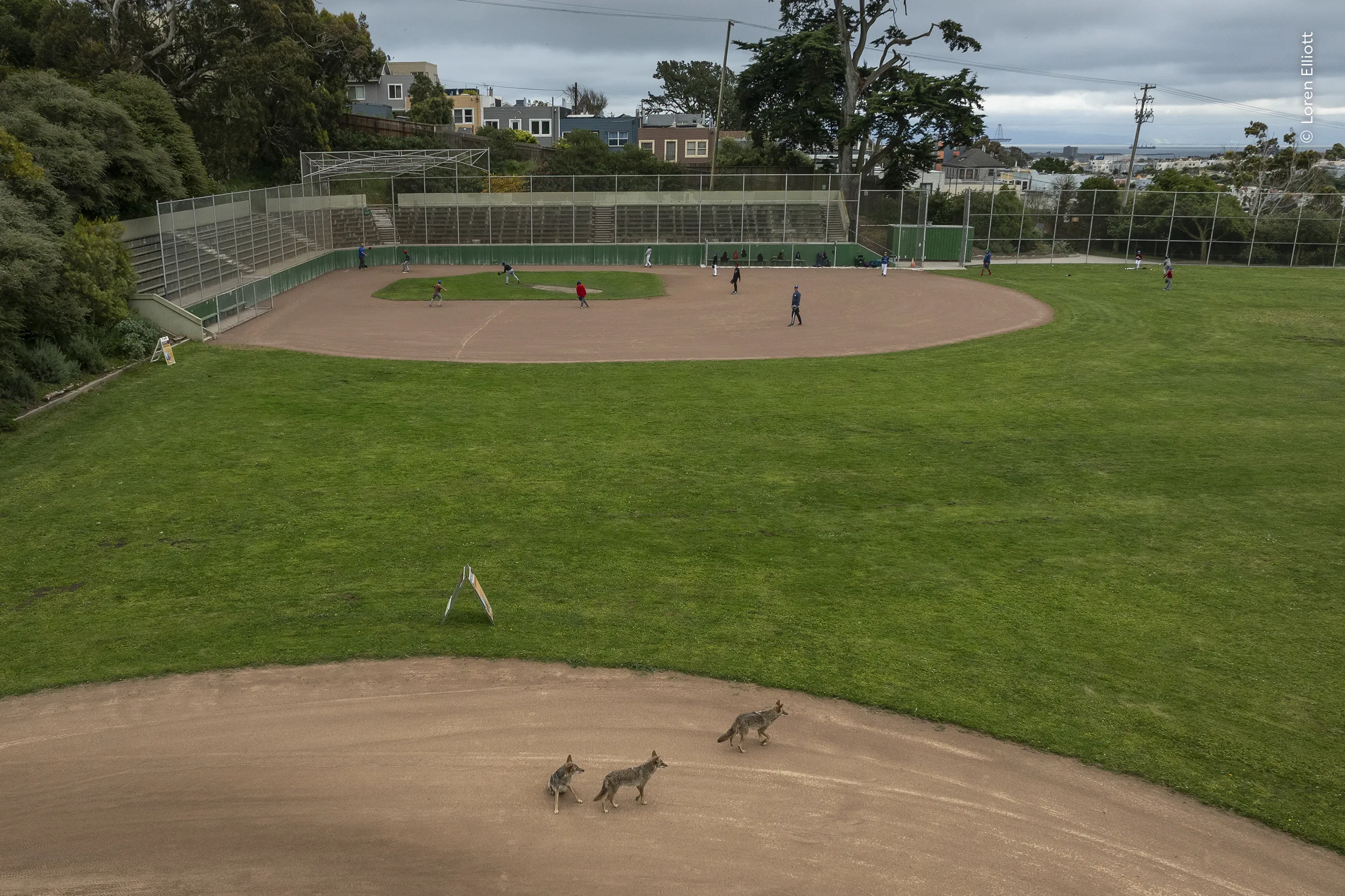
A Respectful Distance — Loren Elliott (Photojournalist Story Award). Three coyotes cross a baseball field while people continue practising nearby, a striking picture of coexistence without direct interaction. Location: San Francisco, California, USA. Equipment: DJI Mavic 3 Classic · Hasselblad L2D 24mm f2.8 lens · 1/640 at f4 • ISO 100.
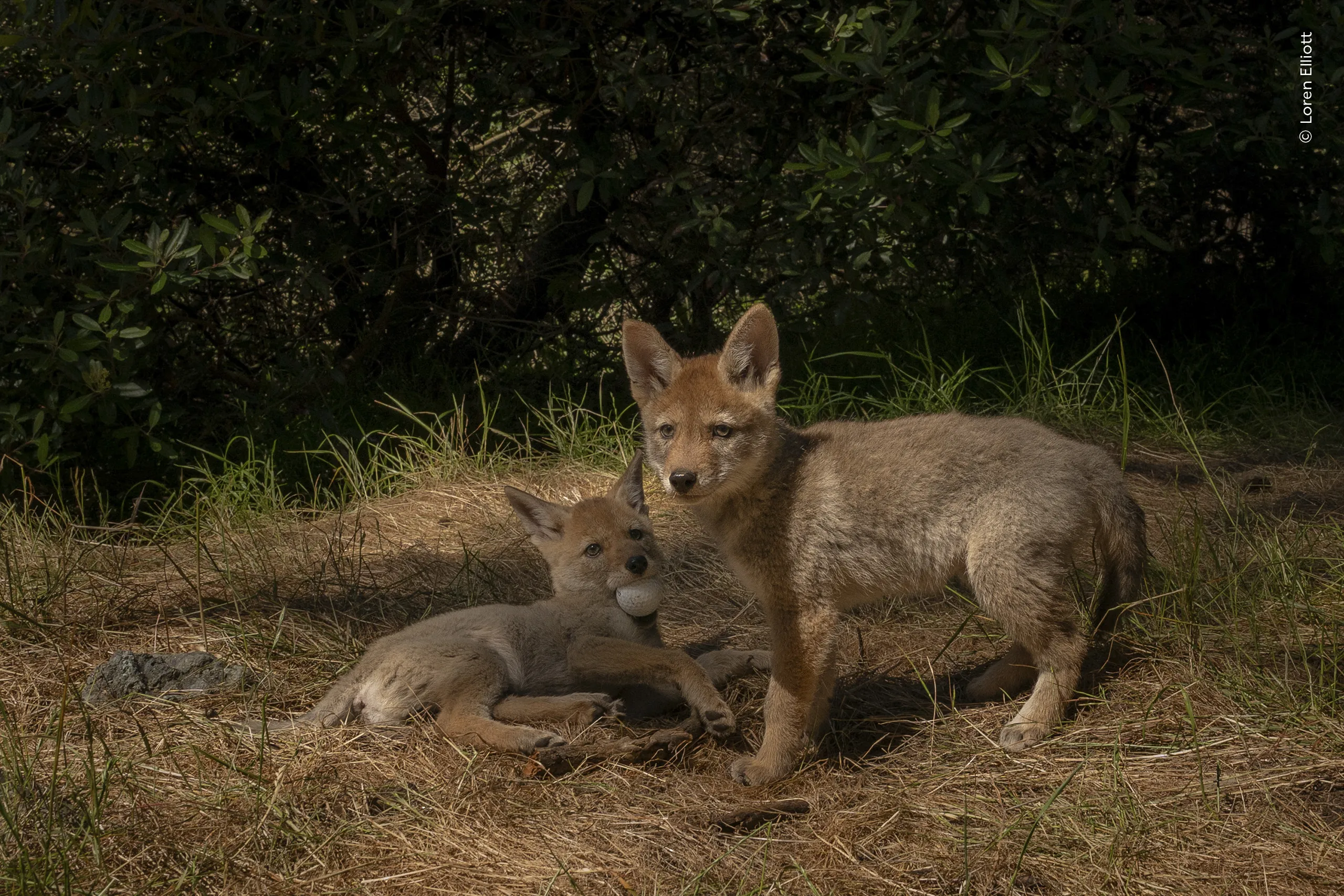
Playing Around — Loren Elliott (Photojournalist Story Award). Two coyote pups play with a golf ball close to their den on a golf course. Elliott captured their curiosity with a remotely positioned camera. Location: San Francisco, California, USA. Equipment: Sony α9 II · 24–70mm lens at 28mm · 1/500 at f11 • ISO 1000 • 2x Pocket Wizard Plus IIIe radio triggers • tripod.
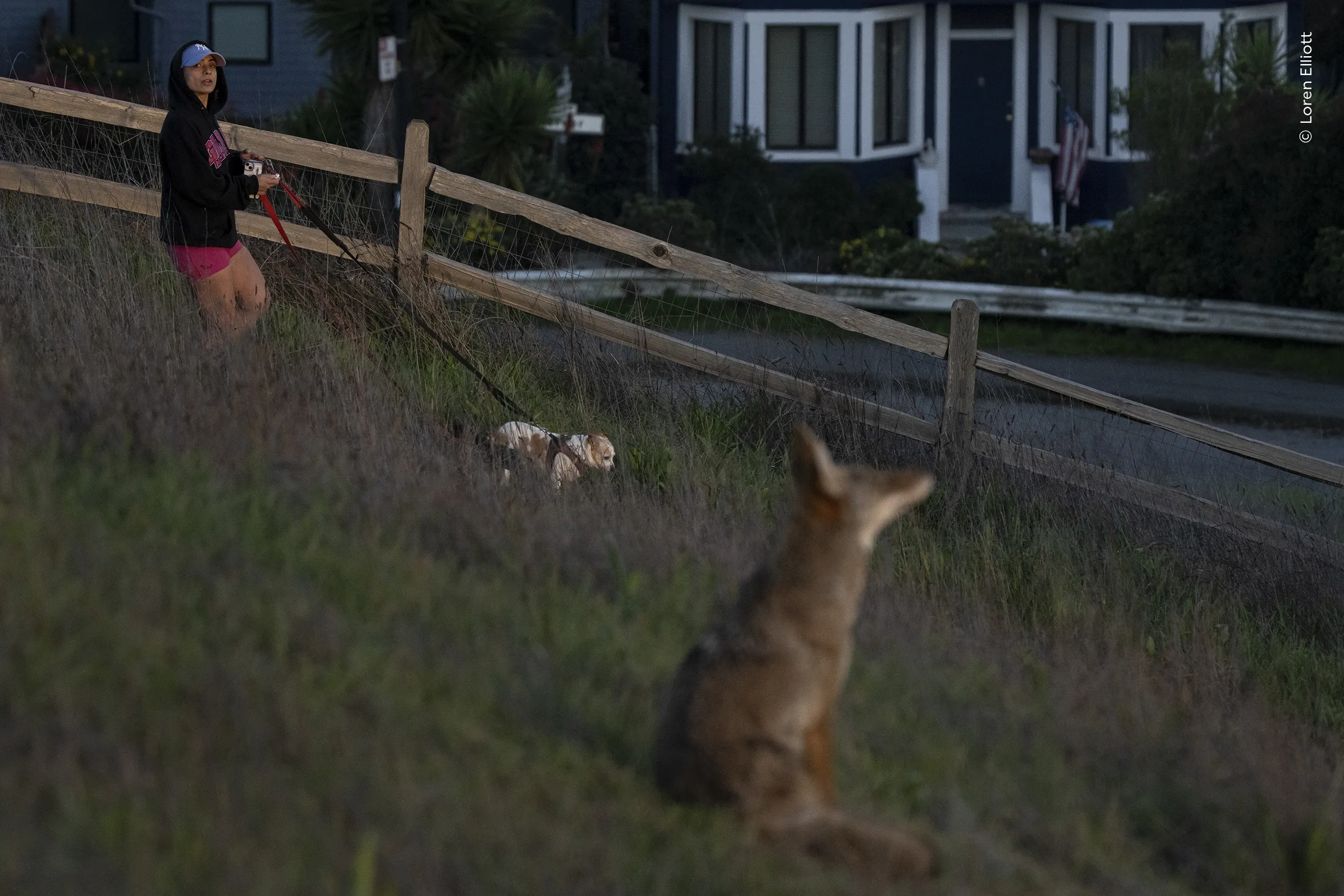
Walk On By — Loren Elliott (Photojournalist Story Award). A coyote searching for rodents calmly watches a woman walking a leashed dog. Shared urban space is the subject of the frame. Location: San Francisco, California, USA. Equipment: Sony α1 · 200–600mm f5.6-6.3 lens at 338mm · 1/1000 at f9 • ISO 3200.
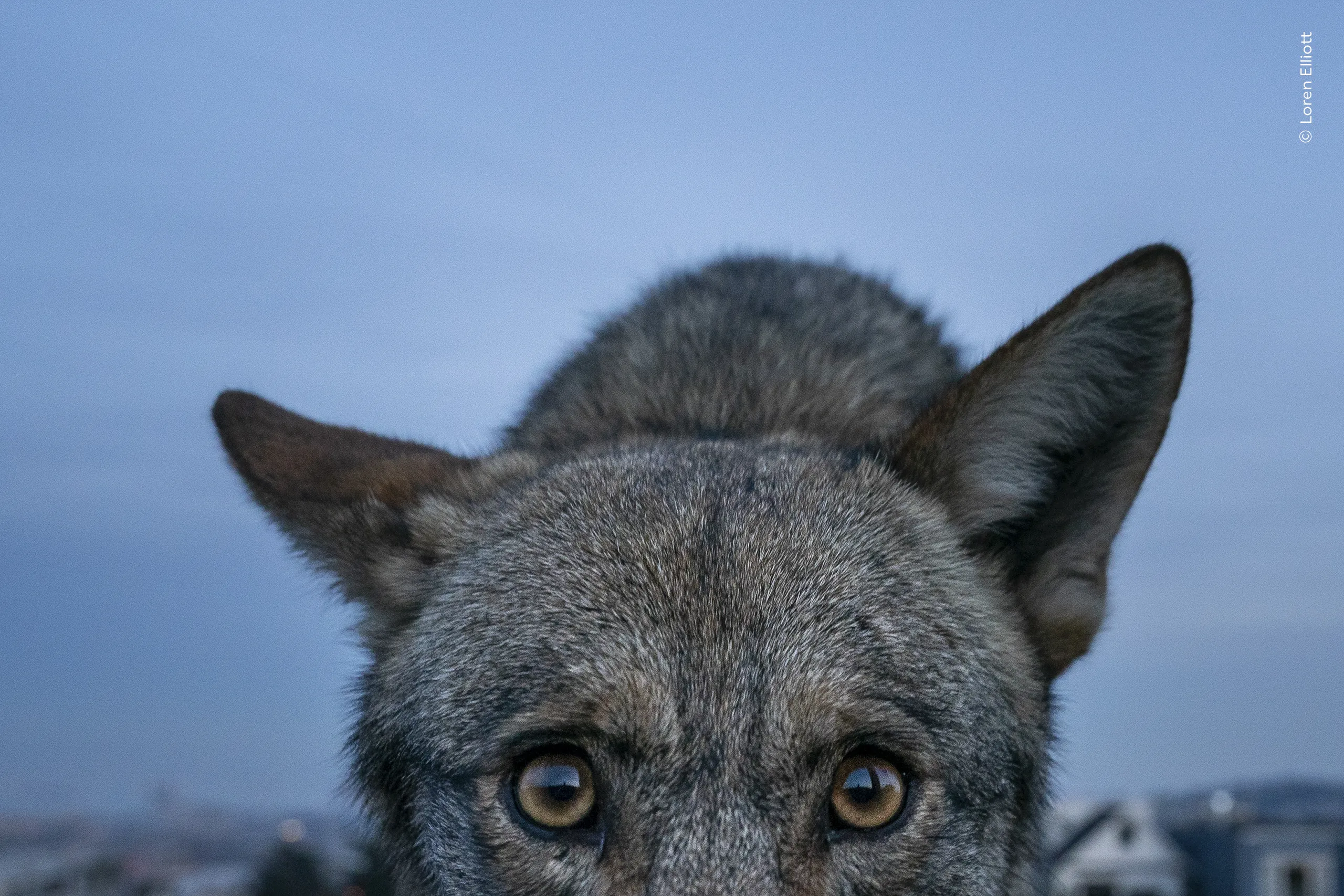
Curious Close-up — Loren Elliott (Photojournalist Story Award). A coyote investigates a camera placed along a path, bringing its face close enough for an intimate portrait. Location: San Francisco, California, USA. Equipment: Sony α9 II · 20mm f1.8 lens · 1/500 at f4 • ISO 2500 • 2x Pocket Wizard Plus IIIe radio triggers.
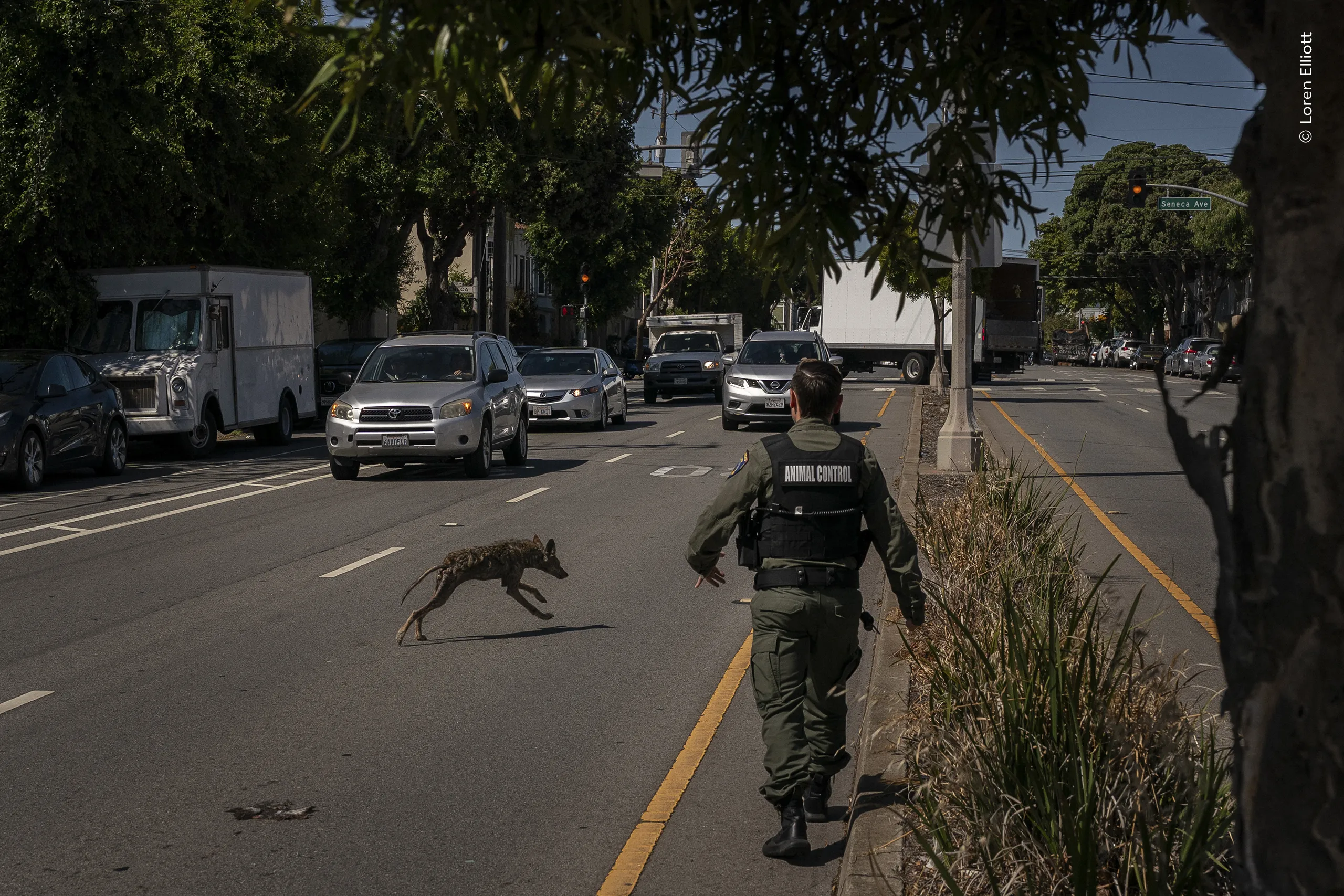
No Way Out — Loren Elliott (Photojournalist Story Award). A coyote suffering from mange crosses a busy street near an Animal Care and Control officer. Its vulnerability complicates the familiar urban-wildlife story. Location: San Francisco, California, USA. Equipment: Sony α9 II · 24–70mm f2.8 lens at 40mm · 1/1600 at f7 • ISO 250.
Rising Star: Alexis Tinker-Tsavalas and the invisible world
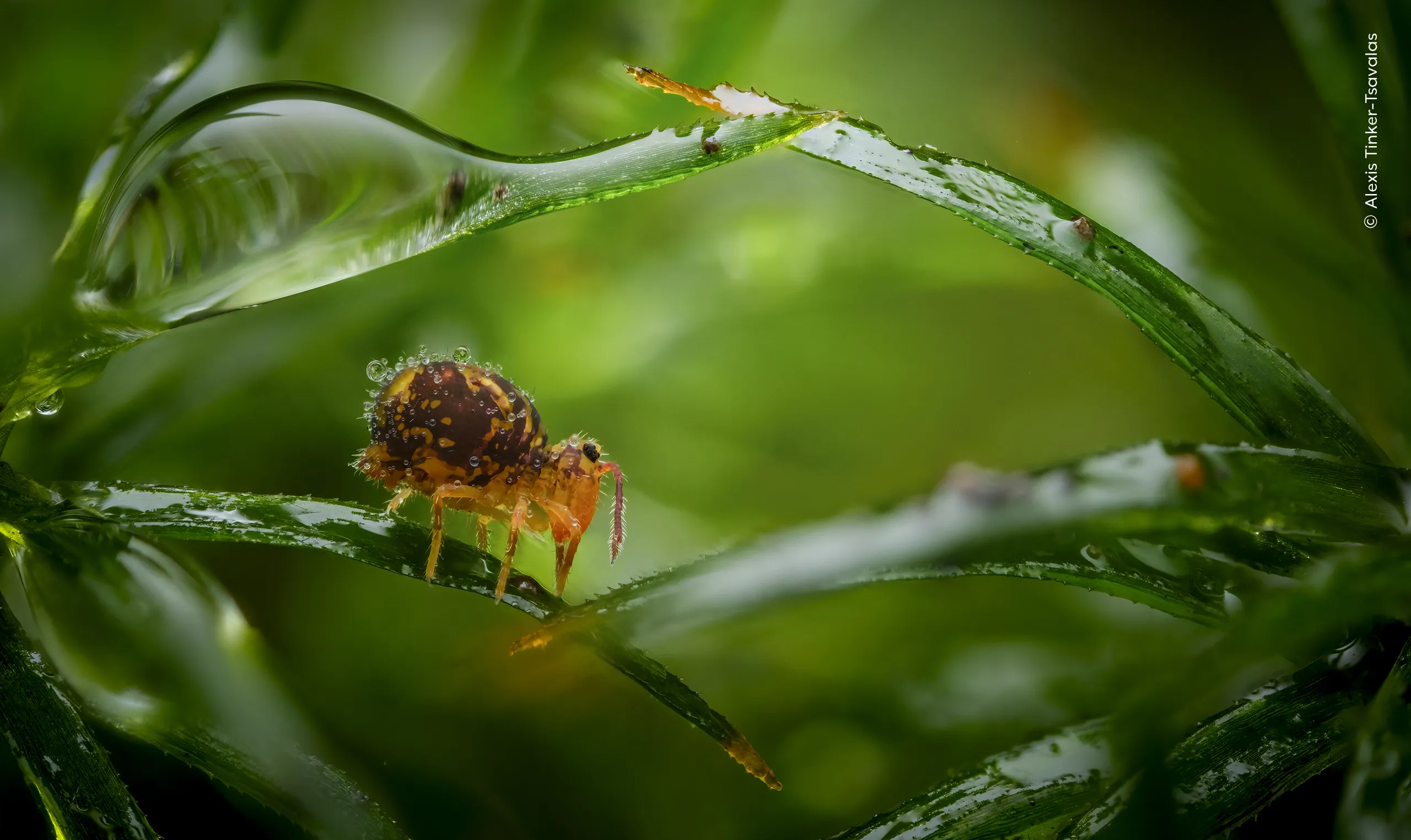
Wanderer in the Moss — Alexis Tinker-Tsavalas (Rising Star Portfolio Award). A springtail just a few millimetres long moves through moss. Macro and focus stacking make a tiny world visible. Location: Brieselang, Brandenburg, Germany. Equipment: Fujifilm X-H2 · Laowa 25mm f2.8 macro lens · 1/200 at f5.6 • ISO 320 • Godox V860III flash + Cygnustech diffuser • focus stack of 45 images.
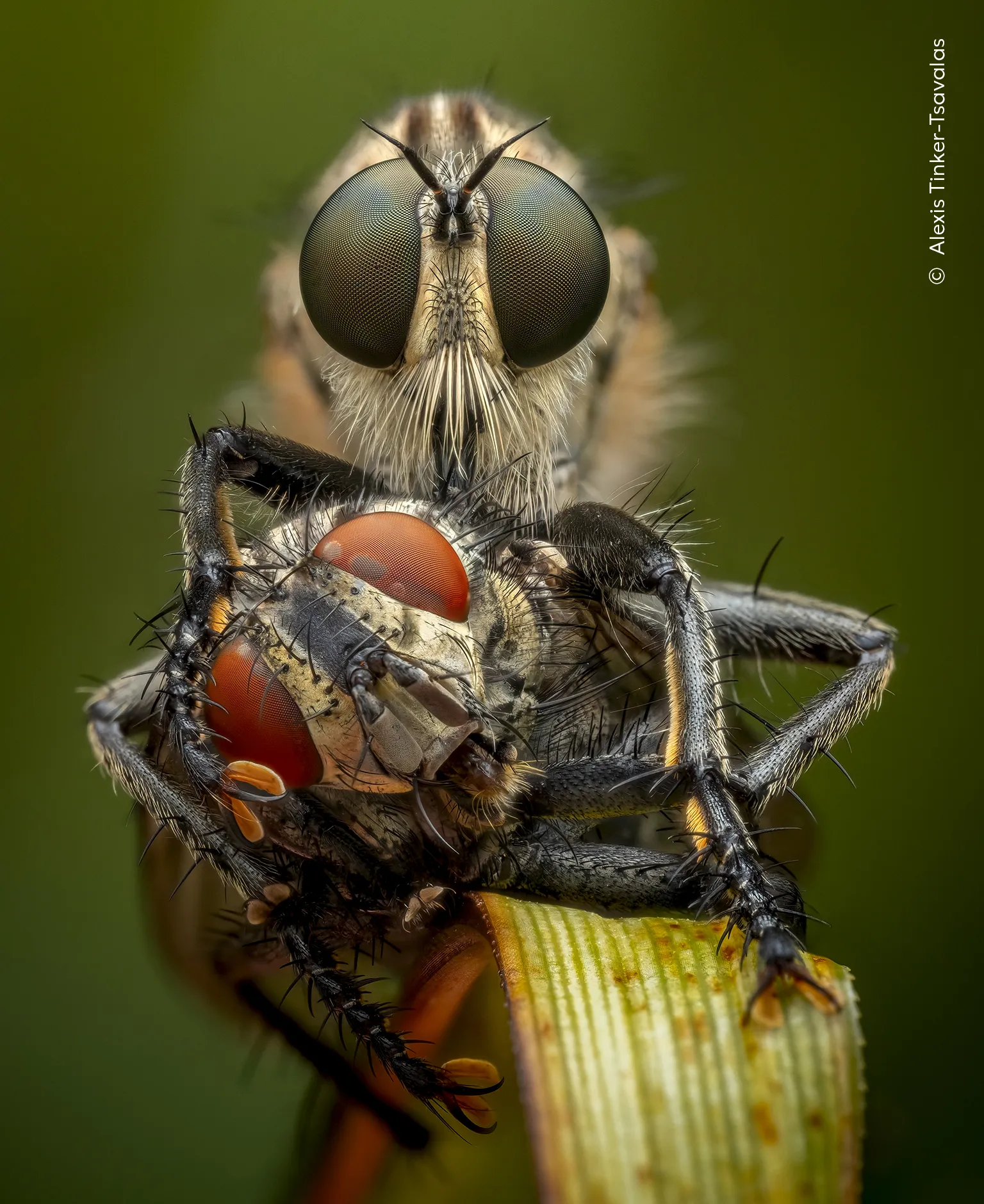
Afternoon Snack — Alexis Tinker-Tsavalas (Rising Star Portfolio Award). A predatory fly pierces another fly with its mouthparts while feeding. The photographer encountered the encounter already underway. Location: Brandenburg, Germany. Equipment: Fujifilm X-H2 · Laowa 65mm f2.8 macro lens · 1/200 at f5.6 • ISO 200 • Godox V860III flash + Cygnustech diffuser • focus stack of 24 images.
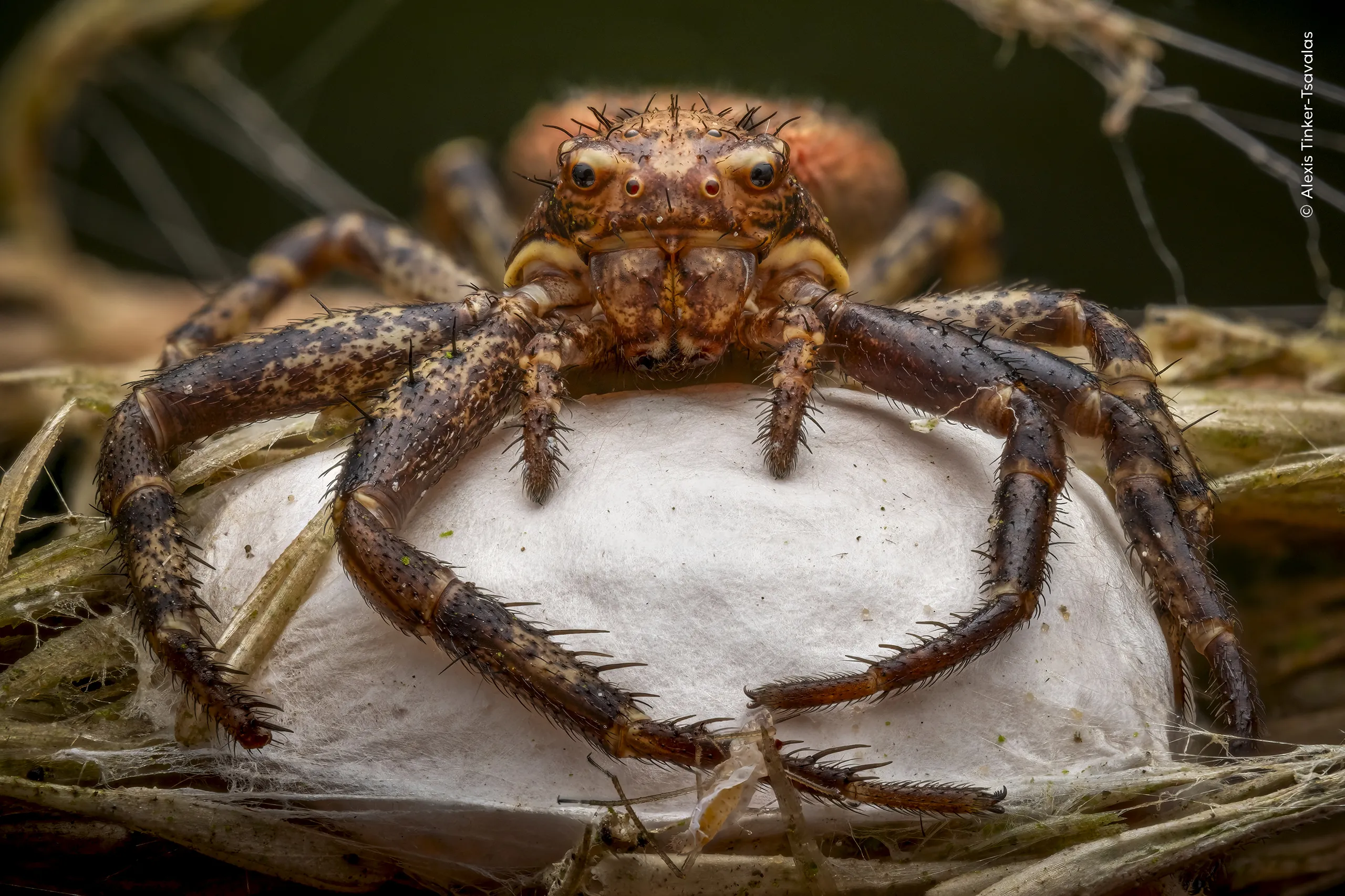
Watching and Waiting — Alexis Tinker-Tsavalas (Rising Star Portfolio Award). A spider guards her egg sac; one shorter leg suggests an earlier loss and regrowth during moulting. Location: Brandenburg, Germany. Equipment: Fujifilm X-H2 · Laowa 65mm f2.8 macro lens · 1/200 at f5.6 • ISO 160 • Godox V860III flash + Cygnustech diffuser • focus stack of 79 images.
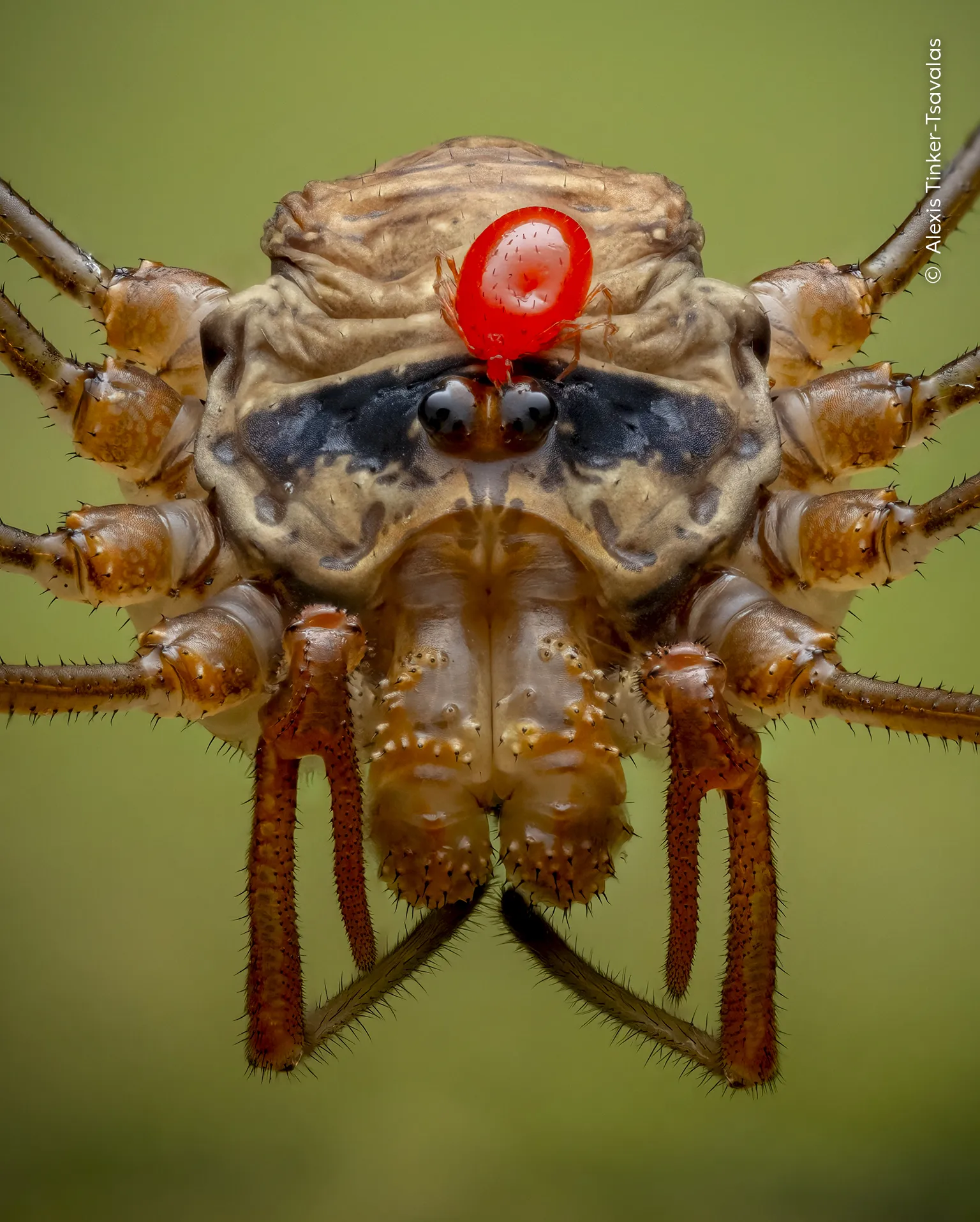
Red Mite Rider — Alexis Tinker-Tsavalas (Rising Star Portfolio Award). A red parasitic mite has attached itself behind the eyes of a harvestman. The unlikely passenger becomes the focus of the composition. Location: Belfast, Northern Ireland, UK. Equipment: Fujifilm X-H2 · Laowa 65mm f2.8 macro lens · 1/200 at f5.6 • ISO 400 • Godox V860III flash + Cygnustech diffuser • focus stack of 71 images.
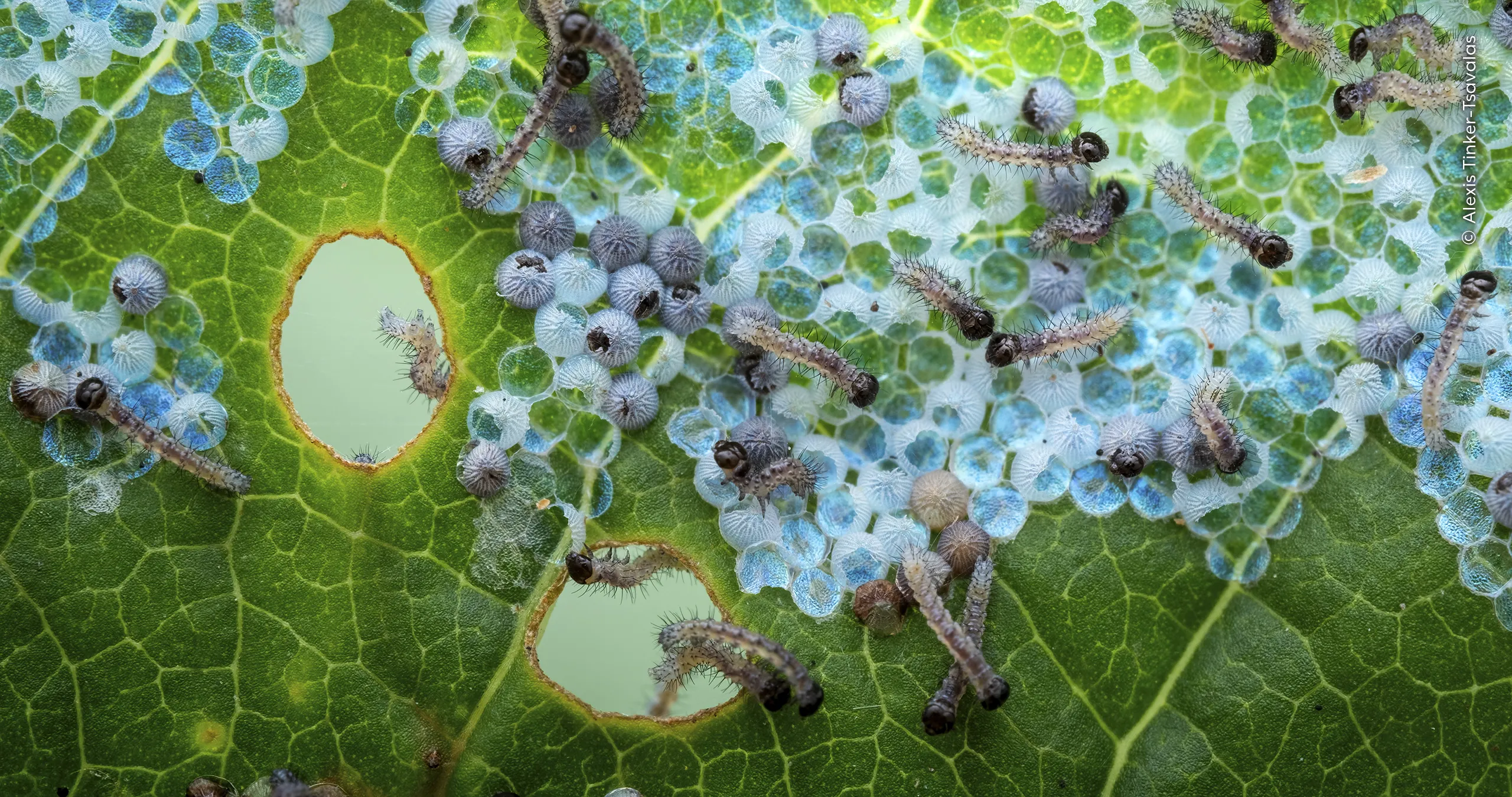
Caterpillar Breakout — Alexis Tinker-Tsavalas (Rising Star Portfolio Award). Tiny caterpillars emerge from blue eggs on the underside of a cherry leaf, found during a visit near Belfast. Location: Near Belfast, Northern Ireland, UK. Equipment: Fujifilm X-H2 · Laowa 65mm f2.8 macro lens · 1/200 at f8 • ISO 320 • Godox V860III flash + Cygnustech diffuser.
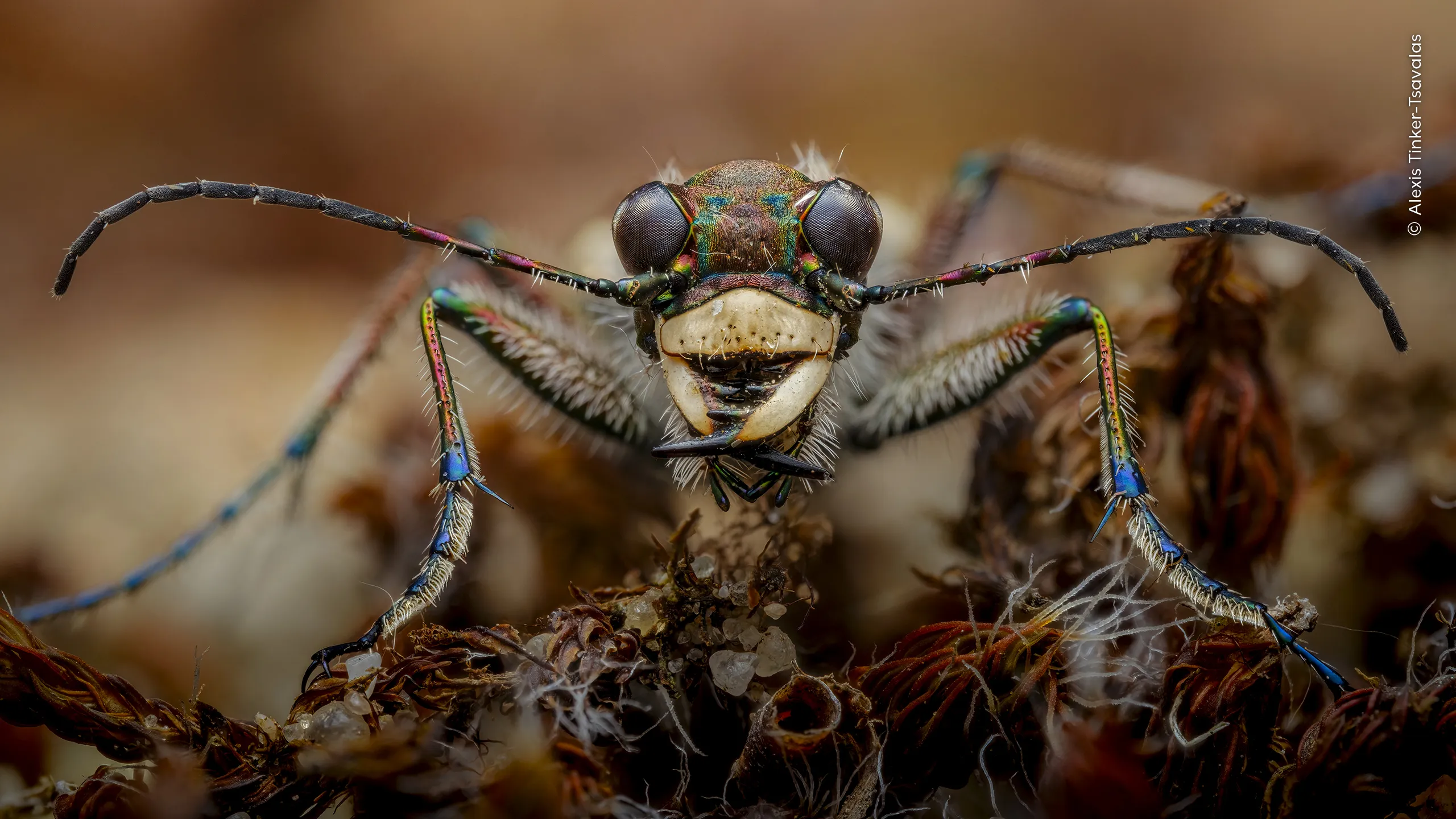
Eyes of the Tiger — Alexis Tinker-Tsavalas (Rising Star Portfolio Award). A head-on macro portrait of a fast-moving tiger beetle, achieved after repeated unsuccessful attempts. Location: Berlin, Germany. Equipment: Fujifilm X-H2 · Laowa 65mm f2.8 macro lens · 1/160 at f4 • ISO 200 • Godox V860III flash + Cygnustech diffuser • focus stack of 70 images.
Portfolio: Kutub Uddin’s miniature worlds
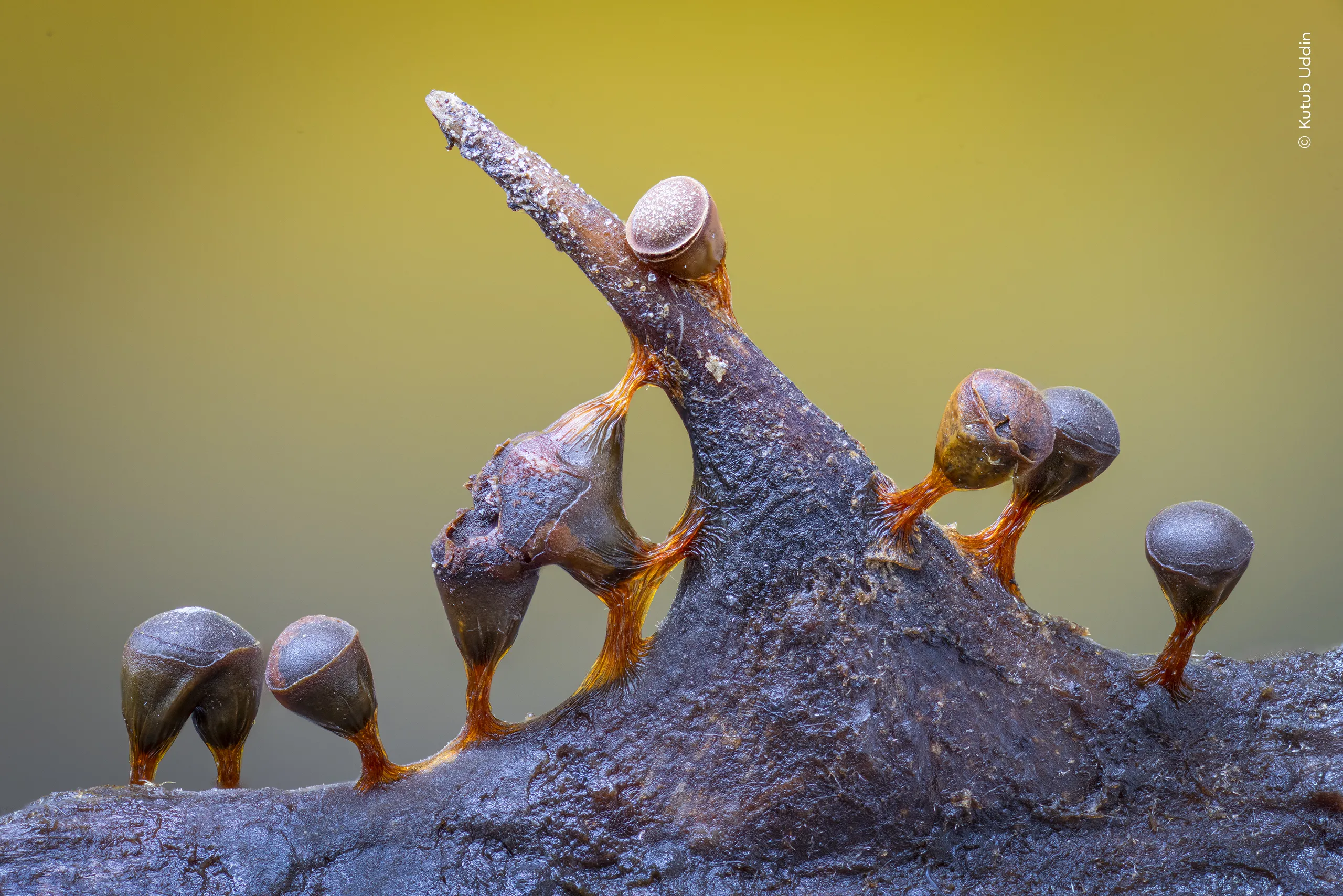
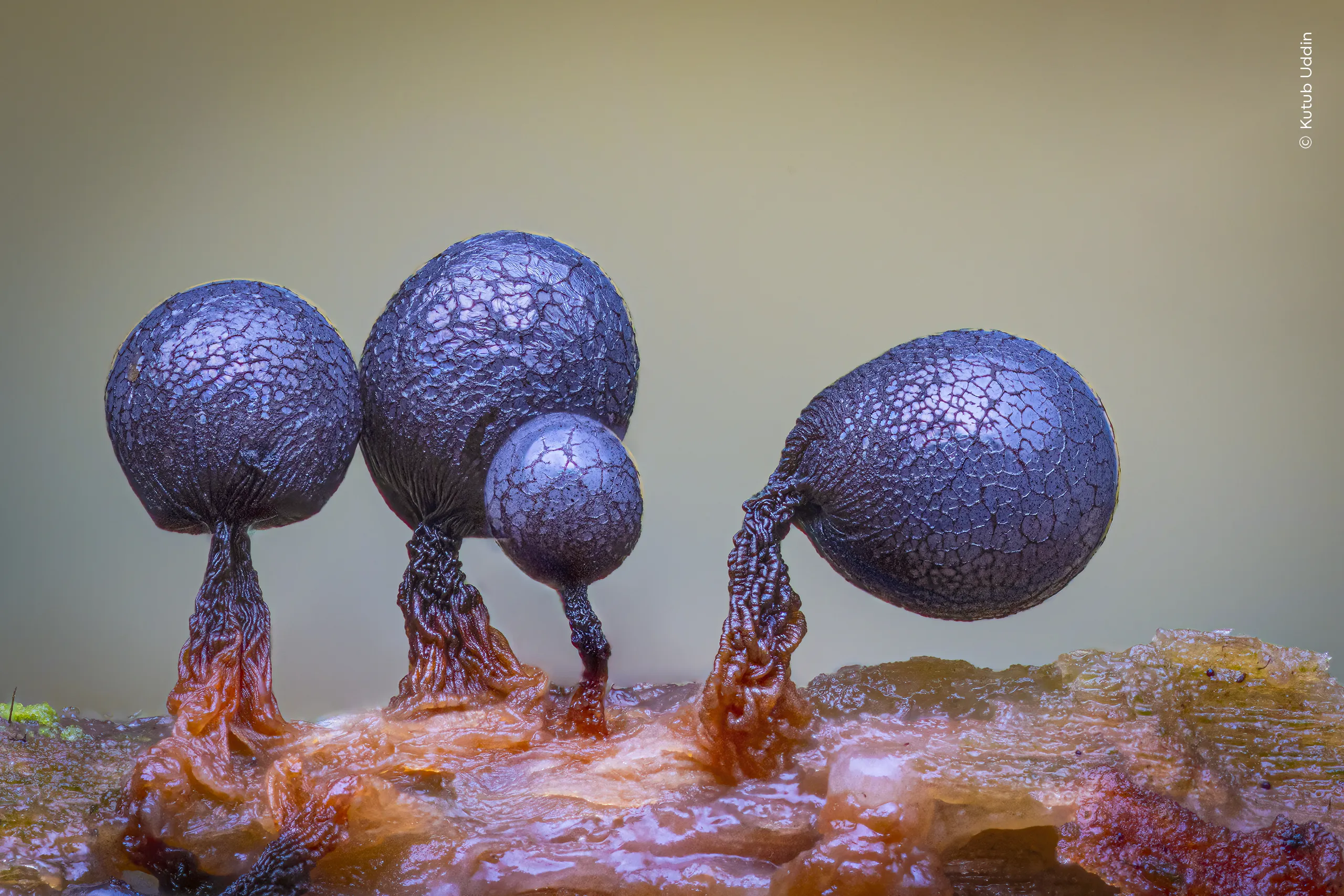
Merging Moulds — Kutub Uddin (Portfolio Award). Dark slime-mould fruiting bodies rise from amber-coloured plasmodial threads on a thorn. Location: Near Bognor Regis, West Sussex, England, UK. Equipment: Canon EOS R5 · 65mm f2.8 1-5x macro lens · 1/2 at f3.2 • ISO 640 • Cognisys StackShot macro rail • Benro Bat tripod • focus stack of 128 images.
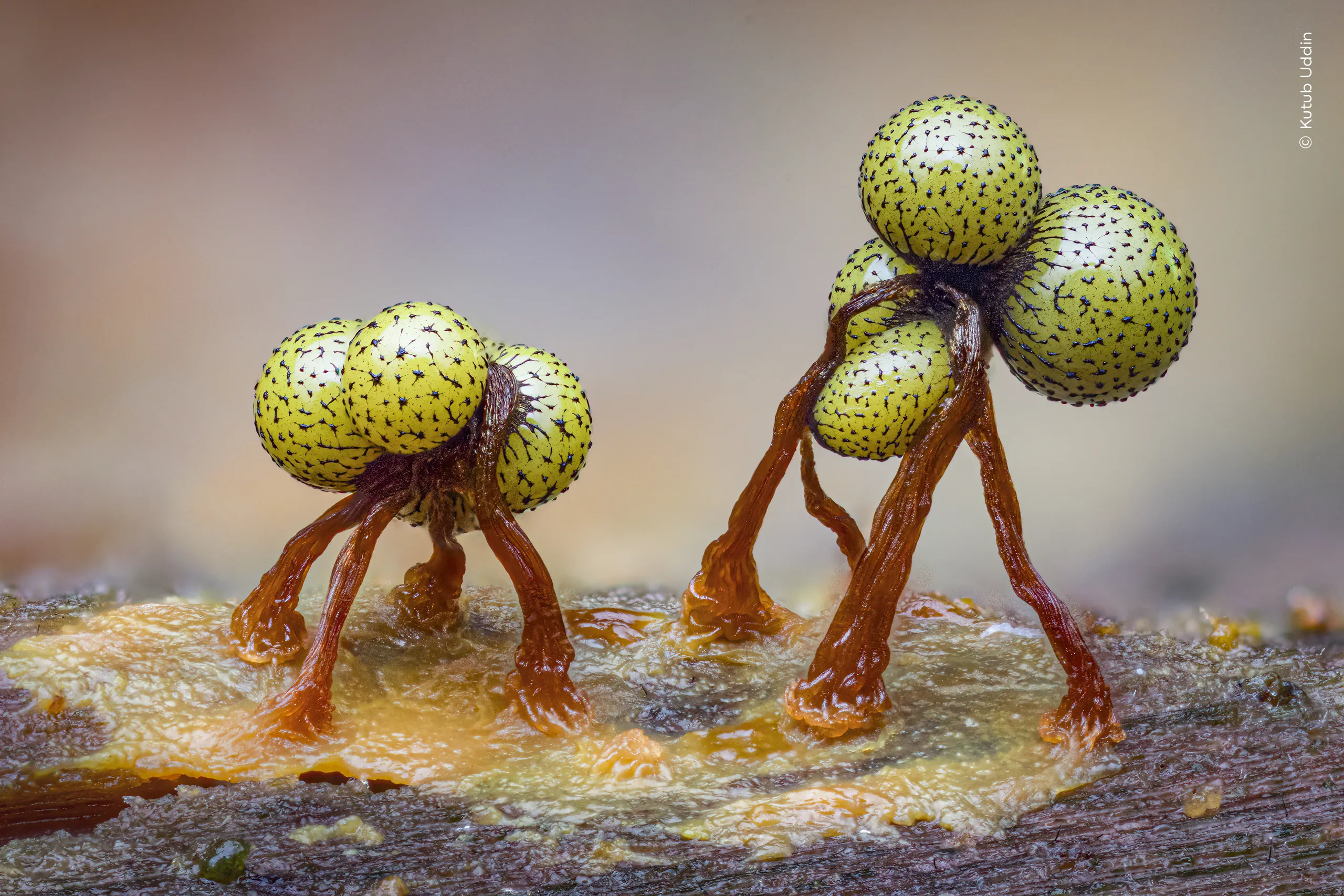
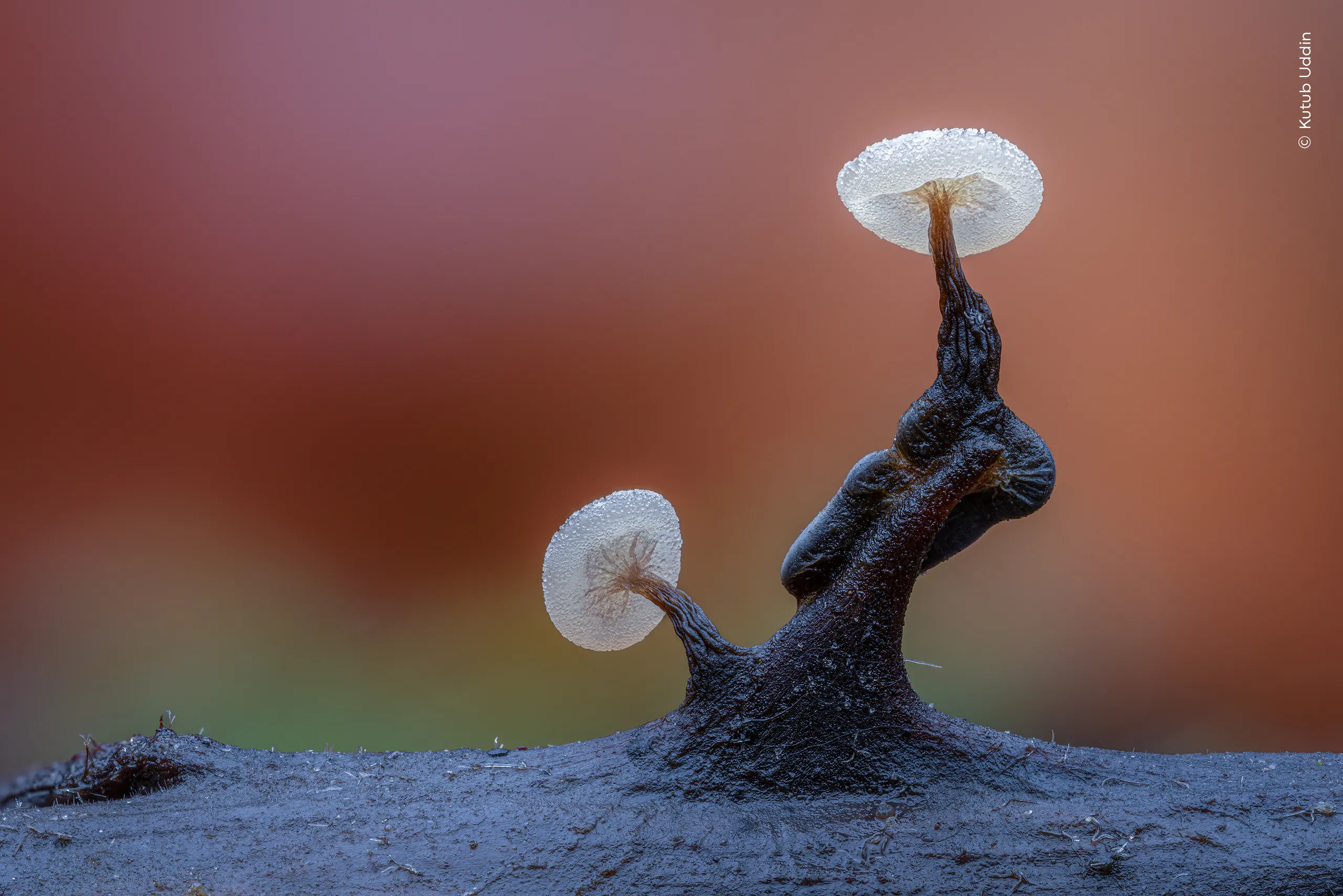
Tiny Dancers — Kutub Uddin (Portfolio Award). Yellow-green slime-mould fruiting bodies open delicate threads that assist the dispersal of spores. Location: Hesworth Common, West Sussex, England, UK. Equipment: Canon EOS R5 · 65mm f2.8 1-5x macro lens · 1/4 at f3.2 • ISO 400 • diffused flash • Cognisys StackShot macro rail • Benro Bat tripod • focus stack of 124 images.
The Gathering — Kutub Uddin (Portfolio Award). A fine line of slime-mould fruiting bodies emerges from the forest floor. Wind made the close-up challenging. Location: Hesworth Common, West Sussex, England, UK. Equipment: Canon EOS R5 · 65mm f2.8 1-5x macro lens · 0.4 sec at f6.3 • ISO 400 • Cognisys StackShot macro rail • Benro Bat tripod • focus stack of 65 images.
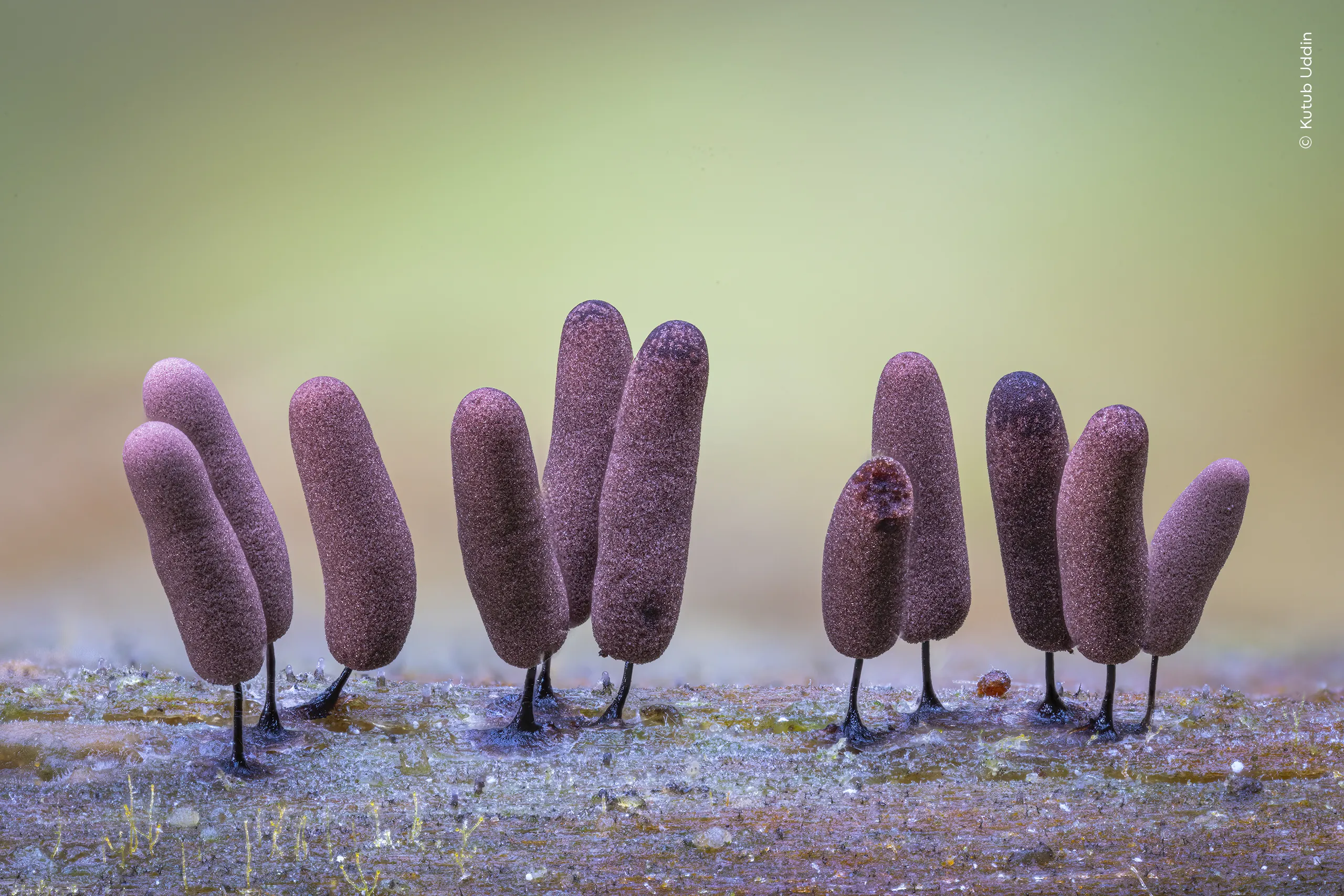
A World in Miniature — Kutub Uddin (Portfolio Award). Didymium clavus fruiting bodies the size of mustard seeds resemble miniature trees. Location: Slindon Wood, West Sussex, England, UK. Equipment: Canon EOS R5 · 65mm f2.8 1-5x macro lens · 1/4 at f3.2 • ISO 400 • diffused flash • Cognisys StackShot macro rail • Benro Bat tripod • focus stack of 124 images.
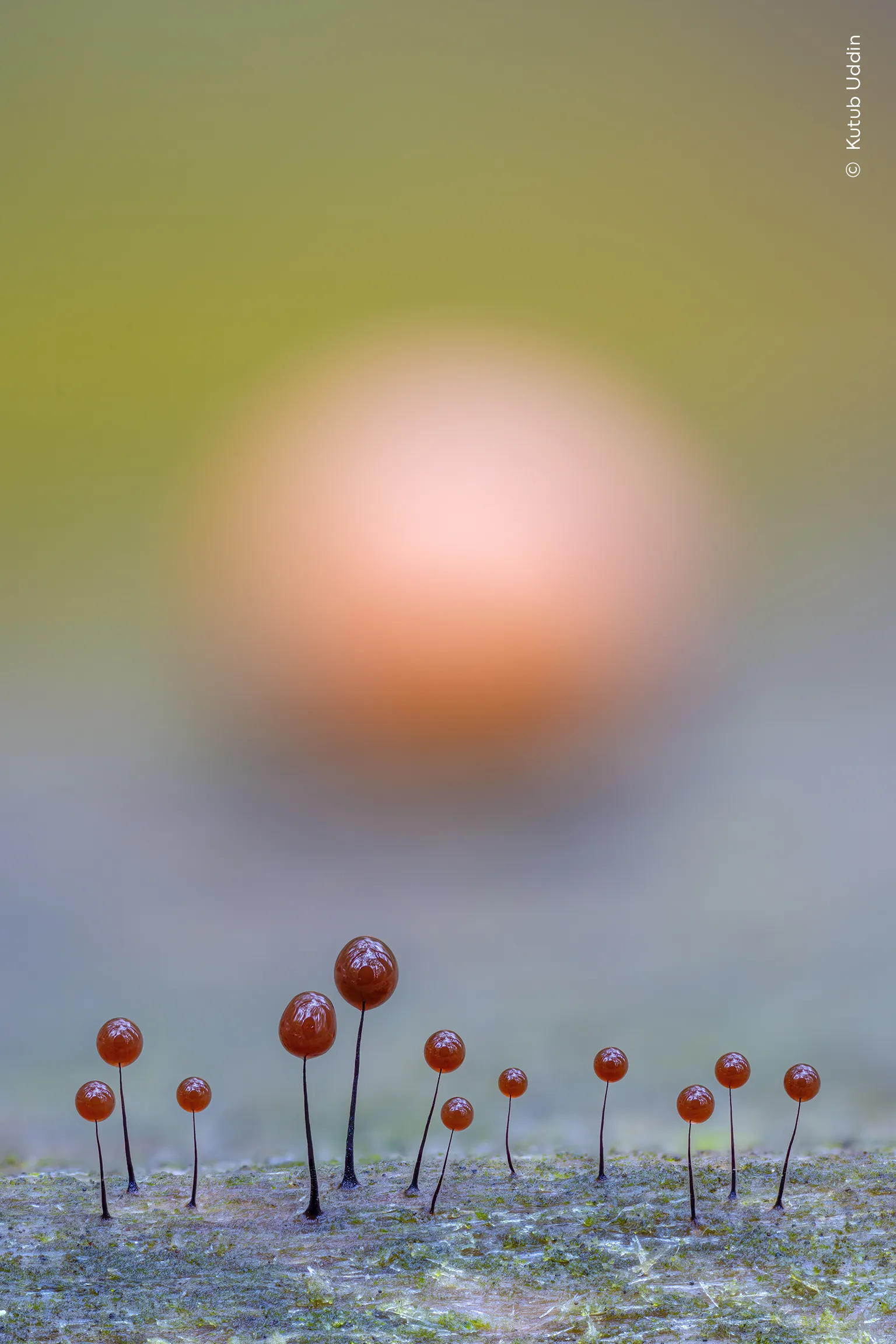
Fruits of the Forest — Kutub Uddin (Portfolio Award). Cribraria argillacea forms dense groups of delicate fruiting bodies with unexpected geometry. Location: Pulborough, West Sussex, England, UK. Equipment: Canon EOS R5 · 65mm f2.8 1-5x macro lens · 0.3 sec at f3.2 • ISO 400 • diffused flash • Cognisys StackShot macro rail • Benro Bat tripod • focus stack of 93 images.
Closer Still — Kutub Uddin (Portfolio Award). Tiny black fruiting bodies of Comatricha nigra, about the size of a pin tip, are rendered as a miniature landscape. Location: Slindon Wood, West Sussex, England, UK. Equipment: Canon EOS R5 · 65mm f2.8 1-5x macro lens · 1/2 at f4 • ISO 125 • Cognisys StackShot macro rail • Benro Bat tripod • focus stack of 110 images.
What we think
Veronesi’s photograph is difficult to look at precisely because it refuses an easy interpretation. We can see an elephant carrying a dead calf, but cannot establish that she is its mother or confidently assign a human emotion to her behaviour. That uncertainty demands more careful observation, not less compassion.
The selection works particularly well as a whole. Infrared at a waterhole, Papatsanis’s ultraviolet illumination and the extreme close-up work of the macro photographers are not demonstrations of expensive equipment for its own sake. Each technique helps reveal something that would otherwise be hard to see.
The Elliott, Tinker-Tsavalas and Uddin series are also a reminder that visual storytelling is not always about one decisive frame. Return visits, patience and the relationship between photographs can communicate more than any single award-winning image. That deserves attention alongside the overall winner.