

Summary
- What a 185-degree field of view means
- Full-frame coverage and mounts
- Optical design and aperture
- STM autofocus and close focus
- Construction, sealing and firmware
- Why it does not accept normal front filters
- Where it fits and where it does not
- Price and availability in Europe and Greece
- What we think
- Frequently asked questions
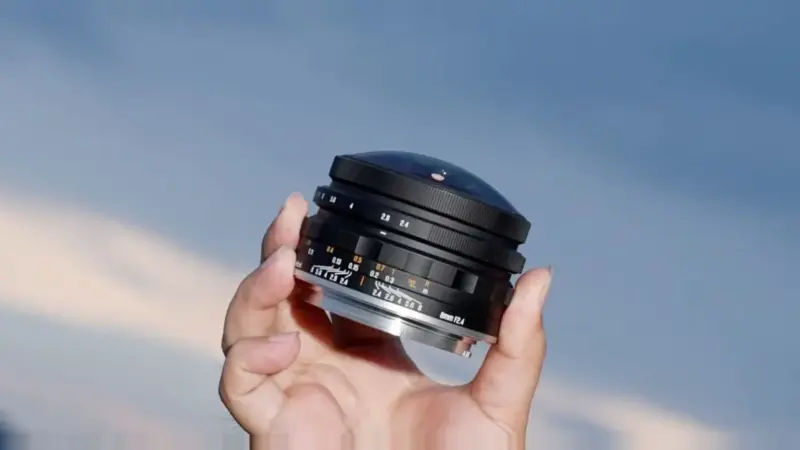
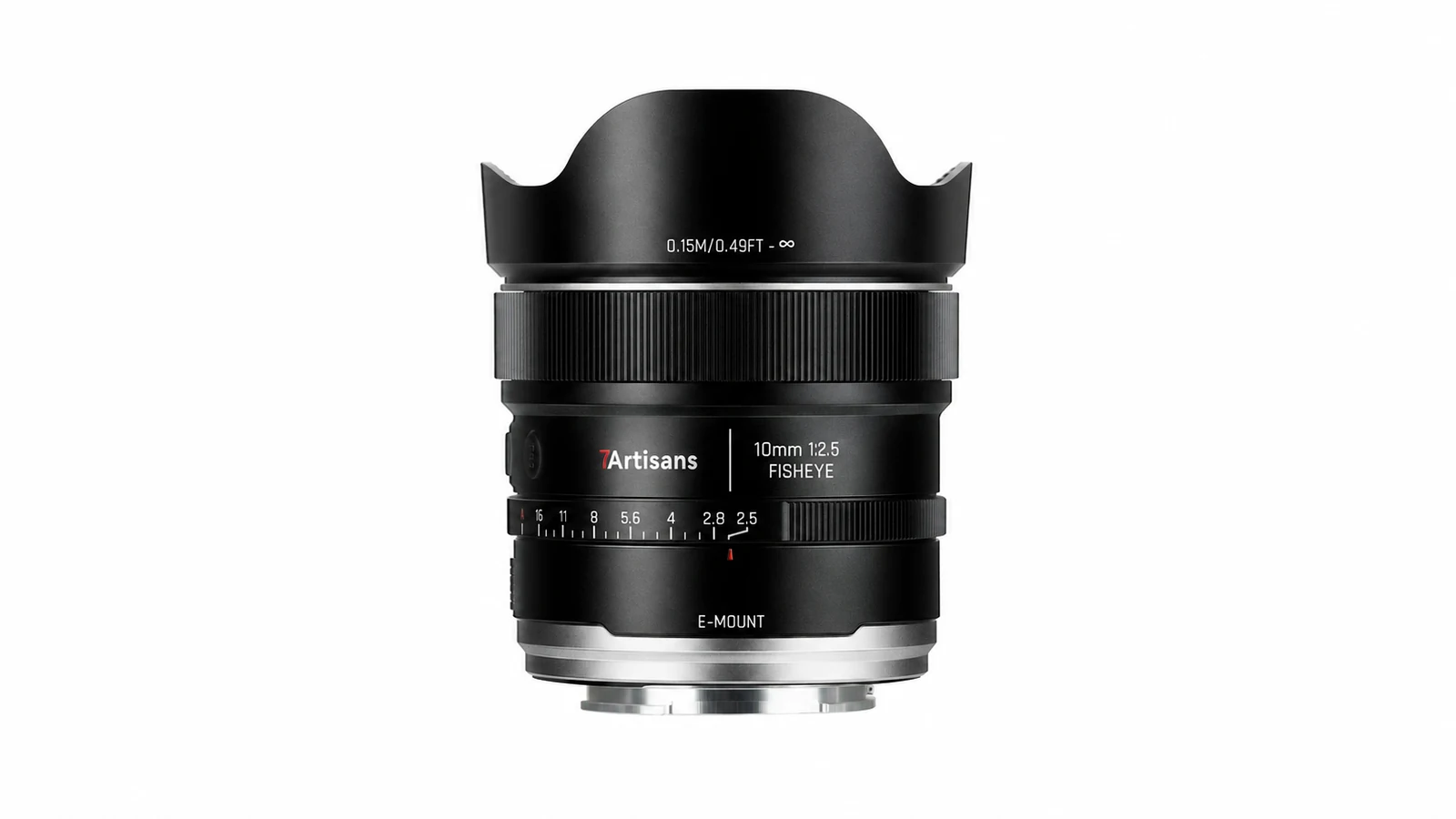
7Artisans has announced the AF 10mm f/2.5 Max Fisheye, a full-frame autofocus lens with a 185-degree field of view for Sony E, Nikon Z and L-Mount, priced at $449.
The lens combines the pronounced curvature of a fisheye with STM autofocus, a bright f/2.5 aperture, 15-centimetre minimum focus and electronic communication with compatible bodies. It belongs to the Max line and covers full-frame mirrorless cameras rather than only APS-C.
The announcement matters because extreme fisheye lenses are still often manual focus. Autofocus does not change the special projection, but it may help with action, skateboarding, concerts, interiors, VR and video where a subject moves rapidly close to the lens.
What a 185-degree field of view means
A 185-degree specification theoretically extends beyond the 180-degree hemisphere. The lens can record elements slightly behind the front plane, but users must be careful to keep fingers, tripod legs, straps and unwanted lights out of the frame.
Fisheye projection strongly curves lines that do not pass through the centre. This is not a flaw the design tries to hide but a core characteristic. Distortion is obvious in architecture and horizons, while symmetrical compositions, domes and very close subjects can use it creatively.
The 185-degree field should not be compared directly with a rectilinear 10mm ultra-wide. A corrected ultra-wide keeps lines straight at the cost of edge stretching, while a fisheye maps the scene differently and creates its characteristic curved image.
Full-frame coverage and mounts
The AF 10mm f/2.5 Max Fisheye is designed for full-frame sensors and ships in Sony E, Nikon Z and L-Mount. These three mirrorless versions cover Sony, Nikon and selected L-Mount Alliance cameras.
Electronic compatibility is not automatic on every older body. The official product page lists supported models and limitations. Buyers should check the exact camera, firmware and available AF functions, since subject detection and video autofocus differ by manufacturer.
Optical design and aperture
The optical formula uses 11 elements in eight groups, including two ED elements and one aspherical element. The goal is to control chromatic aberration and loss of sharpness across a field where rays reach the edges at extreme angles. Independent testing is still needed for corner performance and backlight behaviour.
The aperture ranges from f/2.5 to f/16 and uses nine blades. F/2.5 helps in low light and astrophotography, but coma, edge rendering and flare are more important than the aperture number alone. Aperture is electronic and the lens has a clicked ring.
STM autofocus and close focus
Autofocus uses an STM motor. A 10mm fisheye’s depth of field can hide small errors, but at f/2.5 and 15 centimetres exact focus becomes visible, especially when a close subject dominates the centre and the surroundings stretch toward the edges.
The 0.15-metre minimum is measured from the sensor plane, not the front element. A subject can sit very close to the fixed hood, creating exaggerated perspective: a small foreground object becomes enormous while the background appears distant. It is creatively powerful but increases the risk of contact or casting a shadow.
Construction, sealing and firmware
The lens has a metal body and weighs about 504 grams in Sony E version. 7Artisans mentions a dust-resistant mount seal and an anti-smudge coating on the front element. That wording is not full waterproofing, so rain, saltwater and sand still require caution.
A USB-C port supports future firmware updates. This matters for third-party autofocus lenses because communication with new cameras and manufacturer updates can require fixes. PTTL recently covered a 7Artisans firmware release for eight X and L-Mount autofocus lenses, showing that the company actively uses firmware for compatibility and handling.
Why it does not accept normal front filters
The strongly curved front element and fixed petal hood prevent a conventional screw-in filter. No filter diameter is listed. This limits the use of ND or protection filters and leaves the glass more exposed, although the hood provides basic mechanical protection.
For video in bright light, the lack of ND may make a slow shutter at f/2.5 difficult. Unless a rear-filter solution is offered for the specific mount, users must stop down or increase shutter speed.
Where it fits and where it does not
The lens suits creators who deliberately want fisheye aesthetics: action sports, skate, BMX, musicians, tight spaces, creative portraits, 360/VR work with the appropriate technique and all-sky astrophotography. Close focus can also create dramatic foregrounds in landscapes.
It is not the obvious choice for conventional architecture, real estate or natural face rendering. Defishing in software crops heavily and lowers edge resolution. A rectilinear ultra-wide is better when straight lines are the goal.
Compared with the manual 7Artisans 6mm f/2 220-degree APS-C fisheye, the new lens has a smaller nominal angle but full-frame coverage and autofocus. It targets a different use rather than simply replacing the older model.
Price and availability in Europe and Greece
The official international price is $449 for Sony E, Nikon Z and L-Mount. The official UK store lists £400. No official euro price or Greece-specific price was posted when checked.
Greek buyers should confirm fulfilment location, VAT, possible import charges and warranty terms.
Official 7Artisans AF 10mm f/2.5 Max product page
What we think
The AF 10mm f/2.5 Max Fisheye is not trying to be a general-purpose ultra-wide. Its value lies in extreme projection, close focus and autofocus, which may make fisheye work easier for action and video. The 504-gram weight and lack of filters are real constraints, while edge quality and flare will decide whether the $449 price is justified.
Frequently asked questions
Is the 7Artisans 10mm f/2.5 full-frame?
Yes. It is designed for full-frame Sony E, Nikon Z and L-Mount cameras.
Does it keep straight lines straight?
No. It is a 185-degree fisheye and curvature is a defining part of its projection.
Does it have autofocus?
Yes, with an STM motor and electronic communication, but compatibility should be checked for each camera and firmware version.
Can it use filters?
It has no conventional front filter thread because of the curved element and fixed hood.