

Summary
- Twelve unmodified Osmo Action 6 cameras were mounted on the reusable Zhuque-3
- The cameras recorded ascent, atmospheric return and vertical landing in an unedited shot
- Local recording continued through communications blackout
- DJI cites 400–500°C rocket-surface temperatures, not full thermal data for every camera
- The complete launch and return footage
- What the Zhuque-3 mission was
- Understanding the 500°C claim
- Recording through communications blackout
- Stabilisation against vibration and g-loads
- Sensor performance in difficult light
- Why twelve cameras matter
- What the test says about an action camera
- What we think
- Frequently asked questions
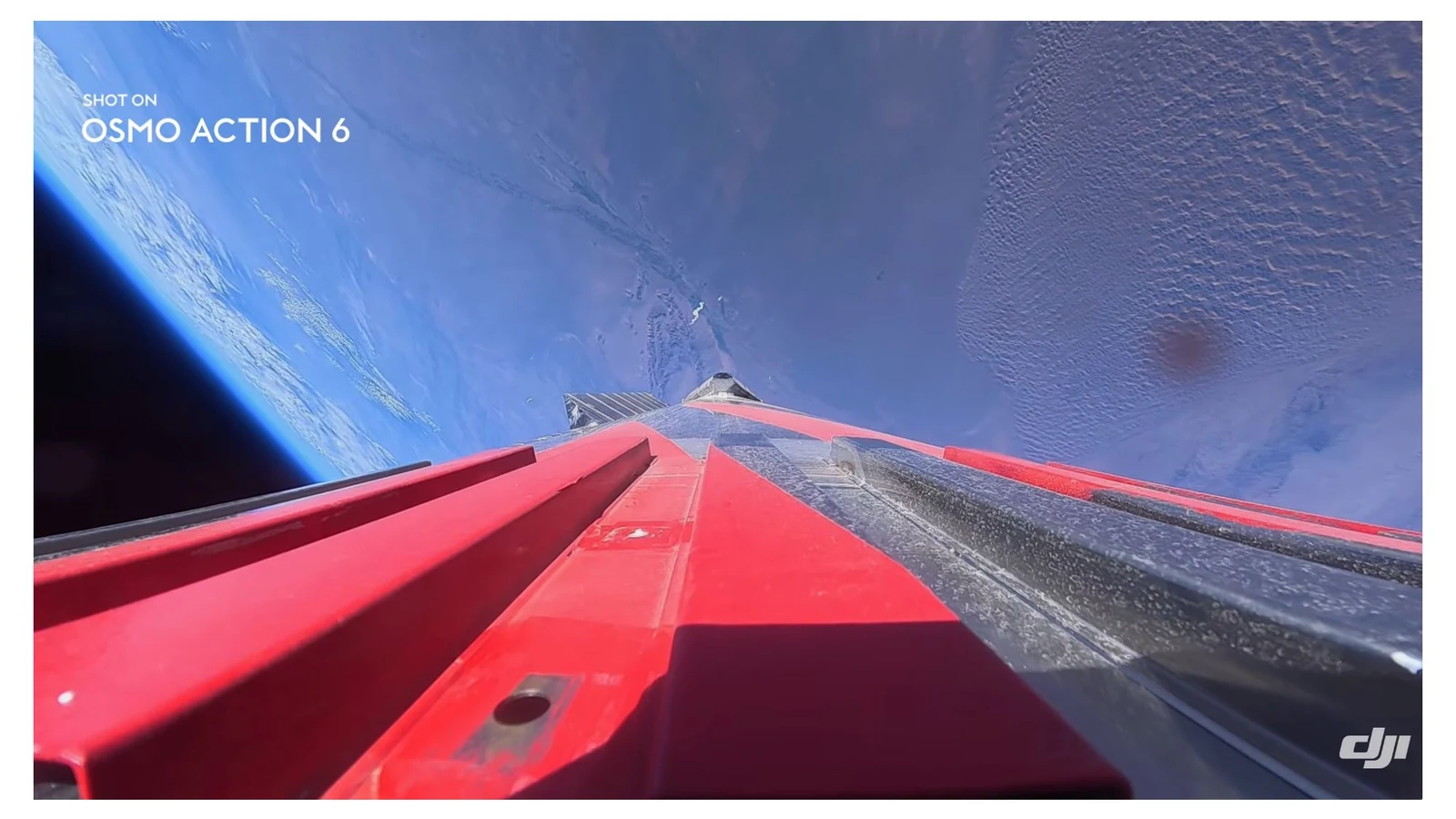
Twelve unmodified DJI Osmo Action 6 cameras were mounted on LandSpace’s reusable Zhuque-3 rocket, recording a first-person view of ascent, atmospheric return and vertical landing.
The mission flew on August 19 and, according to DJI, produced an unedited shot of roughly nine minutes from launch to recovery. Cameras at different critical positions captured ignition, attitude changes, grid fins and final deceleration.
This is not another Action 6 review. It is an extreme recording test involving high g-loads, continuous vibration, enormous lighting changes, external communications blackout and aerodynamic heating. At the same time, DJI’s dramatic 400–500°C claim needs precise interpretation.
The complete launch and return footage
The official video follows Zhuque-3 from the launchpad through the atmosphere and back to the surface. Unlike a fast promotional montage, the unedited one-shot shows major framing changes, rotation, vibration and the transition from a dark horizon to intense sunlight.
The cameras did not all observe the same area. Multiple mounting points provided engineers with visual information about external components, grid fins, first-stage condition and behaviour during return. The footage therefore has technical as well as visual value.
What the Zhuque-3 mission was
Zhuque-3 is a reusable rocket developed by China’s LandSpace. DJI describes this flight as China’s first successful land-based orbital launch and recovery. After ascent, the first stage made a controlled return and vertical landing.
Saying the camera “went to space” describes the flight of the system carrying it. The Action 6 units did not enter orbit independently or operate completely unshielded. Exact position on the structure affects temperature, airflow, radiation and mechanical stress.
Understanding the 500°C claim
DJI says aerodynamic heating during ascent and return raised the rocket body’s surface temperature to roughly 400–500°C. This should not be read as proof that the entire camera or sensor operated continuously at 500°C for nine minutes.
Actual thermal exposure depends on location, conduction through the mount, shielding, peak duration and local flow. DJI says the consumer cameras were not specially modified, but the newsroom post does not publish full thermal data for every position. The safe conclusion is that the units survived the flight environment where they were installed.
Recording through communications blackout
The vehicle entered a blackout zone while passing through the atmosphere. The Action 6 did not need a live uplink: it recorded locally and the files returned with the first stage.
That is a practical advantage of onboard cameras in testing. Recording can continue without telemetry or image transmission, shifting the critical risk to storage survival, stable power and successful recovery.
Stabilisation against vibration and g-loads
DJI credits the Action 6’s latest electronic stabilisation algorithm for much of the smoothness. Launch and attitude adjustments generate high-frequency vibration and large loads unlike cycling or motorsport.
Stabilisation does not remove the rocket’s physical motion. It compensates for part of the micro-movement within the available crop and gyro data. The footage remains readable, but performance cannot be measured fully without the unstabilised file, settings and motion data.
Sensor performance in difficult light
Osmo Action 6 uses a square 1/1.1-inch sensor, records up to 4K/120p and has a claimed 13.5 stops of dynamic range. During flight it faced intense high-altitude sunlight, dark vehicle surfaces, backlight, engine flames, dust and rapid exposure changes.
The square sensor leaves room for different crops and stabilisation in horizontal or vertical formats. Here, the key was retaining highlight and shadow information so moving mechanical parts remained visible.
Why twelve cameras matter
Using twelve units reduces the risk of losing every view to one failure and allows simultaneous monitoring of different areas. One angle can show grid-fin deployment, another the fuselage and another ground contact.
DJI says the wider imaging network also included Osmo 360 II, Mavic 4 Pro, Matrice 4TD thermal imaging, Avata 360 and Osmo Pocket 4P. Those systems filmed from air and ground and should not be confused with the twelve Action 6 units on the rocket.
What the test says about an action camera
The flight shows that a small mass-produced camera can work as a recoverable recorder in industrial testing when placement, mounting and storage are engineered correctly. It does not prove an Action 6 can be mounted anywhere on a rocket or aircraft without mechanical analysis.
PTTL previously covered the DJI Osmo Action 6 announcement and its variable aperture. Here, the important information is not a new product specification but the behaviour of a known camera system inside an exceptionally demanding real event.
What we think
This is one of the most striking onboard action-camera recordings in recent years because it combines a real reusable flight with unedited footage. DJI understandably presents it as a durability demonstration, but 500°C should be attributed as rocket-surface temperature and a company claim, not as complete laboratory certification of the camera. The greatest value is that the files returned, stayed clear and could support engineering review.
Frequently asked questions
How many Osmo Action 6 cameras were used?
Twelve consumer units, according to DJI, mounted at different locations on Zhuque-3.
Were they modified for space?
DJI says the cameras themselves were unmodified. Mounting and exact placement remain part of the engineering installation.
Did they really operate at 500°C?
DJI cites rocket-surface temperatures of 400–500°C. Internal temperatures for each camera are not published, so the figure should not be treated as continuous component temperature.
Why was footage not lost in blackout?
Recording was local and did not depend on live transmission. The files were recovered when the first stage returned.