Summary
- The Euclid DR1-Foundation release includes more than 900 million galaxies and an enormous northern sky mosaic.
The European Space Agency (ESA) released DR1-Foundation on 12 November 2026, the first major scientific dataset from its Euclid space telescope. It brings together about 13 months of observations and records more than 900 million galaxies.
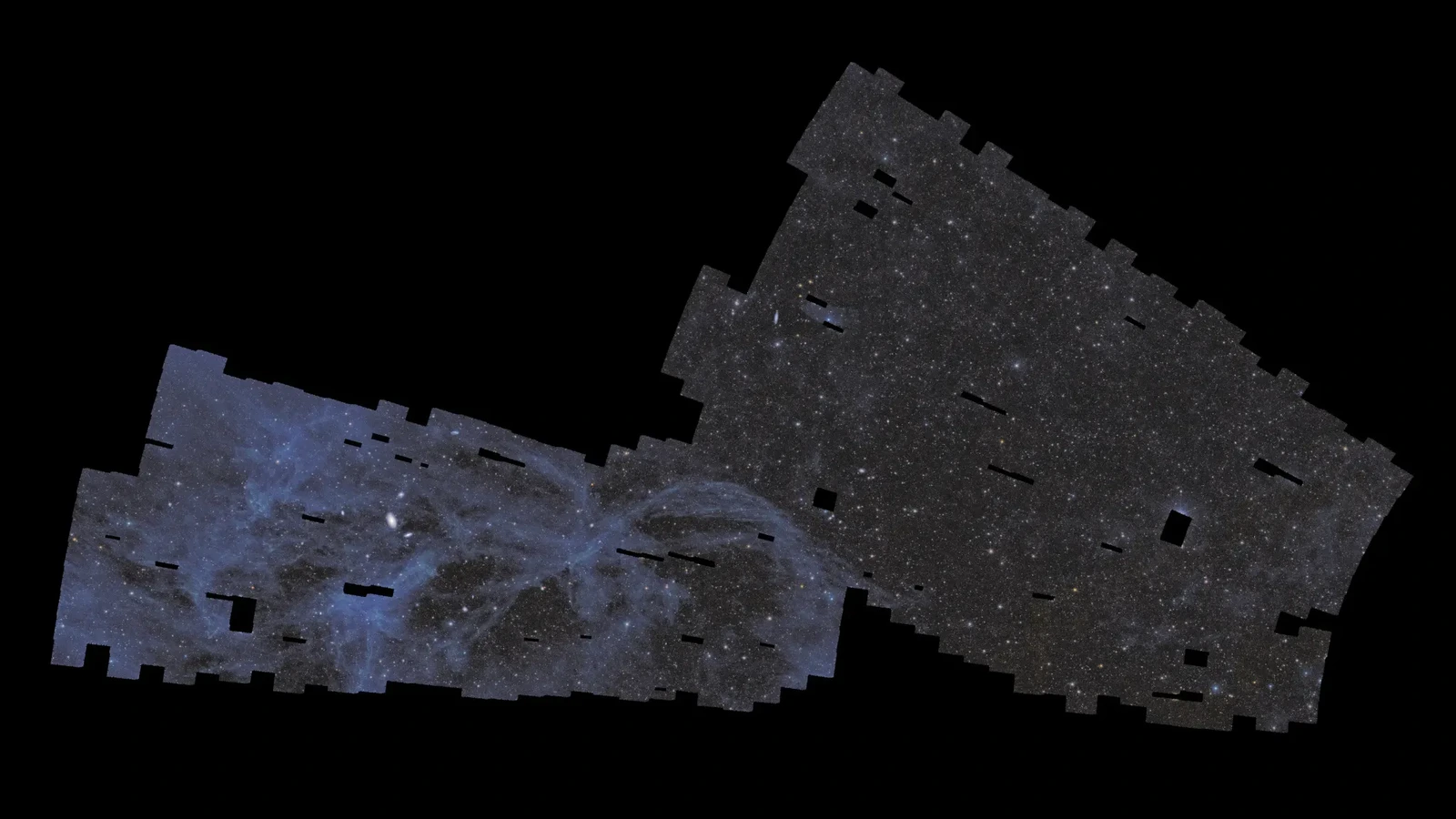
Among its most striking results is a nearly 500-gigapixel mosaic of the northern sky. This immense composition combines 740 observations made in autumn 2024 and spring 2025, spanning 367 square degrees. The 500-gigapixel figure refers to the full scientific mosaic, not the smaller preview image available for download.
What the first major release contains
DR1-Foundation covers about 1,900 square degrees in total, roughly 14% of the mission’s planned survey area. It amounts to 1.7 million GB of data and includes more than 160 million spectra, over 60 million quasar candidates and around 15,000 strong gravitational-lens candidates.
Gravitational lenses occur when the mass of a foreground galaxy or cluster bends the light from a more distant object. They are valuable for studying the distribution of mass and dark matter, as well as revealing extremely distant galaxies.
From Messier 81 to the cosmic web
The spiral galaxy Messier 81, about 12 million light-years away, stands out near the lower-left part of the mosaic. Faint structures of galactic dust surround it, while countless light sources populate the wider image.
Euclid combines visible-light observations with near-infrared data from its VIS and NISP instruments. Researchers therefore obtain more than pictures: they can measure galaxy shapes, positions and distances to build a three-dimensional map of the Universe’s large-scale structure.
PTTL has also covered Euclid’s detailed view of the centre of our Milky Way, a very different application of the same telescope’s capabilities.
What comes next
DR1-Foundation is the beginning rather than the complete first data release. The full DR1 is expected in mid-2027, with additional scientific products and weak gravitational-lensing measurements that will support research into dark matter and dark energy.
What we think
For anyone working with images, the most remarkable aspect is not simply the pixel count. It is how hundreds of individual observations become a coherent, scientifically useful dataset. The visible boundaries and gaps remind us that these are real measurements, not a decorative rendering.
More importantly, the mosaic is backed by spectra and catalogues that enable quantitative analysis. That is the difference between a spectacular picture of the sky and an instrument capable of changing our understanding of the Universe.