

Summary
- FUJIFILM Hellas will exhibit at booth J21 in Pavilion 13 of the 90th TIF
- Fuji Photo Film was founded in Japan in 1934
- The name became FUJIFILM in 2006 as the group expanded beyond photography
- FUJICA, FUJINON and FUJIX are key milestones in its naming and technological journey
- FUJIFILM Hellas has more than 50 years of presence in Greece
FUJIFILM Hellas’ presence at this year’s Thessaloniki International Fair, with Japan as the Honored Country, is an opportunity to examine how a name tied to film evolved into a global imaging, healthcare and technology group.
FUJIFILM Hellas will be at booth J21 in Pavilion 13, inside the Japan Pavilion of the 90th Thessaloniki International Fair, from September 5 to 13, 2026.
The participation carries particular weight because it brings together three different histories: 100 years since the first TIF in 1926, FUJIFILM’s long Japanese journey since 1934 and more than 50 years of FUJIFILM Hellas in the Greek market.
FUJIFILM in the 90th TIF Japan Pavilion
TIF-HELEXPO officially lists FUJIFILM Hellas among the exhibitors representing Honored Country Japan, at booth J21. PTTL has already published a separate practical guide to FUJIFILM’s location, dates and opening hours at TIF.
The Japanese participation occupies Pavilion 13 and is organised around TAKUMI, with references to wisdom, empathy and driving force. FUJIFILM is joined by companies and organisations from technology, healthcare, automotive, energy and tourism.
A detailed programme of products, workshops or presentations specifically planned for J21 has not yet been published. It should therefore not be assumed that every recent camera or lens will be available for hands-on use.
How Fuji Photo Film began in 1934
The company was founded on January 20, 1934 as Fuji Photo Film Co., Ltd., under a Japanese plan to establish domestic photographic film production. It inherited the photographic film operations spun off from Dainippon Celluloid, and the Ashigara factory began operating the following month.
The first production lines made motion-picture and photographic film, photographic paper, dry plates and other photosensitive materials. The location was chosen partly for the clean water and air required to maintain consistent photographic-emulsion quality.
“Fuji” gave the company an immediately recognisable Japanese identity through its reference to Mount Fuji, while “Photo Film” precisely described its original business. For decades, the same name accompanied expansion from analogue materials into cameras, lenses, printing and digital imaging.

From FUJICA and FUJINON to FUJIX
In the late 1940s, the company moved into camera manufacturing with the FUJICA Six. FUJICA became the familiar name on many later cameras, while FUJINON was established for lenses and professional optical systems.
The optical business had already been organised in the 1940s. In 1956, Fujifilm developed FUJIC, the first electronic digital computer built in Japan, to accelerate complex lens-design calculations. This explains why FUJINON is not merely a modern brand name but the continuation of decades of optical expertise.
The FUJICA ST701 of 1970 was the company’s first SLR and used pioneering TTL metering with silicon photodiodes. The later ST801 and ST901 continued with electronic viewfinder displays at a time when in-finder information was only beginning to evolve.
As the digital transition began, the FUJIX name appeared. The 1988 DS-1P was the first fully digital prototype to record images on a memory card. It was not commercially released, but the FUJIX DS-X that followed in 1989 brought the idea to market. PTTL has detailed the significance of the FUJIX DS-1P and its 2MB memory card.
Why the name became FUJIFILM in 2006
The major change came on October 1, 2006. Fuji Photo Film Co., Ltd. became a holding company named FUJIFILM Holdings Corporation, while the new FUJIFILM Corporation took over the operating businesses.
Removing the word “Photo” was more than a formal detail. Photographic film was declining rapidly after the digital shock, and the group had already expanded into medical systems, graphic arts, high-technology materials, business solutions and other activities. “FILM” remained in the name as a link to the company’s technological heritage.
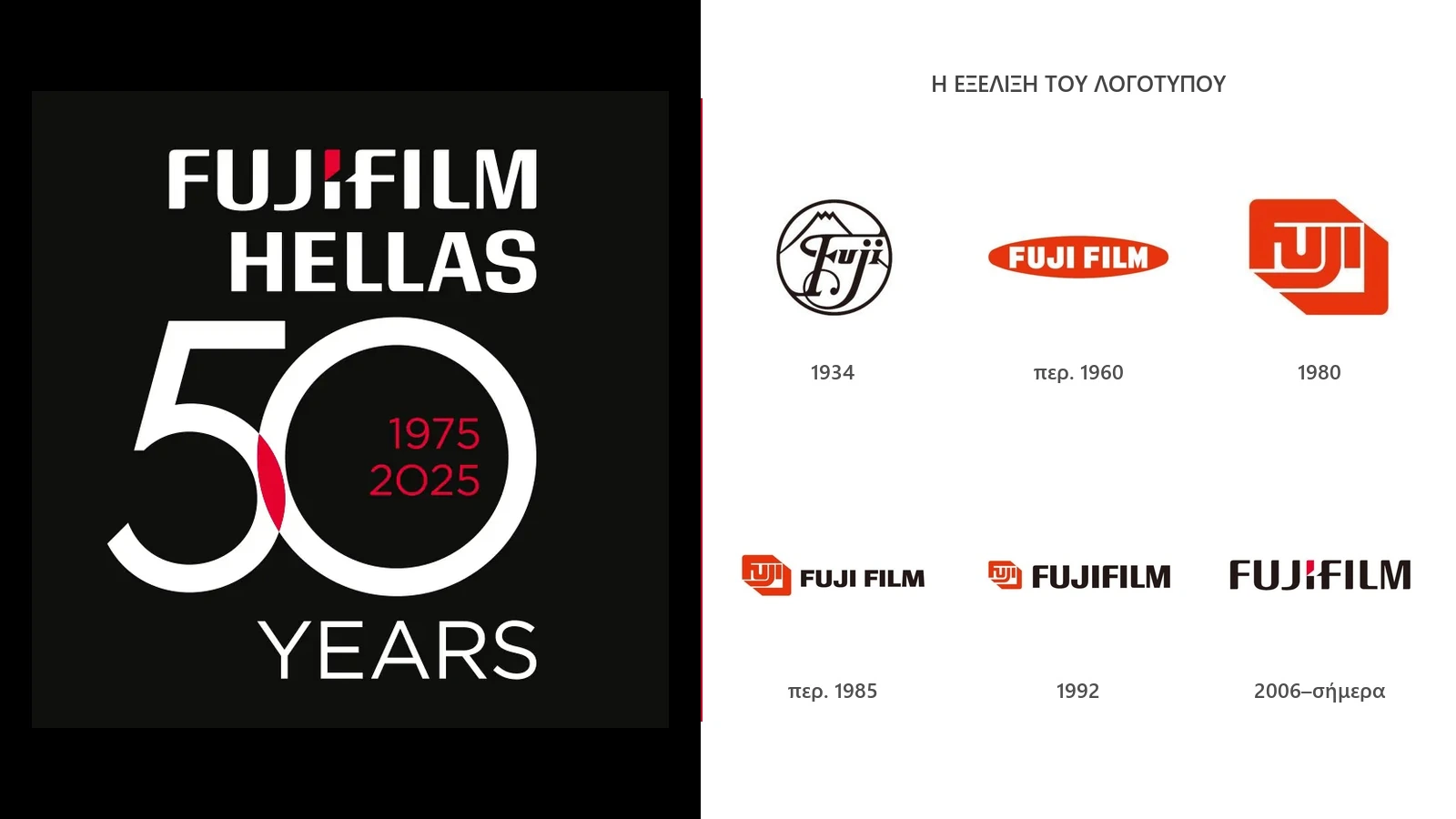
The current corporate logo was adopted in the same year. FUJIFILM presents the distinctive red design element at its centre as a symbol of its commitment to cutting-edge technology.
QuickSnap, FinePix, X Series and GFX
In 1986, QuickSnap turned the simple ready-to-use camera into a global consumer product. Forty years later, PTTL documented how QuickSnap changed mass-market photography and why it survives in the digital era.
During the 1990s and early 2000s, FinePix became the company’s main digital family. Its decisive return to enthusiast photography came with the X100 in 2010-2011, combining an APS-C sensor, fixed lens, hybrid viewfinder and controls inspired by analogue cameras.
In 2012, the X-Pro1 and the first XF lenses launched the X Mount. PTTL covered the system’s ten-year journey, which transferred film-colour expertise into digital Film Simulations and built a complete range of APS-C cameras and lenses.
In 2017, the GFX 50S opened the GFX line with a 43.8×32.9mm sensor, larger than full frame. Today Fujifilm operates across compact, APS-C, large-format mirrorless and cinema solutions, while retaining Instax and the analogue footprint that first made its name familiar.
FUJIFILM Hellas and 50 years in Greece
The Greek presence began in 1975 and marked 50 years in 2025. As PTTL highlighted in “Half a century of Fujifilm Hellas”, the local company has an unusual status: it is not a subsidiary of the Japanese group but an independent distributor authorised to use the FUJIFILM name.
Its activity in Greece is not limited to digital cameras. The official corporate listing includes film and QuickSnap, Instax, cameras and lenses, photofinishing, graphic arts and printing, as well as medical imaging and diagnostic fields.
This broad identity makes its Japan Pavilion participation more representative than the appearance of a camera maker alone. FUJIFILM is an example of a Japanese company that survived the collapse of its core market by transferring chemistry, optics, image processing and materials knowledge into new sectors.
Dates, opening hours and tickets
The 90th TIF takes place from Saturday, September 5 to Sunday, September 13, 2026. It is open from 10:00 to 22:00 on weekends and from 16:00 to 22:00 on weekdays. FUJIFILM Hellas is located at booth J21 in Pavilion 13.
According to TIF-HELEXPO’s official information, a standard ticket costs €7 until August 31 and €9 from September 1 and during the fair. Current ticket categories and packages are listed on the official visitor information page.
What we think
FUJIFILM’s presence at TIF is more meaningful when seen beyond individual products. This is a corporate history in which the name itself retains “film” even though the group has changed radically. At a fair honouring Japan, the journey from photographic emulsion and FUJICA to X Mount, GFX and medical imaging captures the substance of Japanese technological adaptation.
Frequently asked questions
Where will FUJIFILM Hellas be located at TIF?
At booth J21 in Pavilion 13, inside the Japan Pavilion of Honored Country Japan.
When was FUJIFILM founded?
Fuji Photo Film Co., Ltd. was founded on January 20, 1934 to establish domestic photographic film production in Japan.
Why did the name change from Fuji Photo Film to FUJIFILM?
“Photo” was removed in 2006 as the group had expanded far beyond photography. “FILM” remained in the corporate identity as a link to its historical and technological origins.
What was the FUJIX DS-1P?
It was a 1988 digital camera prototype and the first fully digital camera to record images on a removable memory card.
Will specific cameras be available to try at J21?
The participation and booth location are confirmed, but a full programme of products, demos or workshops had not been announced when this article was written.