

Summary
- Giannis Kyriakidis’ archive has been transferred to a specially prepared facility operated by the Municipality of Kalamaria
- It contains more than 250,000 negatives and images, 30,000 color photographs and 3,000 black-and-white photographs
- The collection also includes glass plates, photographic equipment, personal objects and the photojournalist’s trademark ladder
- Part of the archive has already been catalogued and digitized, while systematic inventory, documentation and conservation now begin
- No date for full public access has yet been announced
The vast photographic archive of Giannis Kyriakidis is now held by the Municipality of Kalamaria, where a new phase of cataloguing, conservation and digitization begins for more than seven decades of photographic history.
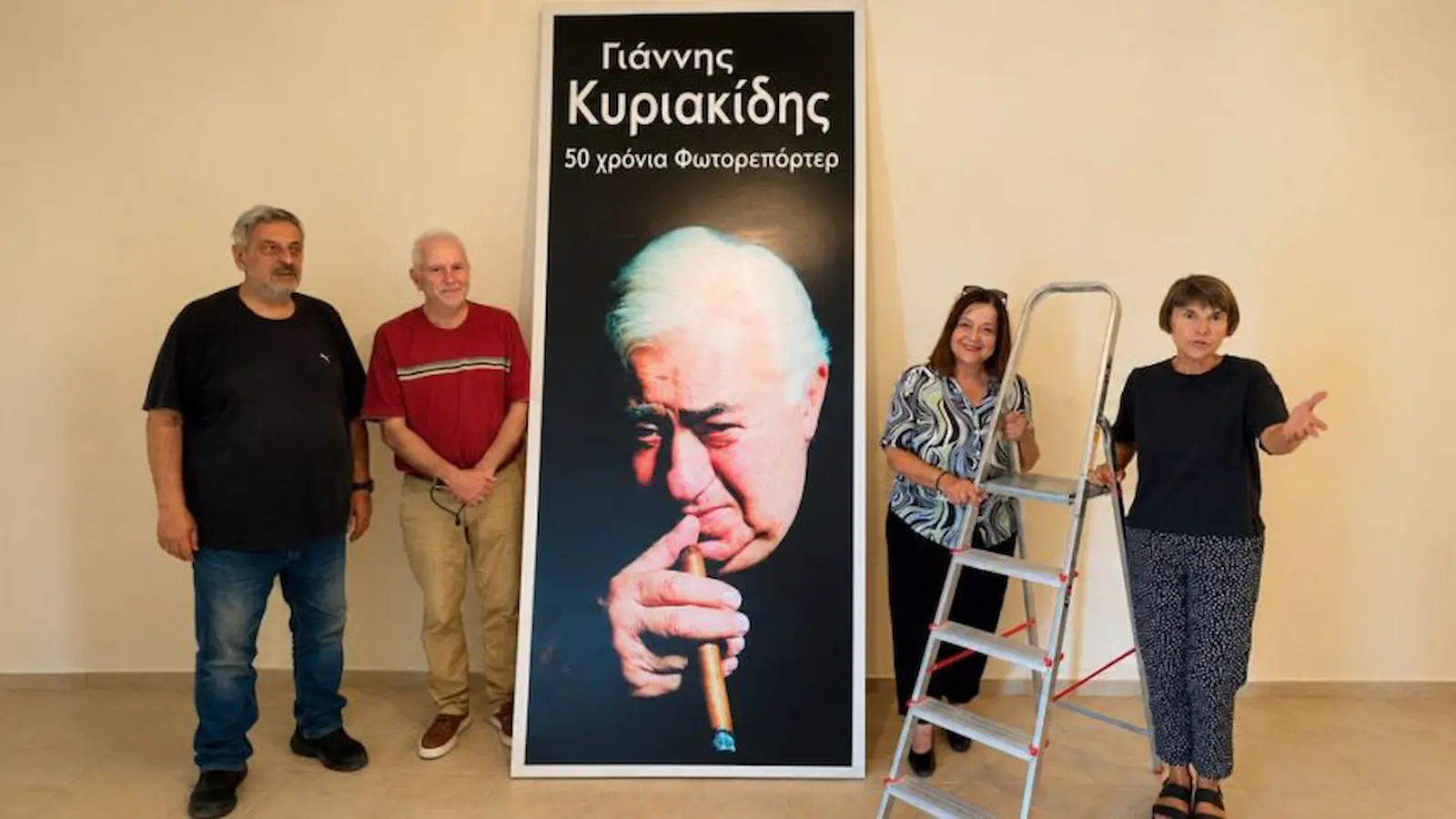
The archive of the iconic Thessaloniki photojournalist, donated by his family, was transferred to a specially prepared facility operated by the Municipality of Kalamaria in early August 2026. The move was supervised by the documentation team, which includes curator Vangelis Ioakimidis, and the collection includes photographs, negatives, equipment, personal objects and the last of the distinctive ladders Kyriakidis used for his photographs.
The significance of the development goes far beyond preserving a large photographic collection. This is a visual archive that follows the transformation of Thessaloniki and Greek society over decades, from politics and culture to everyday life, the Thessaloniki International Fair, festivals, sport and streets or buildings that have since changed or disappeared. Its systematic documentation and future accessibility could transform a family-held collection into an important resource for historical research.
More than 250,000 negatives and images
The volume of material explains why managing the archive is a long-term project. According to the Municipality of Kalamaria, it contains more than 250,000 negatives and images, around 30,000 color and 3,000 black-and-white photographs, rare glass plates and professional objects belonging to the photographer. Part of the material has already been catalogued and digitized.
The photographer’s daughter, Athina Kyriakidou, provided another indication of the collection’s physical scale, describing hundreds of boxes filled with material and folders that may contain dozens or hundreds of images from a single event. Systematic preservation and sorting of the archive had in fact been started by his wife, Chrysa Kyriakidou, as early as 1970.
The Thessaloniki that no longer exists
The archive’s value is not limited to the famous personalities who appeared before his camera. Kyriakidis systematically photographed the city itself, its people and the changing urban landscape.
Among his favorite subjects was Thessaloniki’s old waterfront, photographed at different times of day and under changing weather conditions. The collection preserves images of streets, buildings and people that no longer exist, alongside moments from the city’s political, social and cultural life.
Other already known photographs from the archive show, among many subjects, the 5th Greek Film Week in 1964, the proclamation of Giorgos Seferis as an honorary doctorate of Aristotle University of Thessaloniki that same year, and Manos Hadjidakis with Konstantinos Karamanlis at a meal during Student Week in 1960.
The ladder that became part of his photographic language
The ladder that became inseparable from Kyriakidis’ public image was not simply an eccentric professional accessory. It allowed him to rise above a crowd and include more elements within the frame, creating a broader view of an event.
According to his family, he had begun using ladders for assignments by at least the 1960s and used several of them over the years. The last one is now among the objects transferred with the archive to Kalamaria. The Municipality confirms that photographic equipment, tools and personal objects were moved together with the photographic material.
The technique became so closely associated with his public persona that Kyriakidis was also known as “Ioannis tis Klimakos,” a nickname referencing his constant use of a ladder.
From a Kodak to documenting an entire era
Giannis Kyriakidis was born in Thessaloniki on May 10, 1924, into a family of Pontic refugees, and grew up in Kalamaria. He died on February 22, 2016, after a life connected with photography and photojournalism for more than seven decades.
At around the age of 16, he acquired a Kodak through coupons from the newspaper “Makedonia.” His first photograph is reported to have shown a downed Italian aircraft displayed in Aristotelous Square in 1940. He later obtained his first professional Rolleiflex and developed into one of the most recognizable figures in Greek photojournalism.
His work was not limited to Thessaloniki. He covered political and social developments, cultural events and major sporting competitions, undertook journalistic assignments abroad and covered Olympic Games in Seoul, Barcelona, Atlanta and Athens.
The difficult part begins now
The transfer of the material does not mean that the entire archive has already been digitized or is immediately available online. Instead, it marks the start of an organized process of inventory, documentation, evaluation and conservation so that it can eventually become accessible to citizens, researchers and future generations. No specific date for full public access has been announced.
The Municipality has linked the future use of the collection with research, exhibitions, educational activities and publications. At the same time, according to Athina Kyriakidou, around 3,500 negatives have been digitized for a publication of approximately 700 pages that is currently being prepared.
This is crucial for an archive of this scale: digitization alone is not enough. Without names, dates, locations, events and the correct connection of each image with its historical context, hundreds of thousands of photographs remain difficult to search and use as historical sources.
What we think
Keeping the archive in Thessaloniki and placing it in the care of a public body is an important development, but its real value will be determined by what happens next. Systematic documentation, proper conservation and, above all, broad and functional access could turn Giannis Kyriakidis’ hundreds of thousands of images into one of the most important digital records of modern Thessaloniki and Greek photojournalism. The available information shows that this process has now begun, but the archive’s scale makes clear that it will be a long-term project.
Frequently Asked Questions
What does the Giannis Kyriakidis archive contain?
It contains more than 250,000 negatives and images, around 30,000 color and 3,000 black-and-white photographs, glass plates, photographic equipment, personal objects and the photographer’s tools.
Is the entire archive already available to the public?
No. Part of the material has already been catalogued and digitized, but the full inventory, documentation, evaluation and conservation process is underway. No specific date for full public access has been announced.
Why was the archive transferred to Kalamaria?
The family donated it to the Municipality of Kalamaria, returning the archive to the place where Kyriakidis grew up and lived, after his Pontic refugee parents settled there.
Why was his ladder important?
The ladder allowed him to photograph above crowds and include the wider scene within the frame. He had been using ladders since at least the 1960s, and they became one of the most recognizable elements of his professional presence.
Has digitization started?
Yes. The Municipality says part of the collection has already been digitized, while the family has specifically referred to around 3,500 negatives digitized for a publication of approximately 700 pages currently in preparation.