

Summary
- The iPhone 18 Pro is rumored to gain a variable aperture on its main camera
- The iPhone 17 Pro currently uses a fixed f/1.78 aperture
- Portrait Mode creates additional background blur through computational processing
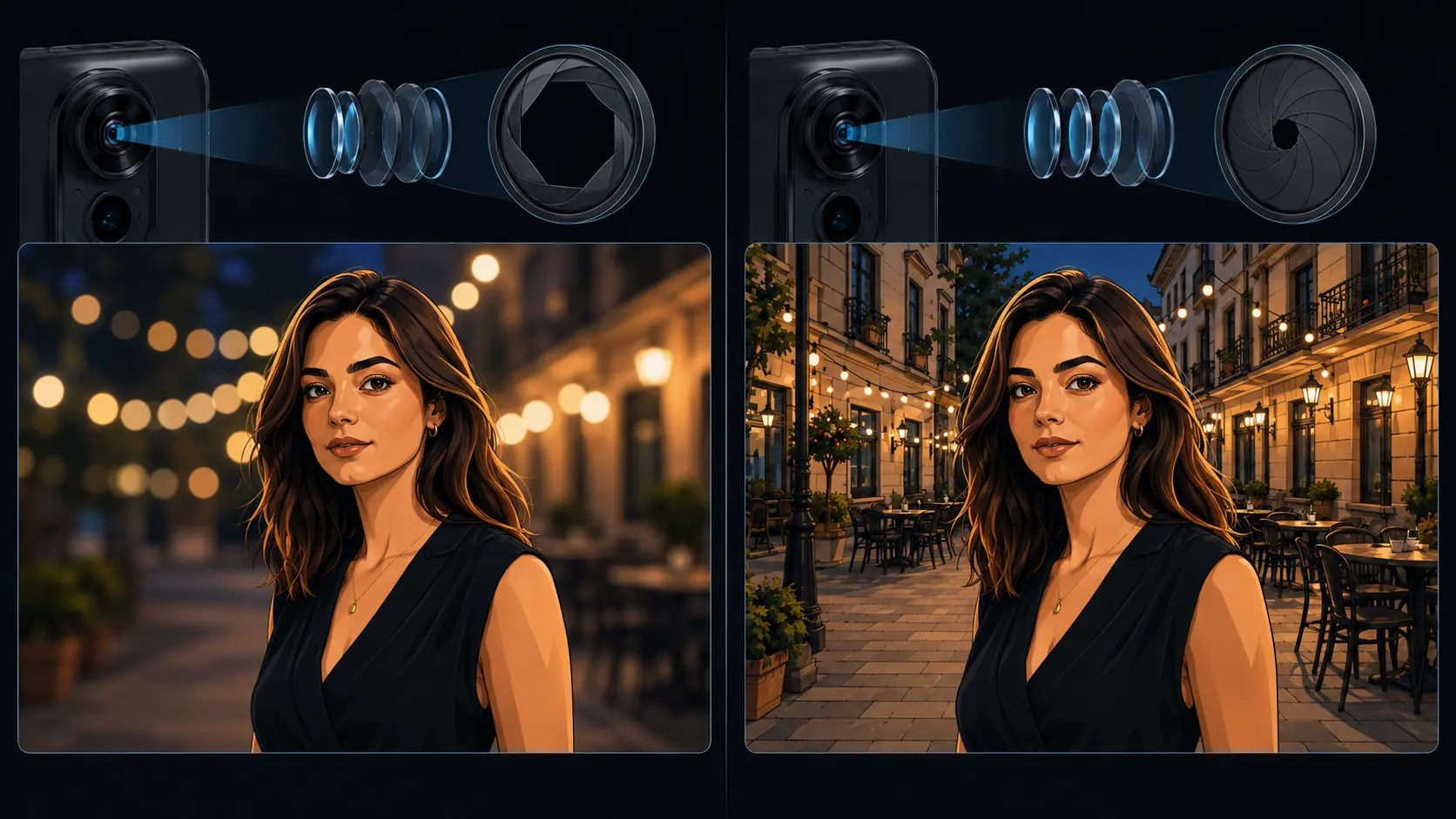
- A real variable aperture would provide optical depth-of-field control before processing
- If the maximum aperture remains f/1.78 it will not automatically create more natural bokeh
- Apple has not confirmed the feature or its actual aperture range
- What the “aperture” in today’s iPhone Portrait Mode actually is
- What a real variable aperture would change
- The big catch: Variable aperture does not necessarily mean more bokeh
- Why natural bokeh still matters
- The telephoto camera remains important for real portraits
- The iPhone would not be the first smartphone to use the idea
- Why the technology makes more sense today
- The rumor now has stronger evidence, but remains a rumor
- What we think
- Frequently asked questions
The rumored variable aperture of the iPhone 18 Pro could bring genuine optical depth-of-field control to the iPhone, but that does not automatically mean more bokeh than today’s model can produce.
Reports about the iPhone 18 Pro and iPhone 18 Pro Max camera systems have converged for months around the addition of a variable aperture to the main camera. Apple’s supply chain has reportedly already moved into production preparations, while Ming-Chi Kuo claims that the new lens system costs around 50% more than Apple’s current seven-element design. Apple has not confirmed the feature and, crucially, we still do not know the actual aperture range it would provide.
The change matters particularly for photography because aperture does not only control light. It also controls real depth of field: how much of a scene appears acceptably sharp and how smoothly the background falls away from the plane of focus. This is precisely where smartphones have relied heavily on computational blur for years to simulate the appearance of a shallower optical depth of field.
What the “aperture” in today’s iPhone Portrait Mode actually is
Today’s iPhone already allows users to open Portrait Mode and change a value that looks like an aperture setting.
It is not, however, a mechanical lens aperture.
Apple describes Portrait Mode as creating a depth-of-field effect that keeps the subject sharp while blurring the background. Through Depth Control, users can even change the amount of background blur after the photograph has been captured.
The smartphone calculates scene depth, identifies the subject and applies selective blur to the background. The technique has improved dramatically and can produce extremely convincing results in many situations.
But it remains a computational effect.
That is why familiar errors can still appear around difficult edges: hair, glasses, thin objects, gaps between hands, leaves or anything else that makes subject-background separation difficult.
The phrase “fake bokeh” in the title refers to this simulation, not to the idea that the result is useless or necessarily poor. A real iPhone can naturally create optical bokeh as well, particularly at close focusing distances and when using its telephoto camera. Portrait Mode simply allows software to produce a much stronger effect.
What a real variable aperture would change
The iPhone 17 Pro currently uses a 48MP main camera with a 24mm-equivalent focal length and a fixed f/1.78 aperture. The physical lens opening does not change from one photograph to another.
A true variable aperture would place a mechanical system inside the optics that changes the physical opening through which light passes.
If, for example, the iPhone could move between a large aperture and a smaller one, it would not only change exposure.
With the aperture opened wider, depth of field becomes shallower and the background can fall further out of focus. With the aperture closed down, depth of field increases and more planes within the scene remain sharp.
This is a genuine optical effect. It is not created by a mask, AI segmentation or post-capture processing.
PTTL has previously examined why a genuine variable aperture remains one of the most significant gaps between smartphones and conventional cameras.
The big catch: Variable aperture does not necessarily mean more bokeh
This is the detail that is often lost in reports about the iPhone 18 Pro.
If Apple keeps today’s f/1.78 as the maximum opening and simply allows the lens to close down to, for example, f/2.8 or f/4, the iPhone 18 Pro will not produce more natural bokeh than the iPhone 17 Pro already can when both are at f/1.78.
What it would gain is something today’s model does not have: the ability to physically increase depth of field when required.
That is equally important photographically.
For a close portrait or object photograph, the widest aperture may be preferable. For a group of people standing at different distances, a landscape, or a close-up where more of the subject needs to remain sharp, a smaller aperture can be the better choice.
For the new camera to produce more natural bokeh than today’s model, it would need a wider maximum aperture than f/1.78, a larger sensor, or a different optical design that significantly changes the relationship between focal length, distance and depth of field.
So far, the exact aperture range rumored for the iPhone 18 Pro has not leaked in a form that can be considered reliably confirmed.
Why natural bokeh still matters
Software blur can become increasingly sophisticated, but optical bokeh has a fundamental difference: it is created at the moment light passes through the lens.
Transitions between focused and unfocused areas are produced by the optics themselves. The phone does not need to decide which strand of hair belongs to the subject, whether a gap between fingers should remain sharp, or whether an object on the same focus plane as a face should be blurred.
That does not mean Portrait Mode will disappear.
Even with a variable aperture, the short physical focal length of a smartphone’s main camera produces far greater depth of field than a large sensor paired with a real portrait lens. Computational photography will still be capable of producing much stronger background separation when users want it.
The most likely future is therefore a combination of both approaches: real optical depth of field as the foundation, with computational processing added when stronger subject isolation is required.
The telephoto camera remains important for real portraits
There is another reason why a variable aperture on the main camera will not replace Portrait Mode by itself.
The iPhone 17 Pro’s main camera uses a 24mm-equivalent focal length, while its telephoto reaches 100mm at 4x with an f/2.8 aperture.
The longer focal length provides a different perspective and makes optical subject separation from the background much easier. This is why portrait photographers generally use longer focal lengths rather than relying exclusively on an ultra-wide lens with a large aperture.
There are also unconfirmed reports that Apple is testing a brighter telephoto lens for the iPhone 18 Pro, which could be equally important for genuine subject separation.
That is a separate rumor, however, and Apple has not confirmed it.
The iPhone would not be the first smartphone to use the idea
The technology itself is not new.
The Samsung Galaxy S9 in 2018 used Dual Aperture with two real settings, f/1.5 and f/2.4. Samsung still confirms both values in the model’s official specifications.
PTTL covered the variable aperture camera of the Galaxy S9 and S9+ when the phones were originally announced.
A more ambitious implementation later appeared on the Huawei Mate 50 Pro, whose 50MP main camera featured a real f/1.4 to f/4.0 aperture. Huawei officially confirms that range, while PTTL also covered how the Mate 50 Pro’s adjustable aperture affected depth of field.
Xiaomi later used real variable-aperture designs as well, including the Xiaomi 13 Ultra with f/1.9–f/4.
Apple is therefore not inventing variable aperture. The interesting question is what it can do with the technology when combined with its own computational photography and the enormous iPhone user ecosystem.
Why the technology makes more sense today
When Samsung used Dual Aperture in 2018, smartphone sensors were much smaller and naturally produced so much depth of field that changing aperture had a relatively limited creative effect.
That situation has changed.
Flagship smartphone sensors have grown, lenses have become faster, and manufacturers now use much more advanced focusing systems and computational photography.
As sensors become larger, genuine depth-of-field control becomes increasingly useful.
The Huawei Mate 50 Pro was a good example: in group portraits, stopping the lens down could help keep more faces sharp when people were positioned at different distances.
Variable aperture is therefore not simply about “more blur.” It is about choice.
And choice is one of the fundamental differences between a fully automatic camera and a photographic tool.
The rumor now has stronger evidence, but remains a rumor
Reports about the iPhone 18 Pro have progressed beyond a single social-media leak.
In April, reports claimed Apple had begun strengthening its supply chain for the new camera, something PTTL covered in detail in its article about production preparations for the iPhone 18 Pro variable-aperture camera.
In May, Ming-Chi Kuo claimed that the variable-aperture lens would carry an average selling price around 50% higher than Apple’s current lens system, with Sunny Optical expected to take a significant share of production.
And the latest information gathered by PTTL about the iPhone 18 Pro camera and hardware continues to place variable aperture among the most significant expected upgrades.
Until the official presentation, however, the details that will determine its true photographic value remain unknown: maximum and minimum f-stop, number of intermediate positions, whether adjustment will be continuous or stepped, and most importantly whether users will have direct manual control.
What we think
Variable aperture could be one of the most important photographic changes the iPhone has received in years, but not because it automatically guarantees “more bokeh.”
Its real value is control.
Today Apple can dramatically alter the appearance of depth of field through software, but the main camera lens remains physically fixed at the same aperture. A mechanical aperture system would allow the iPhone, for the first time, to change one of the fundamental physical characteristics of the image before light reaches the sensor.
If Apple combines that system with a sufficiently wide aperture range and gives photographers genuine control over it, the result could be far more significant than simply improving Portrait Mode again.
If, however, the system starts at the same f/1.78 and only stops down to smaller openings, then this will not be the end of computational bokeh. It will be something different and potentially more photographically mature: the return of genuine optical control that smartphones have largely handed over to software.
Frequently asked questions
Is the iPhone 18 Pro definitely getting variable aperture?
Not yet. Multiple supply-chain reports and Ming-Chi Kuo point to the feature, but Apple has not officially announced it.
Will the iPhone 18 Pro produce more natural bokeh?
Not necessarily. If the maximum opening remains at today’s f/1.78, the ability to stop the aperture down will not create shallower depth of field than the lens can already produce at f/1.78.
Will Portrait Mode disappear?
There is no indication that it will. Natural depth of field and computational blur can work together, while software can create far stronger subject separation than the small optical system of a smartphone can produce on its own.
What will the iPhone 18 Pro aperture range be?
It is not known. There is currently no reliably confirmed information about the maximum and minimum f-stop or whether the mechanism will offer continuous adjustment or predefined steps.